After concrete is placed, a surface can look firm and dry while important questions remain unresolved. Was moisture protected during early hardening? Were temperature conditions considered? What evidence permits the next activity?
Understanding curing makes those questions easier to ask. It also prevents a common scheduling mistake: treating “the concrete is dry” as a single approval for everything from removing protection to installing flooring. This guide explains the mechanisms and the records an owner can request. It does not prescribe a mix, site procedure, loading limit or universal number of curing days.
Concrete develops through a reaction with water
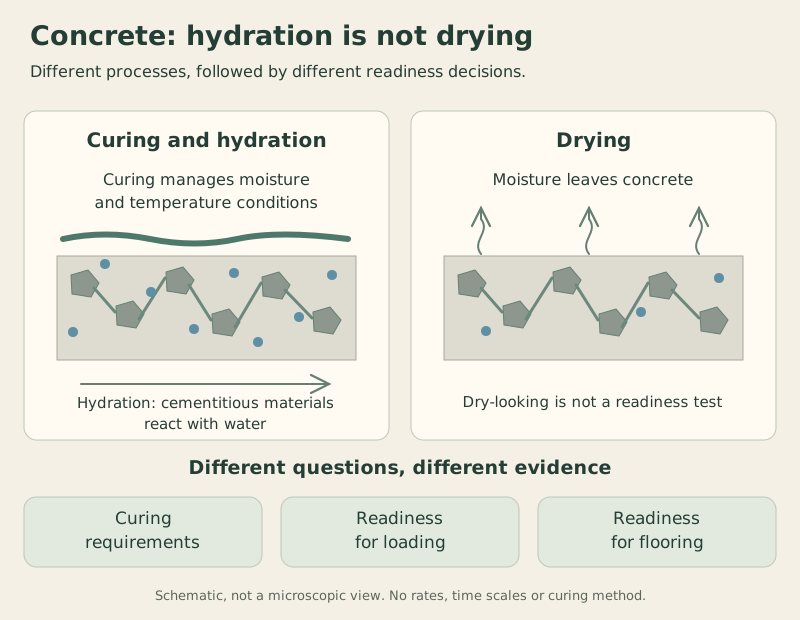
Hydration is the chemical reaction between cementitious materials and water that helps concrete develop its properties. Curing maintains suitable moisture and temperature conditions for those reactions. ACI explains that the developing internal structure contributes to strength and low permeability. [1]
Drying describes moisture leaving the concrete. It is a different process, not the mechanism that creates the hardened cementitious binder. If moisture is lost too soon, the reaction cannot develop the material's intended properties as it would under suitable conditions. NRMCA's curing guidance connects adequate curing to strength development, surface wear resistance and durability. [2]
This distinction explains why protecting moisture can be valuable even when an owner wants the work to feel “finished.” The intended result is a properly developed material, not simply the earliest dry-looking surface. Appearance alone does not establish either the curing history or the internal moisture condition.
On a small screen, swipe or scroll the diagram horizontally to read every panel.
Hydration and moisture loss are different processes. This schematic is not a microscopic view or a construction procedure. Curing, loading and floor-covering decisions need their own evidence.
The diagram shows hydration and moisture loss as different processes. It has no time scale: concrete mixtures, elements and site conditions do not all follow one timetable.
Compare methods by what they do
ACI groups familiar approaches around supplying water or retaining moisture. Examples include continuously maintained wet coverings, moisture-retaining sheets and liquid membrane-forming curing compounds. [3] The contractor's chosen method should be identified before placement so its materials, responsibilities and compatibility with later work are clear.
Compare concrete-curing method families
Method family
What it is intended to do
Useful owner question
Water-maintained curing, including suitable wet coverings
Supply or maintain water at the concrete surface
How will the specified condition be maintained through the required period, rather than only when someone is present?
Moisture-retaining sheet or paper covering
Limit moisture leaving the surface through a physical covering
Who checks that the specified protection remains effective, and how does it fit the required appearance?
Membrane-forming curing compound
Form a surface film that reduces evaporation
Which exact product is specified, and is it compatible with subsequent coatings or bonded finishes?
On a small screen, swipe the table horizontally to see every column.
The mechanism descriptions are based on ACI's overview. [3] The questions are a coordination tool, not application instructions or a ranking of the three families. Different parts of the work may need different arrangements.
Continuity matters. NRMCA rejects alternating wetting and drying as an acceptable curing practice. It also distinguishes evaporation retardants used before concrete sets from products used for final curing. [2] A site record saying only “sprayed” is therefore incomplete: identify the product or method and its intended stage.
Do not assume an ordinary sealer is an approved curing compound because both are liquids applied to a surface. Request the exact product name and technical sheet, and have the contractor identify the project requirement it meets. Where the finish is important, agree how appearance will be reviewed as well as how moisture protection will be documented.
Hot-weather risk involves more than air temperature
NRMCA's hot-weather guide identifies a combination of air temperature, concrete temperature, relative humidity, wind and solar radiation. These conditions can accelerate moisture loss and setting. High relative humidity generally reduces evaporation effects, but “humid climate” is not a complete description of the conditions at a particular slab. [4]
An exposed surface in sun and wind deserves a different discussion from a shaded, sheltered location. That is a planning comparison, not a claim about a particular Panama project. Ask how the contractor will assess the actual weather and concrete conditions, including changes while placement and finishing are underway.
Higher temperature can accelerate early reactions without guaranteeing a better eventual result. ACI describes how increased curing temperature can produce faster early strength development but lower strength at later ages. [5] “It hardened quickly” is therefore not a sufficient quality report.
Use the pre-placement meeting to establish who can change the sequence, who checks the protection and how problems are reported. The response needs to be planned by the responsible team. An owner should not add water, change the mixture or improvise a curing procedure based on a forecast or this article.
Put three separate decisions on the schedule
A single line marked “concrete complete” hides decisions that need different evidence. Ask the team to distinguish the following.
Separate curing, loading and flooring decisions
Decision
What the record should answer
What does not settle it by itself
End the specified curing measures
Which project requirement applies, what was done and who authorizes the transition?
A dry-looking surface or a generic online day count
Permit a construction activity or loading
What condition is required for that activity, and what assessment supports proceeding?
Completion of surface finishing or a date on the calendar
Install flooring or a bonded coating
What do the selected system's substrate, moisture and compatibility requirements call for?
A strength result or the fact that curing protection has been removed
On a small screen, swipe the table horizontally to see every column.
This is an owner coordination table, not an acceptance standard. The relevant project professionals and product requirements determine the actual criteria.
For curing, NRMCA directs continuation according to the specification. [2] For the effect of temperature, ACI explains why reaction and strength-development rates change with conditions. [5] Together, those principles are more useful than a universal countdown copied onto every pour.
Ask for planned milestones, but label them as planned until the required evidence is available. If the concrete mixture, weather, element or next activity changes, have the responsible person confirm whether the earlier assumptions still apply.
Know what a test report represents
A test result should identify the concrete and the question it was intended to answer. ACI distinguishes specimens cured under prescribed standard conditions for acceptance from field-cured specimens used for decisions such as formwork removal. The latter are intended to reflect the structure's environment. [6]
That distinction matters when someone presents a laboratory result as a complete record of site curing. Ask how the result relates to the actual placement and proposed decision. The owner does not need to choose a test method, interpret structural capacity or instruct the testing technician. The useful task is to make sure the report's purpose and the responsible reviewer's decision are recorded.
A photograph belongs in that record too, but with a limited role. It can show visible protection at one moment. It cannot reconstruct uninterrupted conditions between visits or certify the entire element. Keep images linked to dates and locations rather than treating them as a substitute for the curing log.
Plan later floor coverings before choosing a compound
For an interior slab, curing and flooring readiness must be coordinated from the outset. NRMCA explains that residual slab moisture can affect coverings and coatings, and that manufacturers set requirements for the substrate before installation. Drying depends on the concrete, slab and surrounding conditions; later wetting can delay it. [7]
The curing method also belongs in that discussion. NRMCA flags compatibility between curing compounds and subsequent surface treatments. [2] Have the concrete contractor and flooring or coating supplier identify a documented compatible sequence before either package is finalized. A general statement that a compound “wears off” is less useful than written requirements for the exact products.
Record who assesses moisture, which current manufacturer requirements apply and who releases the substrate for the specified finish. Avoid turning a single moisture reading into a verdict without the test context. This article supplies no test thresholds or drying schedule; those belong to the chosen system and the project's assessment. [7]
Ask for a short, traceable curing record
The following checklist is an original owner-facing record, not a formal inspection form. Request it as part of the contractor's project documentation:
Placement identity: date, location and concrete delivery or mixture reference.
Requirement: the applicable specification and the responsible reviewer.
Protection: the chosen method, exact products where relevant, and recorded start and end of the measures.
Conditions and checks: the monitoring required by the project and who kept the record.
Interruptions: what changed, when it was noticed and the team's documented response.
Next activity: the release decision, its supporting evidence and any remaining restriction.
Later finishes: compatibility confirmation and the separate substrate-readiness review.
If a record is missing, ask for the available facts and the appropriate review rather than inviting someone to recreate a perfect history. An honest gap is more useful than an unsupported statement that everything was “fully cured.”
Keep the documents with the house handover file, and connect any revised sequence to the construction-change record. The goal is a clear account of how the concrete was protected and why each later step was allowed to proceed.
NRMCA: CIP 28, Concrete Slab Moisture. Used for the separate flooring-readiness and compatibility discussion, not its numerical test procedures or limits.
Sources checked November 8, 2026. These U.S. technical references explain general mechanisms and distinctions. They are not Panama law, project specifications or instructions to perform concrete work. Source numerical examples, curing durations, temperature limits and moisture-test thresholds are intentionally not reproduced.