During a house build, a small request can travel through several conversations before anyone sees its full effect. A different window, an unavailable finish or a shifted doorway may involve the owner, supplier, designer and more than one trade. Give the proposal one clear record before the conversations diverge.
This is an owner's coordination guide. It does not decide who is entitled to extra payment, interpret a contract or authorize a change to approved plans. Use the project's actual contract and qualified local advisers for those questions. Foreign examples below illustrate documentation principles, not Panama law.
Agree how a proposal becomes an instruction
At the start of the project, ask who can request a change, who reviews it, who can authorize it and how the site team receives the final instruction. Include a method for dealing with urgent safety or protection work under the contract. This record-keeping guide should never delay an appropriate emergency response.
New Zealand's Business.govt.nz describes a variation process that identifies the proposed changes and how they will be agreed. Its guidance also emphasizes consequences elsewhere in the contract. [1] For your project, have the relevant adviser explain the actual notice and approval procedure rather than assuming a message saying “looks good” settles everything.
Create a simple project convention: each proposal receives an identifier, a date and an owner responsible for the next response. Keep the same identifier through revised quotations and drawings. If a proposal is abandoned, retain its final status so an old sketch cannot easily be mistaken for an active instruction.
Describe the difference from the current plan
A useful record identifies both the existing requirement and the proposed replacement. Refer to the drawing number and revision, the specification item, the exact product where relevant, and the affected location. Attach a marked sketch when words alone would leave room for different interpretations.
The AIA's G701 change-order summary illustrates this relationship: the description can reference supporting drawings and specifications, while the agreed change also addresses contract sum and time. [2] That is a useful way to structure a discussion even when an entirely different contract form applies.
Avoid entries such as “upgrade bathroom” or “change terrace.” Write what is proposed, what remains unchanged and what still needs an answer. A supplier quotation should identify the same scope as the decision record, rather than introduce an unnoticed second version.
Keep technical review and commercial agreement visible
An owner's preference, a supplier's availability statement and a designer's review answer different questions. Give each its own place in the record. A price acceptance alone should not be treated as evidence that a structural, weatherproofing, electrical or other technical issue has been resolved.
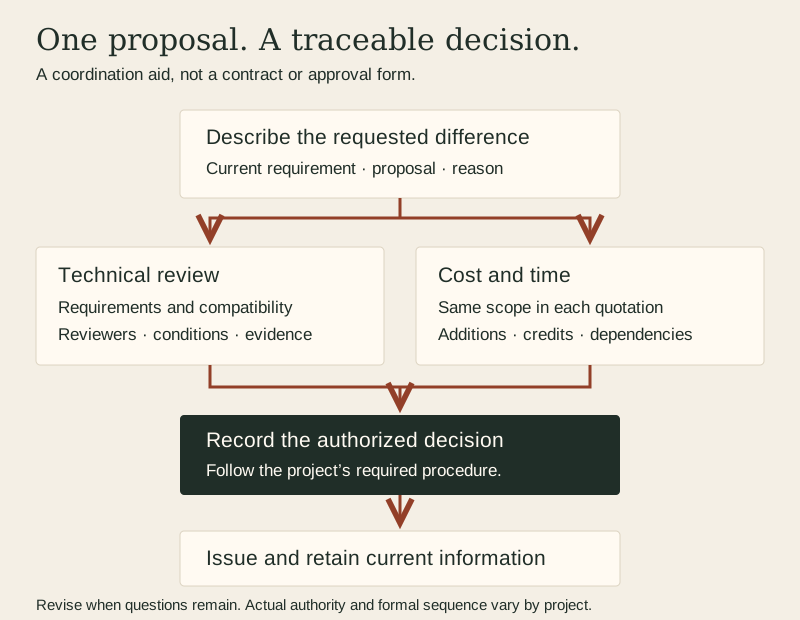
Original coordination diagram. Actual authority, approvals and sequence depend on the project; unresolved proposals return for revision.
The diagram is an editorial coordination sequence. Actual authority, required approvals and the order of formal actions depend on the contract, local requirements and the proposed work. Some proposals will need to go back for revision rather than move forward.
Use the following worksheet to prepare the conversation. It is not a substitute contract or an approval form.
A construction-change discussion worksheet
Part of the record
What to write or attach
Question that should remain visible
Proposal
Current requirement, requested difference and reason
Are everyone’s descriptions referring to the same change?
Technical review
Named reviewer, response and revised information
What conditions or further approvals remain?
Cost
Dated quotation, additions, credits and exclusions
Is this a complete price, an allowance or still an estimate?
Time
Stated effect on ordering, work sequence and completion
Which dates are confirmed, and which depend on something else?
Authorization
Decision, authorized person, date and applicable document
Has the project’s required procedure been followed?
Site record
Issued drawing or instruction and recipient list
Does the team know which earlier information is superseded?
On a small screen, swipe the table horizontally to see every column.
Investigate substitutions beyond the product name
If the specified item is unavailable, ask for the exact proposed substitute and supporting documentation. Compare the requirements that mattered in the original choice, including compatibility with adjacent components, installation conditions, maintenance and warranty limitations.
MBIE's product-substitution guidance makes an important distinction: meeting minimum code requirements may still fall short of an owner's specified performance. It also notes that changes can affect other work and proprietary-system warranties. [3] Its New Zealand approval categories do not establish what a Panama authority will require.
For an owner, the practical question is: “Who has checked this replacement against the complete project requirement?” A similar color, thickness or marketing description is not enough information to record that review as complete. Keep unknowns open and identify who will resolve them.
Follow one hypothetical change through the record
Suppose an owner asks to widen a terrace opening. This is an invented example, not a change made on one of Arthur's projects.
The initial entry records the desired view and the opening shown on the current drawing. The design team is asked what reviews are needed, including any effect on the structure and surrounding building details. The supplier identifies the proposed window or door assembly. The contractor then explains the scope, pricing and schedule consequences on a consistent basis.
If a revised option is chosen, the record points to the issued information and the authorization required by the project. Until then, its status remains a proposal. No beam size, opening dimension or permission to alter structural work can be inferred from this example.
The same method can help with less dramatic decisions. Changing a tile selection still deserves an identifiable product, a clear quantity basis and an explanation of what the quoted change includes. The depth of review should fit the actual change.
Keep the running total separate from the pending list
Maintain distinct lists for proposed changes, approved changes and items that have been completed and checked. In the cost record, show additions and credits rather than only a net number whose components are difficult to trace.
Use the project's agreed method for reconciling allowances. Ask what original allowance is being replaced, what the new amount covers and whether related labor, delivery or other charges are included. Do not quietly treat an unresolved estimate as a final commitment.
For timing, ask which activity is affected. “May delay completion” is less useful than identifying the outstanding decision, the item it prevents ordering and the point at which the contractor needs a response. Record the contractor's current explanation without inventing a delay or promising a completion date.
Close the record after the work is checked
When the change is implemented, attach the relevant completion record, product information and any required review or inspection outcome. Identify outstanding items separately. Photographs may help show what was visible at a particular time, but they do not replace professional review or prove concealed work is correct.
Move the final information into the house handover file. Keep the decision history too: it can explain why a product or detail differs from the first quotation.
Sources checked November 7, 2026. Contract and regulatory examples are jurisdiction-specific. The workflow, worksheet and hypothetical scenario are original editorial planning tools, not legal advice or an AIA form.