Ownership · Handover and records
The House Handover File: Records You Will Want After Moving In
By Best House Ideas · November 7, 2026
External sources open in a new tab so you can keep your place.
When construction ends, the information about the house should not disappear with the site team. A useful handover file answers ordinary questions: Which model is installed? Where is its manual? Who should inspect it? Which drawing reflects the work that was actually approved?
Start the file during construction. Ask the builder and relevant professionals what they will provide, then track missing items before handover rather than searching for them after a problem appears.
Collect instructions for the actual house
Your Home, the Australian government's housing guide, recommends an owner's manual covering operation and maintenance of the home's systems. [1] That principle is useful beyond Australia, but its legal and certification guidance should not be treated as Panama's requirements.
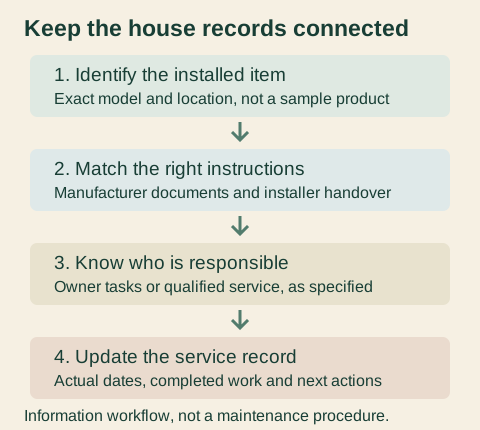
Ask for instructions matched to the installed products, not a folder of unrelated brochures. Keep manufacturer documents distinct from notes supplied by the installer. If a product changes during construction, update the record so it no longer points to the rejected model.
Use a simple equipment register
The following is an original blank worksheet, not a record of Arthur's equipment or a universal maintenance schedule.
| Field | What to enter | Where to verify it |
|---|---|---|
| Equipment and location | A name that makes sense to the owner | Installed item and installer |
| Manufacturer and model | Exact identification | Product label and supplied documents |
| Manual | Saved document or stable link | Manufacturer or supplier |
| Operating instructions | Normal use and limits | Product instructions and installer handover |
| Maintenance responsibility | Owner task or qualified service | Manufacturer requirements and service provider |
| Service interval | Documented schedule and applicable conditions | Exact product guidance; do not guess |
| Warranty and contact | Terms, dates and responsible supplier | Written warranty and purchase record |
| Last service and next action | Date, work completed and follow-up | Actual service record |
On a small screen, swipe the table horizontally to see every column.
Store serial numbers, private contacts and access information in the owner's private copy, not a public project article. Leave unavailable information marked 'to confirm.' A blank field is easier to fix than a plausible but incorrect entry.
Keep questions separate from completed work
Create an outstanding-items list with the location, description, responsible person, agreed next step and status. A photograph can help identify an item, but record what the picture actually shows. Do not label a hidden condition as verified because a surface looks finished.
For example, 'manual requested' and 'manual received' are different statuses. So are 'repair reported complete' and 'repair checked by the responsible professional.' Keeping those distinctions visible avoids treating every message as a finished task.
Walk through the house with the right people
Ask the responsible installers to explain controls and safe owner access. Have them identify which tasks require qualified service. Keep the resulting notes with the relevant equipment record, and ask for clarification if the explanation conflicts with the product instructions.
The file is not an invitation to open electrical equipment, work on a roof or alter a system. It should make it easier to contact the right person and describe the issue accurately.
Keep one current version
Retain the applicable approvals and inspection records supplied by the responsible parties. Keep drawing revisions identifiable, with superseded copies clearly marked. Ask the local team which documents are required for the specific project rather than treating this worksheet as a legal checklist.
Save a backed-up digital copy and a small practical index that the owner can find. When equipment is replaced or work changes, update the relevant record. A handover file remains useful only if it describes the house that exists now.
Plan the document requirements alongside contractor proposals. For operating observations, see humidity in a tropical house, or return to the building guides.