Field notes · Water and the household
Before the House, Ask Where the Water Comes From
Three possible supplies. Better questions before the house.
For entertainment and general understanding. These illustrations and questions are not a construction specification or a legal, engineering or site-specific professional assessment.
I can enjoy a house drawing for quite a while before noticing that nobody has explained the water. The terrace has a lovely view. The bathroom has excellent lighting. The supply is described as “available nearby,” which is doing an impressive amount of work for two words.
Before building, I would give that little phrase its own meeting. Can the proposed supply serve this property, through the seasons, for the uses the household expects? And who will establish the condition of the water that actually reaches those uses?
Those questions belong together. Choosing a source and commissioning useful testing are parts of the same decision, even though they need different evidence.
A tropical house on a tabletop landscape beside three folders representing utility, well and delivered water. These are separate sources to investigate, not a plumbing arrangement.
Start with the property, not the promise
For a utility connection, I would request a dated response tied to the parcel and proposed demand. Ask what connection work remains, who provides it, what permissions are needed and which conditions attach to the offer. A pipe in the road gives you a useful question to ask. It does not answer the whole inquiry.
For an existing or proposed well, ask the appropriate local professionals to establish the available records, lawful access and abstraction permissions, investigation needs and evidence of supply performance. Keep the well's identity attached to every document. A report from somewhere nearby is background, not a report for your well.
For delivered water, identify the supplier, declared source, intended uses, delivery arrangements and records available for each delivery. Ask who is responsible for the water at collection, during transport and at handover. If the provider changes sources, how will you find out?
I would put unresolved permissions in a separate column. A favourable laboratory result cannot grant a connection right, settle ownership or approve a well. Those questions need the relevant local authority, provider or professional.
Compare the awkward week
A sunny-day visit can tell you something about that sunny day. For the house brief, I want the less photogenic version: dry-season demand, a storm-disrupted road, a supply interruption or an unusually busy household.
Ask the utility what records or service information are available for the area, then have the designer identify what still needs checking at the property. Neighbours' observations can help frame questions, provided their dates and circumstances are kept. They should not quietly become guaranteed service levels.
For a well, ask the qualified assessor what the available yield and seasonal evidence actually supports, including limitations. For deliveries, ask about lead times, access in poor weather, shortages and the proposed fallback. A backup supplier deserves the same questions as the first supplier.
Pressure also needs its own evidence. Ask the plumbing designer what observations or professional measurements are needed to assess the proposed house. A seller's description of “good pressure” does not tell the designer the measurement location, time, demand conditions or seasonal coverage.
| Proposed source | Evidence I would request | Question still needing an answer |
|---|---|---|
| Utility | Parcel-specific provider response, connection scope and available service records | What remains unverified at the house? |
| Well | Identified well records, permissions and qualified assessment of performance | Which seasons and conditions does the evidence cover? |
| Delivered water | Named source/provider, delivery records and access arrangements | What happens when the usual delivery cannot arrive? |
This is my comparison worksheet, not a ranking. None of the three wins simply by having the most reassuring name.
Follow the water beyond its starting point
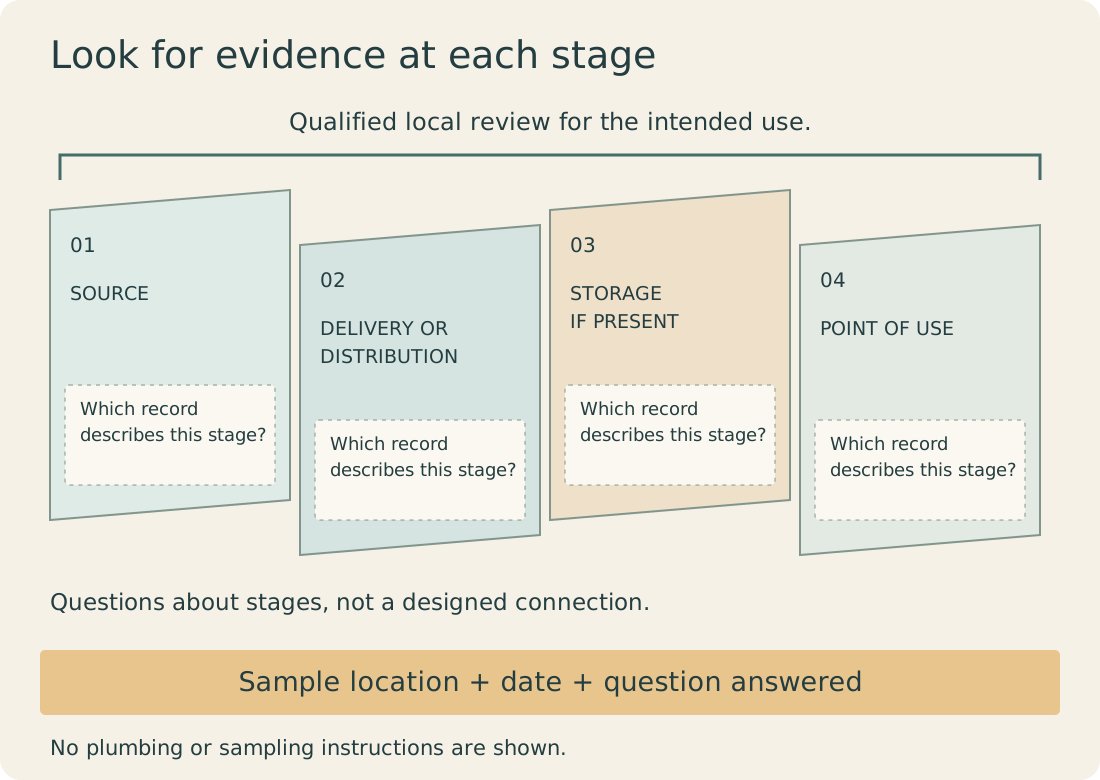
I would draw separate boxes for source, delivery or distribution, storage where present, and the intended point of use. Then ask what evidence describes each box. There are deliberately no pipe connections in this drawing.
WHO's water-safety planning approach considers risks across the supply, from catchment to consumer. That wider view is useful here: a document about the starting point should not be stretched into a conclusion about every later stage. WHO water safety planning (opens in a new tab).
Suppose, as an imagined example, a delivery company supplies a source report. I would ask when and where that sample was taken, whether it relates to the water offered, and what arrangements address transport, household storage and the eventual outlet. That is a request for a complete explanation, not an accusation against the supplier.
Bulk delivery has its own sampling context. The published abstract of ISO 5667-21:2010 covers tanker and other bulk supplies through stages including consumption or transfer to a piped system; it expressly excludes source-water sampling. I read the public abstract, not the paid standard, and I am not turning it into a collection procedure. ISO scope and abstract (opens in a new tab).
The separate storage guide develops the service a tank should preserve. Here I want to establish what evidence follows the supply into that plan.
Look for evidence at each stage
Qualified local review for the intended use.
Questions about stages, not a designed connection.
-
SOURCE
Which record describes this stage?
-
DELIVERY OR DISTRIBUTION
Which record describes this stage?
-
STORAGE IF PRESENT
Which record describes this stage?
-
POINT OF USE
Which record describes this stage?
- Sample location + date + question answered
No plumbing or sampling instructions are shown.
Give testing a question worth answering
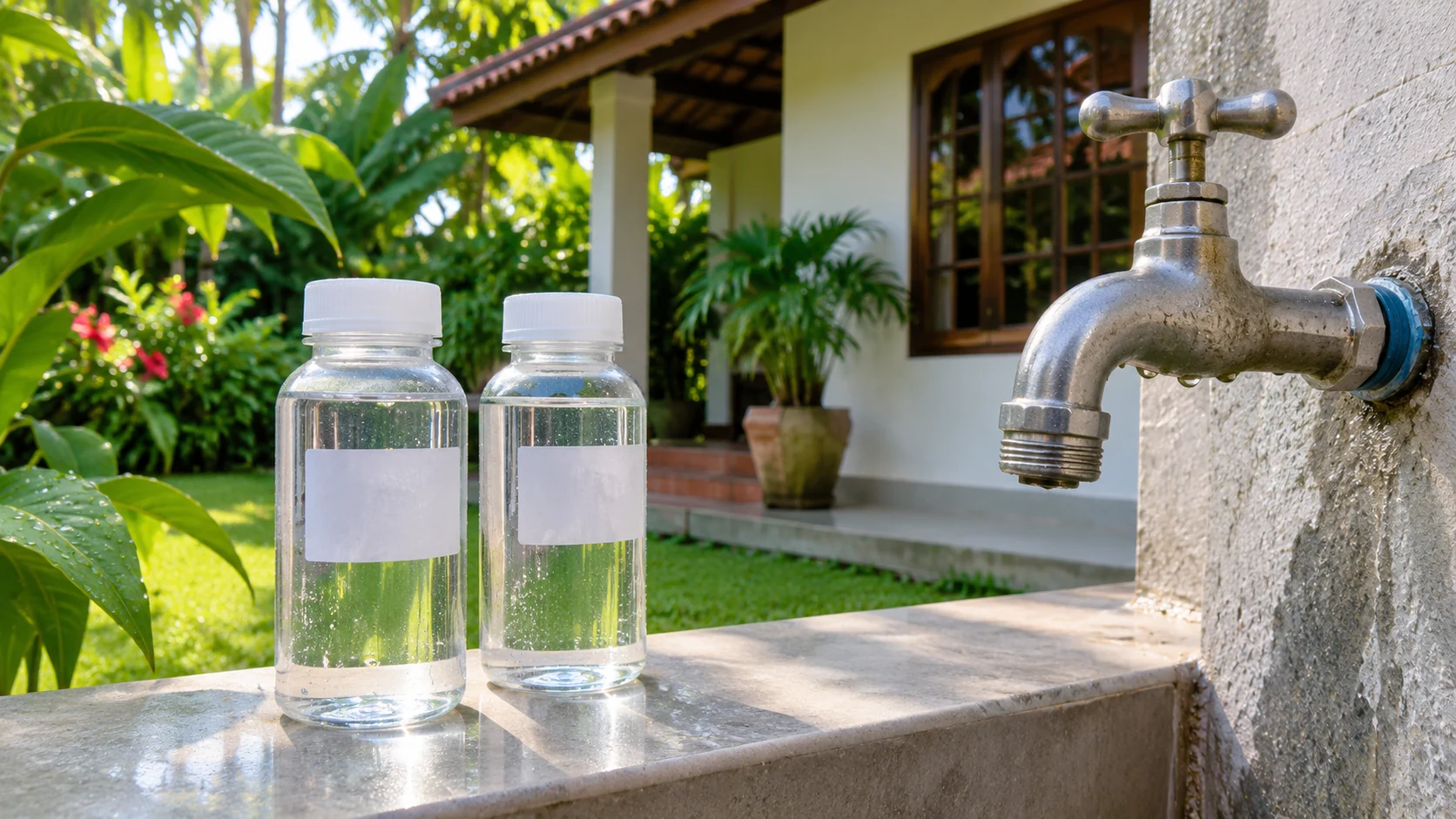
Before asking for a price, write down the intended uses: drinking, cooking, washing food, bathing, laundry, toilets or irrigation, as applicable. “Non-drinking” is too broad to explain all the ways people may contact water. Let the qualified local adviser determine which quality requirements and exposures matter.
Then explain the decision. Are you assessing a possible source before committing to it, investigating a concern, or checking water at an installed outlet? Send available source records, relevant site history and existing reports to the provider through an agreed private channel.
CDC's U.S. well guidance explains that the germs and chemicals worth investigating depend on location and circumstances, and directs owners to health or environmental departments. I take the principle of a locally informed question from that guidance, not a universal test panel or testing calendar. CDC, Guidelines for Testing Well Water, July 1, 2024 (opens in a new tab).
Choose the people as carefully as the package
I would ask the local health or water authority which providers and reports it recognizes for the intended purpose. Request the laboratory's current credentials and the scope covering the actual analyses proposed. A handsome certificate on the wall needs to match the job.
Accreditation has a defined scope. ILAC's explanation says the relevant accreditation body can confirm a laboratory's status and scope. That is a verification route, not evidence that a particular laboratory is authorized for your project. ILAC, accredited bodies and reports (opens in a new tab).
As a U.S. example, EPA directs people seeking independent drinking-water testing to state-certified laboratories. That U.S. certification route should not be presented as a Panama requirement. EPA laboratory guidance, updated August 11, 2026 (opens in a new tab).
Ask what the quotation includes: professional collection, analysis, subcontracted work, explanation of results and follow-up. If interpretation is a separate service, identify that person before ordering. Otherwise the much-awaited answer may arrive as a PDF full of numbers and a polite goodbye.
Agree who does what before anyone collects anything
My testing brief would name responsibilities rather than teach sampling:
- The qualified local adviser, coordinating with the relevant authority, defines the decision, intended uses and applicable criteria.
- The adviser and laboratory agree the analytes, sampling locations and timing needed for that decision, with the reasons recorded.
- The provider names the qualified collector and confirms who controls identification, handling, transport and documented custody under the agreed method.
- The laboratory identifies its analytical work, reporting limits, quality qualifications and any rejected or unsuitable samples.
- The named interpreter explains what the findings support, what remains uncertain and which follow-up is needed.
These are proposed commissioning questions, not universal contractual duties. Get the actual division of work in writing. I would leave bottles, collection technique and sample preparation entirely to the agreed professional service.
Read the result with its limits attached
At the results meeting, match the report to the source, location, date, conditions and intended use in the brief. Ask what was tested, what was not, which criteria were used and whether any qualifications restrict the conclusions. Have the interpreter explain terms such as “not detected” rather than reading them as a promise about everything in the water.
If something needs action, request the responsible person's advice on use restrictions, further investigation, any professionally designed response and the evidence needed before use resumes. This article cannot diagnose potability or prescribe treatment, disinfection or a retesting interval.
Finally, bring the findings back to the building decision. Is the source still a workable option? What supply uncertainties remain? Who owns the next step? Save that answer with the rural design brief, not just in an email called “water stuff.”
I would rather discover a difficult water question beside a drawing than beside a finished kitchen. The drawing is considerably easier to move.
Sources checked November 8, 2026. International guidance and explicitly identified U.S. examples inform these planning questions; they do not establish Panama permissions, compliance or the suitability of any actual supply.
Sources behind the questions
Research checked 2026-11-08. External source links open in a new tab. Foreign sources explain principles, not Panama project requirements. No illustration establishes the performance of a real house.
-
WHO water safety planning (opens in a new tab)
Principle or local example only; scope and limitations are explained beside the claim.
-
ISO scope and abstract (opens in a new tab)
Principle or local example only; scope and limitations are explained beside the claim.
-
CDC, Guidelines for Testing Well Water, July 1, 2024 (opens in a new tab)
Principle or local example only; scope and limitations are explained beside the claim.
-
ILAC, accredited bodies and reports (opens in a new tab)
Principle or local example only; scope and limitations are explained beside the claim.
-
EPA laboratory guidance, updated August 11, 2026 (opens in a new tab)
Principle or local example only; scope and limitations are explained beside the claim.