Field notes · Water and the household
Before Handover, Give Every Water Control a Name
Match the label, the record and the explanation.
For entertainment and general understanding. These illustrations and questions are not a construction specification or a legal, engineering or site-specific professional assessment.
A small panel in a finished wall can be a very elegant thing. It can also conceal the one item everyone remembers as “somewhere near the bathroom.” I would prefer to solve that mystery while the installer is still there, rather than when the floor is getting wetter.
At plumbing handover, I want three things to agree: what is installed, what the records say and what the household has been taught. A folder alone cannot do that. Neither can a confident wave toward a cupboard.
This is a guide to asking for identification, usable access and clear responsibilities. It is not an instruction to explore concealed services, operate unknown valves or carry out repairs.
A warmly lit tropical-home hallway with a closed access panel and an organized owner-information folder.
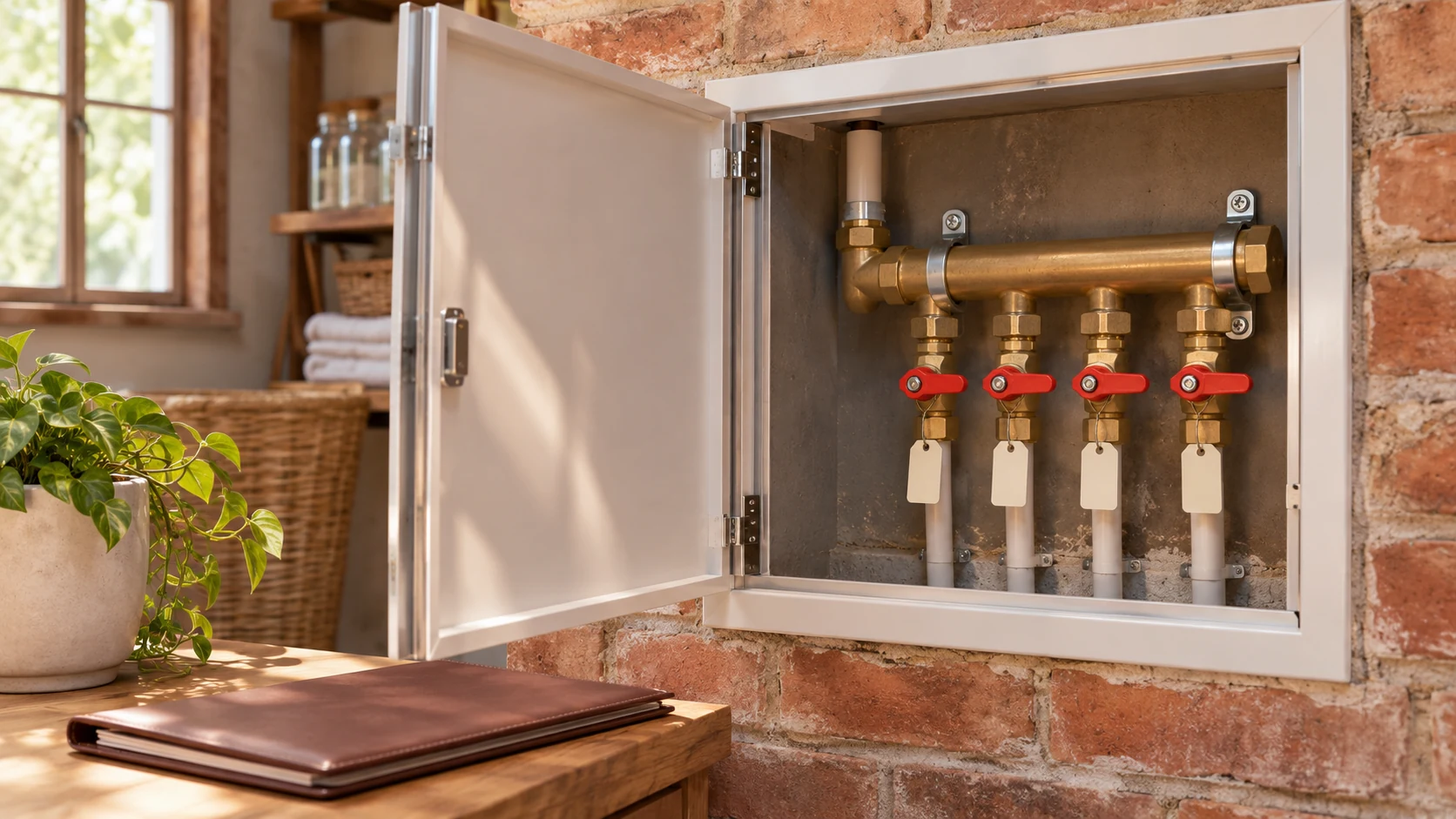
Make the labels describe the actual house
I would arrange a walk-through with the qualified plumbing installer after the relevant finishes and fittings are in place. Bring the current installed drawings, component list and photographs together. Ask the installer to identify discrepancies before anyone calls the file complete.
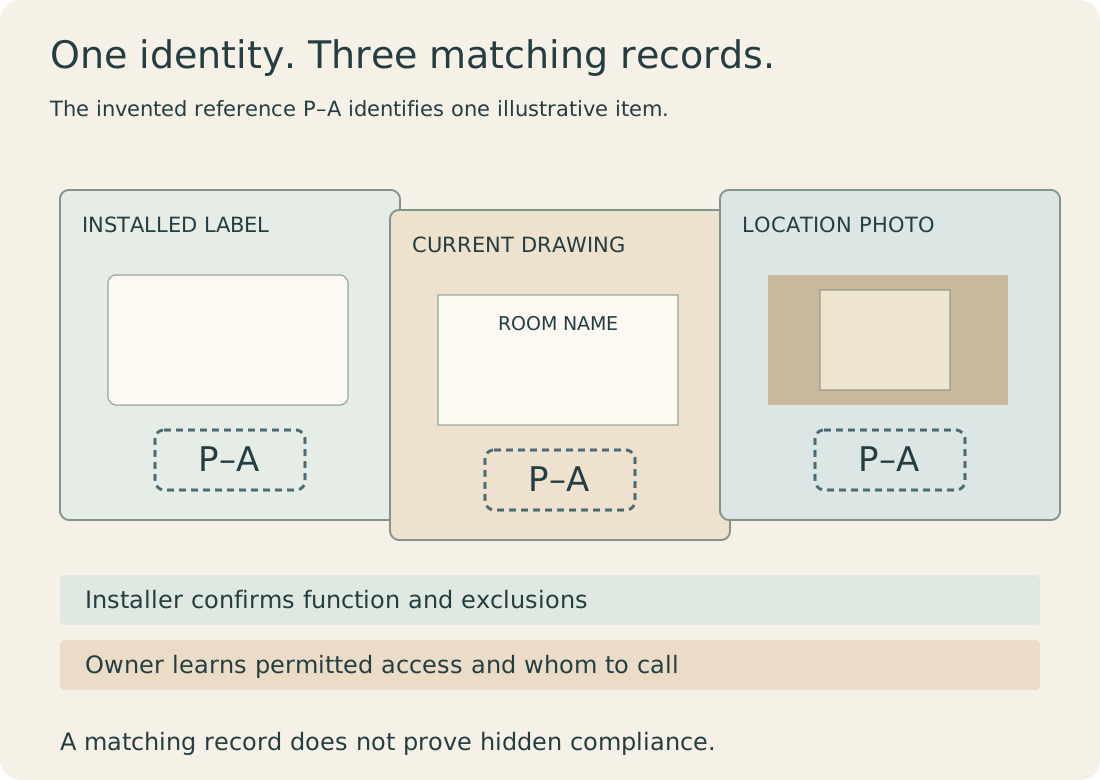
Give each relevant panel and control a consistent reference. The label on the installation, its location on the drawing and the photograph caption should all point to the same thing. A plain description helps too: the room, a recognizable landmark and the exact function confirmed by the installer.
Water Regs UK's informative guidance recommends labelling stop valves to show which parts of a plumbing system they control, and placing them where they are readily accessible. That is a useful UK example of the principle, not a statement of local requirements elsewhere. Water Regs UK, Why do customers need their own stop valves? (opens in a new tab).
I would avoid guessing from handle colour, position or resemblance to another valve. Ask the installer to supply the correct description. “Main water” sounds decisive, but I would still want to know exactly what it controls and what remains supplied.
Ask what each control affects
For every owner-relevant control, request a written explanation of its function, affected outlets or equipment, and any important exclusions. Ask whether the house has storage, pumps or other supply arrangements that change what shutting a particular control accomplishes. The responsible installer should explain the actual system without leaving the owner to infer it from a sketch.
Separate domestic, utility, shared-building and fire-protection systems in the records. This distinction matters even when their components sit close together.
The U.S.-based Home Fire Sprinkler Coalition warns that shutting off a home's water can also interrupt its fire sprinklers in the arrangements it describes, and advises asking the sprinkler contractor about the system. I would have the responsible professionals explicitly explain any interaction at this house. Do not disable fire protection as an experiment. HFSC, Know Your Water Controls (opens in a new tab).
Utility equipment needs its own boundary. WaterSafe's UK guidance notes that external stop-tap operation may need supplier permission, including in an emergency. I would ask the actual provider to identify local responsibility and access rules rather than import that UK arrangement. WaterSafe, problems turning off a supply (opens in a new tab).
Check access in the room you will live in
The service-access guide covers coordination before walls and ceilings close. At handover, I would compare that agreed arrangement with the finished room.
Can the intended resident locate the owner-accessible control without climbing, moving a heavy appliance or reaching through another service? Does the installer-confirmed access area remain available after shelving, doors and permanent furniture are fitted? If the household member who may need it cannot reach it safely, the team needs to resolve that problem.
An access panel also needs a purpose. Ask what it serves, who is allowed to open it and what work the opening is intended to support. Seeing a component through a gap does not tell you whether a professional can maintain or replace it there.
Ask the installer to show permitted owner access safely. Leave locked, sealed, elevated or otherwise restricted locations to the appropriate person. Do not remove protective covers or disturb a wall assembly to improve the view. Any unresolved access problem goes back to the responsible contractor and designer.
I would mark agreed keep-clear areas in the private owner instructions. The temptation to fill a useful empty cupboard is strong. Apparently spare paint tins can detect one from several rooms away.
Build a small record that people can actually use
Here is the checklist I would bring to the walk-through. It organizes information; it does not certify the installation.
| Item to match | Evidence to request | If it does not agree |
|---|---|---|
| Panel or control reference | Installed label, drawing and location photograph | Installer reconciles the identity |
| Exact function | Written description of what is affected and excluded | Keep it unresolved; do not experiment |
| Owner access | Demonstration and instructions for permitted access | Record the obstruction or limitation |
| Service responsibility | Named installer, provider or building contact | Assign someone to confirm the boundary |
| Maintenance and changes | Applicable product instructions and updated records | Request the missing or revised document |
For photographs, I would ask for one view that explains the location and another that identifies the relevant label or component, taken safely by the appropriate person. Pre-enclosure photographs can provide useful background, but their dates and locations need to be clear. They do not prove that hidden work is compliant or unchanged.
Retain the installer-issued description of the installed arrangement and its revision date. Keep superseded drawings distinguishable from the current set. Private access details, account numbers and personal contacts belong in the owner's copy, not an article or a public photograph.
One identity. Three matching records.
The invented reference P–A identifies one illustrative item.
-
INSTALLED LABEL
P–A
-
CURRENT DRAWING
P–A
-
LOCATION PHOTO
P–A
- Installer confirms function and exclusions
- Owner learns permitted access and whom to call
A matching record does not prove hidden compliance.
Let the installer teach, then check the explanation
Ask the qualified installer to demonstrate the approved owner routine for the actual controls and explain when the owner should stop and call for help. Any operation during that demonstration belongs under the installer's direction and the system's applicable instructions.
I would then describe the routine back in my own words and ask whether I have understood it. That small conversation can reveal an assumption that a signature on a handover sheet misses.
Ask what tasks require qualified service, what maintenance instructions apply to the installed products and who returns the system to service after professional work. If verbal advice conflicts with the supplied documents, ask the responsible person to resolve it in writing. This article supplies no turning sequence, pressure-test method or repair recipe.
Finish with the contact, not just the cupboard
The household needs a short emergency contact sheet: plumbing help, the water provider, building management where applicable and the relevant emergency service contacts. Have the installer explain whom to call for different situations, including an inaccessible control, an unknown label or a problem involving shared or fire-protection equipment.
Do not enter a flooded or otherwise hazardous area to reach a valve. Where water and electrical hazards may coincide, keep away and seek appropriate emergency help. Knowing where something is does not make reaching it safe.
Keep the agreed instructions somewhere residents can find, with a backed-up copy in the house handover file. After alterations, ask the contractor to update the labels, photographs and descriptions that changed.
My final question would be simple: “If someone who missed today's walk-through needed help, could they identify the right information without guessing?” A good handover should make that answer comfortably boring.
Sources checked November 8, 2026. UK and U.S. examples support the stated distinctions only. The local team must establish applicable requirements, ownership and safe owner instructions for the actual house.
Sources behind the questions
Research checked 2026-11-08. External source links open in a new tab. Foreign sources explain principles, not Panama project requirements. No illustration establishes the performance of a real house.
-
Water Regs UK, Why do customers need their own stop valves? (opens in a new tab)
Principle or local example only; scope and limitations are explained beside the claim.
-
HFSC, Know Your Water Controls (opens in a new tab)
Principle or local example only; scope and limitations are explained beside the claim.
-
WaterSafe, problems turning off a supply (opens in a new tab)
Principle or local example only; scope and limitations are explained beside the claim.