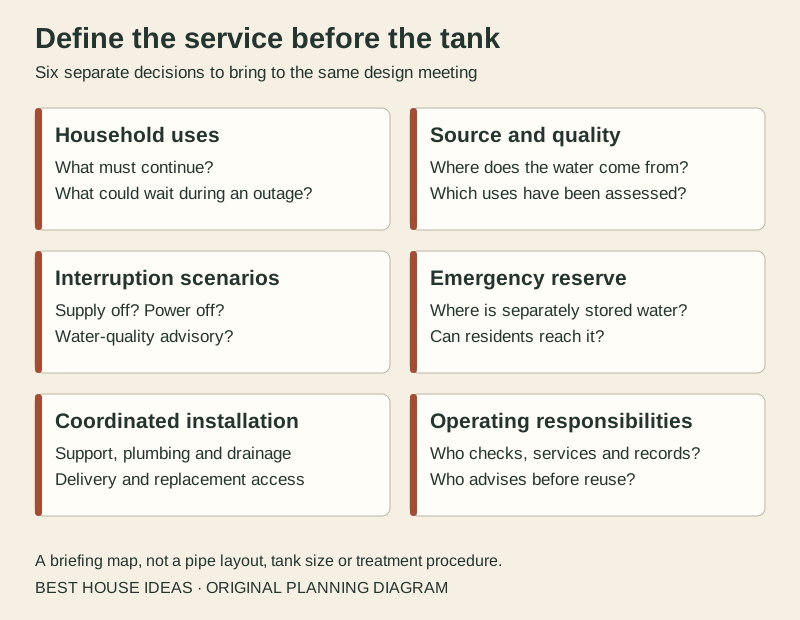
A water-storage plan should start with the interruption you want the household to manage. A brief loss of pressure, an extended supply outage and a warning that water may be unsafe are different problems. Before comparing tanks, describe what must continue, what can wait and how the household will obtain safe water if the usual arrangement cannot be used.
This guide helps prepare that brief. It does not calculate tank capacity, prescribe treatment or specify supports and plumbing. The separate rainwater collection guide explains catchment questions. Here the focus is the household's demand, the storage service it needs and the decisions that must be coordinated before equipment is ordered.
Describe the service you need to preserve
Make a list of activities rather than beginning with a tank catalogue: drinking, food preparation, personal hygiene, toilet use, laundry, cleaning and irrigation. Then mark which activities must continue during an interruption, which could be reduced and which could be postponed. Include visitors and pets in the conversation without assuming that an ordinary weekday represents the busiest period.
Record what you actually know about interruptions. A household log might show the date, whether water stopped completely, whether pressure changed, how long the interruption lasted and whether an official advisory was issued. Separate observations from explanations. “No water at the kitchen tap” is an observation; “the utility pump failed” needs confirmation.
Bring available bills, meter records and the activity list to the system designer. Explain missing periods and unusual occupancy. These records are inputs for professional assessment, not a reason to divide one bill by the number of residents and call the result a design. Ask how the proposal accounts for variable demand, refill opportunities and the household's agreed outage routine.
Keep source, quality and intended use separate
A label such as “backup water” says little about what is in a container. Write down where each supply comes from, which uses it is intended to serve and how its suitability will be established. Public-system water, delivered water and collected rainwater should not be treated as interchangeable descriptions.
CDC explains that rainwater can carry germs and chemicals even when it looks clear, and that mixing it with treated water can contaminate the treated supply. It also advises keeping rainwater from entering pipes that carry safe drinking water. [1] Ask the qualified plumbing designer to resolve separation and any required protection. A sketch in a homeowner's notebook is not a connection detail.
For every proposed outlet, ask a plain question: “What water reaches this point, and what uses have been assessed?” Do not use “non-drinking” as a blanket permission for bathing, food washing or other contact. Intended use and exposure belong in the water-quality discussion. Where safety is uncertain, obtain advice from the relevant health authority before use rather than relying on appearance or a generic filter claim.
On a small screen, swipe or scroll the diagram horizontally to read every panel.
Original briefing map, not a plumbing schematic, capacity calculation or water-treatment procedure. Source and use distinctions are informed by CDC sources 1–4.
The diagram separates decisions so that an appealing tank location does not quietly settle the water-quality question. It is an original briefing map, with no implied pipe connections, storage proportions or capacities.
Distinguish a household system from an emergency reserve
A fixed tank connected to the house and a separately accessible emergency drinking-water reserve have different roles. CDC recommends having an emergency supply in addition to cistern water, because a disaster can affect the cistern or make its contents inaccessible. [2] Discuss both arrangements rather than expecting one piece of equipment to address every failure.
CDC identifies unopened commercially bottled water as the safest and most reliable emergency source. Its emergency-storage guidance also covers container choice, storage and replacement. [3] Follow that guidance and current local advice for your emergency preparations. Its emergency quantities should not be repurposed as a whole-house tank-sizing formula.
For the fixed system, ask the designer to describe the service available during each proposed operating state. What happens if supply stops but electricity remains available? What happens if both fail? What happens if water is available but an advisory limits its use? Record the answer without assuming that water visible in a tank can necessarily reach the fixtures.
Compare arrangements by questions, not headline volume
Use this worksheet to make competing proposals explain the same responsibilities. The rows are planning prompts, not endorsements, an exhaustive list of systems or technical installation instructions.
Water-storage arrangements to discuss
Arrangement to discuss
Household question
Evidence or coordination to request
Separate emergency reserve
Can residents reach safe water when the normal system is unavailable?
Storage location, stock rotation and a clear household routine
Storage serving selected uses
Which activities continue, and which outlets are excluded?
Clearly documented uses and professionally designed separation
Storage serving the usual household supply
What changes during loss of supply or power?
Operating description, water-quality responsibilities and service access
More than one source
Who confirms that each source is suitable for its destination?
Source records and the designer's connection and protection plan
A proposed future expansion
What must be allowed for now, and what remains a later decision?
Reserved space and a coordinated design review before alteration
On a small screen, swipe the table horizontally to see every column.
Ask each proposer to identify what is included in the price and what another contractor must provide. An attractive equipment allowance may leave excavation, support, electrical work, commissioning or maintenance access unresolved. Keep those scope questions beside the operating comparison, rather than comparing tank prices alone.
Plan the location with the people responsible for it
Walk the proposed location with the relevant design team before treating it as agreed. Ask the structural professional to assess the tank, support and site conditions for the proposed installation. An empty tank's appearance is not evidence that a roof, platform or existing slab is suitable. This guide supplies no load, foundation or anchoring design.
Ask how the tank will arrive, be installed and eventually be replaced. Check the route after gates, landscaping, walls and permanent equipment are in place. A location that is convenient on an unfinished site may become difficult to service later. Put the delivery and replacement assumptions on the drawing so a later landscape decision does not erase them.
Have the plumbing, drainage and electrical responsibilities identified together. Ask where planned overflow or service discharge will go, how a fault will be noticed and how equipment can be isolated by an appropriate person. These are coordination questions for the professionals, not instructions to modify a pipe or electrical supply yourself. Extend the same thinking through the home service-access plan.
Make maintenance a deliverable
Request a written maintenance plan for the exact installed equipment, including who carries out each task and which work requires a qualified provider. Ask for accessible identification of components and the records needed when the system changes hands. Agree how reminders, inspections and service visits will be managed before the installer leaves.
For portable safe-water storage, CDC emphasizes containers that protect water against recontamination and warns against containers that previously held toxic chemicals. [4] That small-container guidance does not establish the suitability of a large installed tank. Ask for the exact tank's intended-use documentation and the applicable installation and maintenance instructions.
Keep a simple service record with dates, observed problems, provider details and follow-up actions. Do not enter a tank to inspect or clean it. Arrange appropriate professional service and ask how maintenance will be completed safely. If a supplier's procedure cannot be performed with the access shown on the plan, resolve the conflict before construction.
Write the disruption and return-to-service plan
A short household instruction sheet should say whom to contact, how residents learn about advisories and where the separate emergency reserve is kept. Ask the installer to explain the approved operating routine and demonstrate normal controls at handover. Avoid relying on one person's memory or an unlabeled collection of valves.
After flooding or another suspected contamination event, do not assume that the stored supply is safe because the tank still looks intact. CDC notes that disasters can introduce contamination and recommends health-authority advice before reusing affected catchment water. [2] This article deliberately gives no disinfectant dose, cleaning recipe or DIY return-to-service procedure.
Keep official notices and professional assessments with the maintenance record. If the source, intended use or connected outlets change, have the responsible professionals reassess the arrangement before operating it differently. The same applies when the house's occupancy changes substantially: the original brief may no longer describe the service required.
Leave the design meeting with a usable brief
The useful outcome is a short, shared record: essential activities, interruption scenarios, source and use distinctions, known demand information, location constraints and named responsibilities. Add unresolved questions and the evidence needed to close each one. A supplier should be able to explain how its proposal responds to that record.
Keep the final operating description and installed-equipment documents in the house handover file. Revisit them with the home-absence plan if the property will be empty for extended periods. Storage works best as a maintained household service, with its limits understood, rather than as a purchase whose volume is expected to answer every question.
Sources checked November 8, 2026. U.S. public-health guidance supports the stated general distinctions; it does not establish Panama regulations, permission or installation compliance. The worksheets and meeting prompts are original editorial planning aids, not engineering or water-treatment specifications.