Field notes · Materials · Where products meet
Those Fasteners Look Fine. Do They Belong Together?
A lovely house proposal can hide a small question: do the products belong together? I would put that question on the kitchen table.
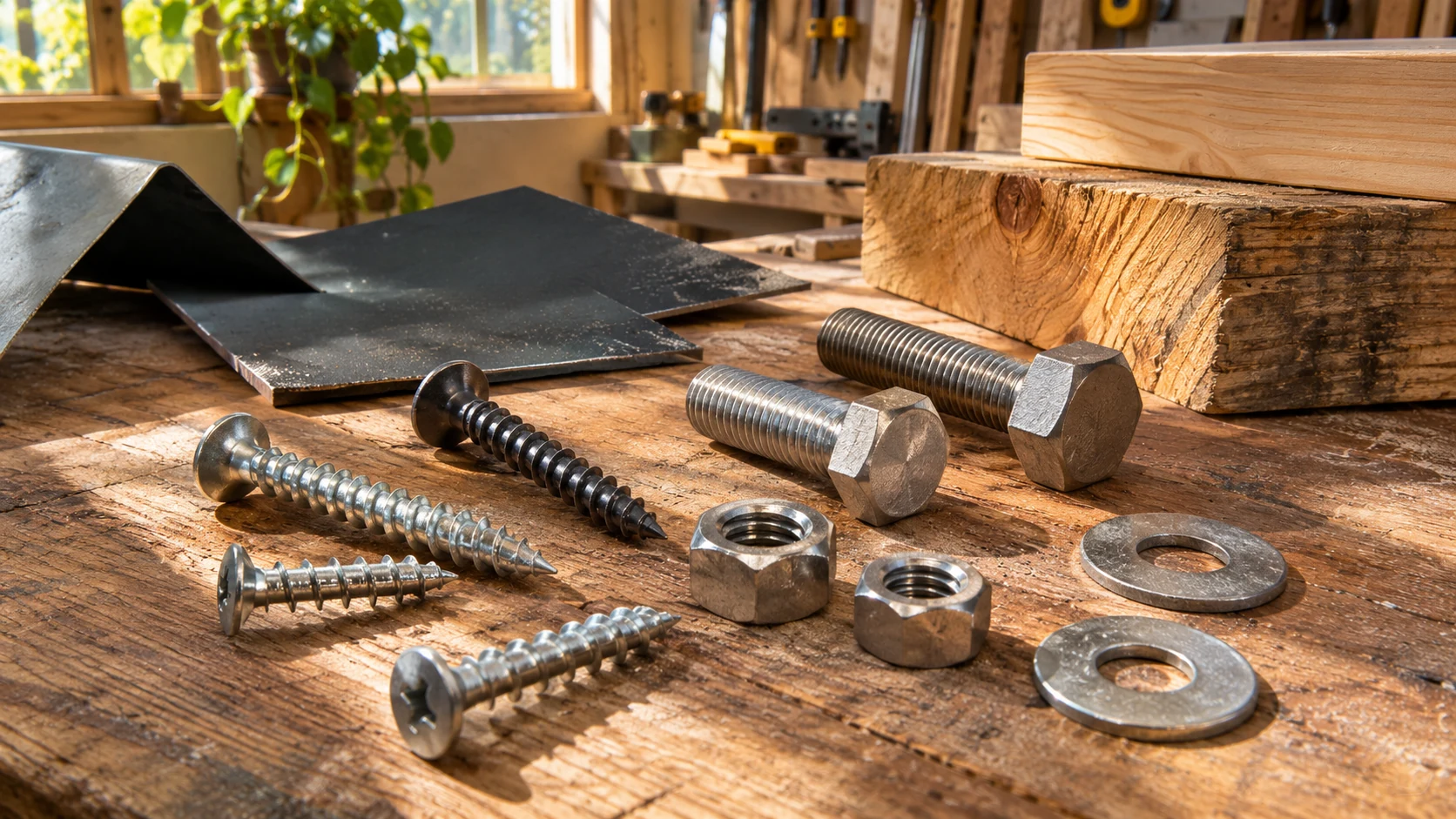
For entertainment and general understanding. These illustrations and questions are not a construction specification or a site-specific engineering assessment.
Let me put two imaginary quotes on the kitchen table. Both offer a lovely metal-clad house. One lists “premium corrosion-resistant fasteners.” The other names the cladding, fasteners, washers, supporting material, and documents that cover their use together.
The first sounds nicer. The second gives me something to check.
I would still want the lovely house, obviously. Nobody dreams of retiring inside a filing cabinet. But before choosing between these imaginary proposals, I would ask a less glamorous question: Who checked that all these good products belong together?
That question reaches beyond roofing. Think of wall cladding, metal brackets, gutters, and the small pieces connecting everything to something else.
Three questions before mixing products
Follow the contacts. Follow the rain.
Contact
What touches?
Identify the exact touching materials and the guidance that applies.
Runoff
Where does water travel?
Check the upstream surfaces and the material receiving the water.
Documentation
Who checks the whole assembly?
Bring the product information and project requirements together.
Start where the materials meet
I would begin by asking the designer to point out the contacts on a drawing. Which fastener touches which panel? What bracket touches the supporting material? What stays wet?
Galvanic corrosion needs electrochemically different metals, an electrical connection, and a conductive liquid, or electrolyte. Under those conditions, one metal can corrode faster because of the pairing. NASA’s corrosion guidance explains this mechanism; it does not offer a shopping list for houses. NASA Kennedy Space Center: Forms of Corrosion (opens in a new tab)
The surroundings matter too. BlueScope’s technical explanation considers the relative exposed areas, surface behavior, and time spent wet. Salts can make the problem worse. Reading two metal names from a chart leaves out important parts of the situation. BlueScope CTB-12: Dissimilar metals (opens in a new tab)
This is where I would resist becoming the family corrosion expert after an energetic afternoon online. I want enough understanding to ask a useful question, then a documented answer for the actual assembly.
The tempting “upgrade”
Back at our imaginary table, suppose someone offers stainless-steel fasteners as an upgrade. That sounds reassuring. I would ask what the specified panel manufacturer says before accepting it.
Here is a deliberately narrow example: BlueScope’s Australian TB-16 says stainless-steel fasteners are incompatible with its named COLORBOND and ZINCALUME steel products. That instruction concerns those products, not every painted metal panel in the world. BlueScope TB-16, June 2026 revision (opens in a new tab)
Meanwhile, Simpson Strong-Tie requires stainless-steel fasteners with its stainless-steel connectors and also identifies restrictions within its stainless product combinations. The broad material label alone does not settle the choice. Simpson Strong-Tie: Stainless-Steel Fastener Solutions (opens in a new tab)
I cannot turn those examples into a universal winner between stainless and galvanized. They persuade me to ask for the exact product names and the relevant instructions. “Better” needs an address: better for this connection, in this environment, doing this job.
Follow the rain as well
Now I would trace water across the drawing. Where does it start, what does it pass over, and where does it land?
Direct contact and runoff are separate compatibility questions. BlueScope publishes distinct guidance for them, including cases where drainage is acceptable but direct contact should be avoided. BlueScope STEEL SELECT: Direct Contact and Drainage (opens in a new tab)
Its corrosion bulletin explains one reason: material dissolved from an upstream metal can travel in water and deposit on a different metal below, creating a corrosion problem there. The original pieces need not be touching. BlueScope CTB-12 (opens in a new tab)
That gives our imaginary owner a better question than “Is this gutter good?” I would ask, “Is this gutter suitable for the water coming from everything above it?” A small arrow on the drawing could earn its place here. Rain does not stop at the edge of a supplier’s quotation.
A fastener has more than one job
Corrosion resistance is only part of the conversation. Structural fasteners transfer loads through a connection, and substitutions can change the assembly’s performance. Simpson’s engineering guidance describes tested alternatives and application-specific limits rather than treating similar-looking fasteners as interchangeable. Simpson Strong-Tie: Fastener Substitutions in Connectors (opens in a new tab)
For exposed cladding fixings, sealing and installation matter as well. BlueScope’s bulletin addresses compatible washer materials and the need to prevent leakage without damaging the sealing system or sheet. BlueScope TB-16 (opens in a new tab)
Even the sealant deserves its own line in the conversation. BlueScope warns that curing by-products from some sealants can attack protective coatings, although those sealants may suit other materials. BlueScope TB-9: Sealants for exterior coated steel products (opens in a new tab)
So I would want the complete documented assembly reviewed: panel or connector, fastener, substrate, coating, washer, sealant where required, and installation requirements. I would leave improvised isolating layers, substitute screws, and repair details to the responsible professional. A sensible-sounding change still needs checking.
What I would put beside those two quotes
This is my owner’s comparison sheet, not a table telling anyone which metals to combine. It turns the source guidance above into questions for the supplier and designer.
| What I am comparing | The answer I would want |
|---|---|
| “Corrosion-resistant” hardware | Exact product and finish, with suitability documented for the proposed exposure and connected materials. |
| Direct contact | A drawing identifying the touching components and the applicable manufacturer guidance. |
| Water runoff | The drainage route, including upstream accessories, checked against the receiving materials. |
| The complete connection | Documentation covering structural performance, sealing where needed, and installation in the actual substrate. |
| A proposed substitution | The changed product identified, the affected assembly reviewed, and written acceptance from the responsible designer plus manufacturer confirmation where needed. |
| Handover information | A record of what was actually installed, with the relevant product instructions and care requirements. |
I would also ask who is collecting the answers. Otherwise, it is easy to have a panel supplier answering for the panel, a hardware supplier answering for the screw, and nobody answering for the place where they meet.
Bring the answer back to the actual house
The Australian and US manufacturer examples here show why compatibility needs checking. They do not establish Panama’s building requirements or approve a particular local design. For a house in Panama, I would have the locally responsible designer reconcile the actual site conditions, applicable requirements, and the exact products available.
At the end of our imaginary comparison, I would favor the proposal whose details can be verified, rather than the one with the most impressive adjective. Any unresolved combination should go back for clarification before approval.
And I can do this part with drawings and documents on the table. No roof expedition required. If an existing connection raises concern, I would arrange a qualified assessment rather than loosen or replace structural hardware myself.
The screws may be small. The question of whether they belong there deserves a full-sized answer.
Sources behind the questions
Research checked 2026-11-08. External source links open in a new tab. Manufacturer examples apply to the named products; they do not approve a local design.
-
NASA Kennedy Space Center: Forms of corrosion (opens in a new tab)
Mechanism explanation, not residential product approval.
-
BlueScope CTB-12: Dissimilar metals (opens in a new tab)
PDF: October 2022, revision 6. Product-context guidance, not a universal pairing chart.
-
BlueScope TB-16: Fasteners for roofing, walling and accessory products (opens in a new tab)
PDF: June 2026, revision 15. Australian product-specific guidance.
-
Simpson Strong-Tie: Stainless-steel fastener solutions (opens in a new tab)
Product-specific requirements; no universal winner between material types.
-
BlueScope STEEL SELECT: Direct contact and drainage (opens in a new tab)
Older summary used only to separate contact and runoff questions.
-
Simpson Strong-Tie: Fastener substitutions in connectors (opens in a new tab)
July 2025 engineering article. No substitution or capacity instruction reproduced.
-
BlueScope TB-9: Sealants for exterior coated steel products (opens in a new tab)
PDF: August 2025, revision 9. Coating-specific warning, not a sealant recommendation.