Field notes · Poolside planning
Pool electrical safety: what I would ask a qualified inspector
I would choose the comfortable chairs after arranging the professional checks behind that lovely evening.
For entertainment and general understanding. These illustrations and questions are not legal advice, an electrical design, a construction specification or a site-specific professional assessment.
Picture an imagined evening by a tropical pool: the garden is settling into shadow, the water catches the last blue of the sky, and someone has claimed the comfortable chair. I would happily spend time choosing the terrace furniture for that scene. Preferably furniture that does not require a small expedition to find its cushions.
But before arranging the evening, I would arrange the professional checks behind it. Pool electrical safety belongs in the planning conversation, alongside the lovely things we can actually see.
This is my owner’s meeting brief, not an electrical inspection checklist. A tidy equipment area, clear water and working lights cannot establish that a pool’s electrical installation is safe.

Start with the right appointment
I would ask for a professional who is authorized for the work locally and specifically experienced with pool electrical installations. I would also ask what the appointment includes. A cleaning visit or a general look at the property is not a substitute for that assignment.
CPSC’s longstanding advice is to have an electrician qualified in pool and spa repairs inspect the installation and address needed upgrades. Its warning about older pools includes deteriorating underwater lights and wiring that has gone unexamined. Although that guidance dates to 2003, it gives a useful reason to ask about history rather than judge everything by appearance. CPSC’s pool inspection guidance (opens in a new tab).
Before the visit, I would gather existing drawings, equipment manuals, previous reports and records of repairs. If there are gaps, I would say so. “I don’t know who changed that light” is useful information, not an answer to disguise with confidence.
Look beyond the water
The inspection conversation should cover more than the illuminated rectangle in the garden. CPSC identifies underwater lights, pool equipment, outlets, switches, cords, electrical appliances and overhead lines as potential sources of electrical hazards around pools. Wet skin and wet surroundings can increase the danger when electricity is present. CPSC’s electrical safety guide (opens in a new tab).
I would want the professional to explain the scope in ordinary language: which pumps, heaters, lighting, associated wiring and nearby installations are included, and what cannot be assessed during that visit.
For a pool with a complicated renovation history, I would bring every known alteration into that conversation. A replacement pump, added fountain or new terrace lighting might look like a separate project in the invoice folder. I would ask how it fits into the overall electrical review.
Give the hidden details proper attention
Underwater lighting deserves more than a discussion about whether the blue is flattering. In a 2022 professional article, NFPA electrical specialist Corey Hannahs discusses inspection of lights, cords and seals, as well as deterioration associated with environmental exposure, including corrosive pool-chemical environments. Those are professional inspection subjects, not an invitation for owners to remove fittings. NFPA Code Talk in IAEI Magazine (opens in a new tab).
I would describe the setting honestly: wind-driven rain, an exposed equipment area, any known flooding, and where chemicals are kept. Then I would ask what those conditions mean for the installed equipment and its upkeep. A beautiful screen around machinery should still be discussed with the people who must inspect and service it.
Protection devices belong on the agenda too. ESFI identifies ground-fault circuit-interrupter protection, commonly called GFCI protection, as an important safeguard against electrical shock. I would ask the professional to explain which protections the installation requires and how their condition and operation will be verified. I would not use this article to test them myself. ESFI’s pool and spa guidance (opens in a new tab).
I would also ask whether grounding and bonding are included in the assessment. They are distinct electrical safety subjects, and their adequacy cannot be established by spotting a wire beside a pump. The North Carolina Department of Labor treats both in its pool electrical hazard guidance; the technical requirements need professional interpretation for the actual installation. Swimming Pool Electrical Hazards (opens in a new tab).
The questions I would bring
This table is a conversation aid, not a pass-or-fail test.
| Subject | My question for the professional | What I would want recorded |
|---|---|---|
| History | What do age, repairs and undocumented changes mean for this review? | Known changes and missing information |
| Equipment and lighting | Which components and connections are included? | Scope and inaccessible areas |
| Protection | How will required protective measures be assessed? | Findings, limitations and needed work |
| Surroundings | What nearby wiring, additions or exposure needs attention? | Issues requiring further review |
| Follow-through | What must happen before use, and who confirms completion? | Responsibilities and written next steps |
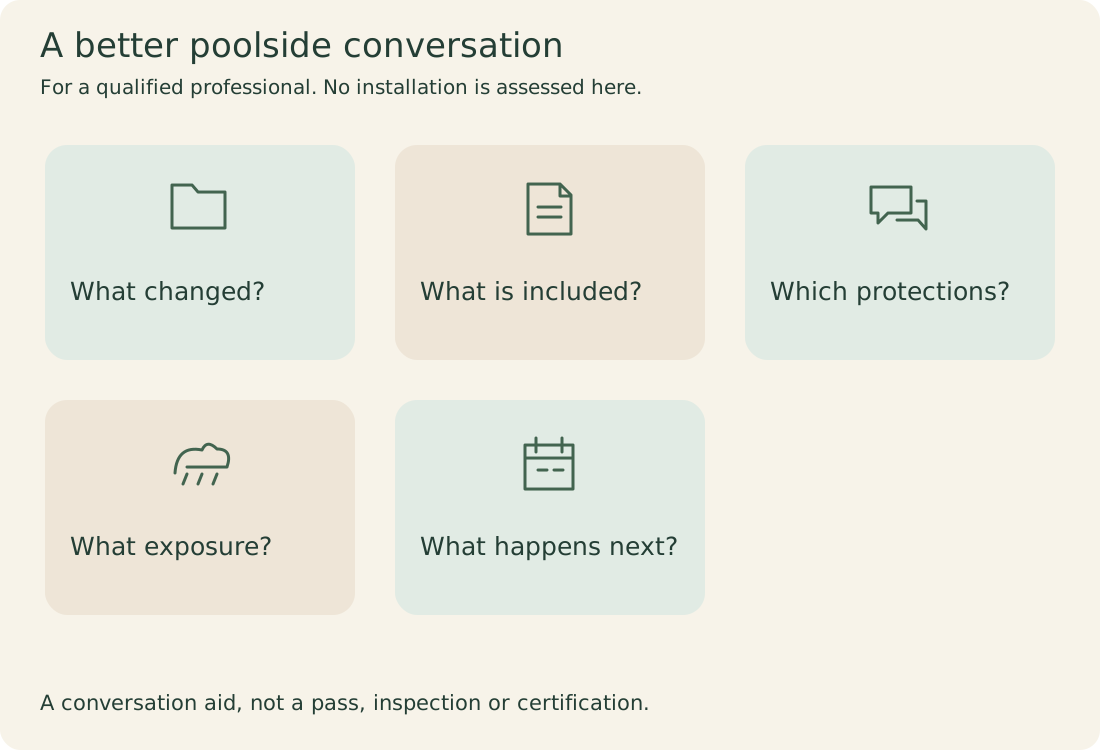
A better poolside conversation
Five owner questions for a qualified professional, not an inspection checklist.
-
What changed?
Gather repair records, drawings and previous reports.
-
What is included?
Agree the professional inspection scope.
-
Which protections?
Ask the professional what must be assessed.
-
What exposure?
Discuss wet, weathered and corrosive surroundings.
-
What happens next?
Ask for findings, restrictions and follow-up in writing.
Questions for a qualified professional. This conversation aid does not inspect or certify an installation.
Keep the local rules local
For a Panama property, I would ask which RIE provisions and local approvals apply. ASEP’s official electrical-regulation page identifies the JTIA framework and lists successive adoption resolutions. It also contains older introductory wording, so I would not choose a controlling edition from a casual reading of the page. U.S. consumer guidance is useful background, but its distances and code references are not a ready-made Panama specification. ASEP’s RIE reference page (opens in a new tab).
Know when the evening must wait
An owner can report something noticed during ordinary use without investigating it. Flickering underwater lights or a report of tingling in the water deserve immediate attention, not an experiment. CPSC lists these among possible electrical warning signs. Stop pool use, keep people out and obtain qualified help. If someone may be receiving a shock or is in distress, call emergency services immediately and do not enter potentially energized water to attempt a rescue. CPSC’s warning signs (opens in a new tab); North Carolina’s rescue warning (opens in a new tab).
I would ask for a site-specific emergency plan and clear instructions before they are needed. Routine maintenance notes cannot certify safety, and unresolved concerns need professional follow-through before swimming resumes.
That leaves room for the evening I imagined: a comfortable chair, a quiet garden and no unfinished inspection questions tucked behind the cushions.
Sources behind the questions
Research checked 2026-11-08. External source links open in a new tab. Foreign sources explain principles, not Panama project requirements. Local examples do not replace confirmation for the property.
-
CPSC’s pool inspection guidance (opens in a new tab)
Principle or local example only; scope and limitations are explained beside the claim.
-
CPSC’s electrical safety guide (opens in a new tab)
Principle or local example only; scope and limitations are explained beside the claim.
-
NFPA Code Talk in IAEI Magazine (opens in a new tab)
Principle or local example only; scope and limitations are explained beside the claim.
-
ESFI’s pool and spa guidance (opens in a new tab)
Principle or local example only; scope and limitations are explained beside the claim.
-
Swimming Pool Electrical Hazards (opens in a new tab)
Principle or local example only; scope and limitations are explained beside the claim.
-
ASEP’s RIE reference page (opens in a new tab)
Principle or local example only; scope and limitations are explained beside the claim.