Field notes · Paperwork · A clearer handover
The Electrical Panel Paperwork I’d Want Before Handover
I want the next electrical conversation to start with useful records, rather than a circuit mysteriously called “Other.”
For entertainment and general understanding. These illustrations and questions are not a construction specification or a electrical design, inspection or site-specific professional assessment.
Imagine calling an electrician because something in the kitchen has stopped working. They ask which panel serves that area. You find a handover folder, open the circuit list, and discover the helpful description “Other.”
Other what? Other kitchen? Other house? A small mystery novel has arrived where a useful label should be.
I’d rather sort out that paperwork while the people who know the installation are still involved. A load center, often called an electrical panel or breaker panel, deserves a readable set of records. My part as an owner would be understanding those records and asking good questions. The electrician’s part is confirming what is actually installed.
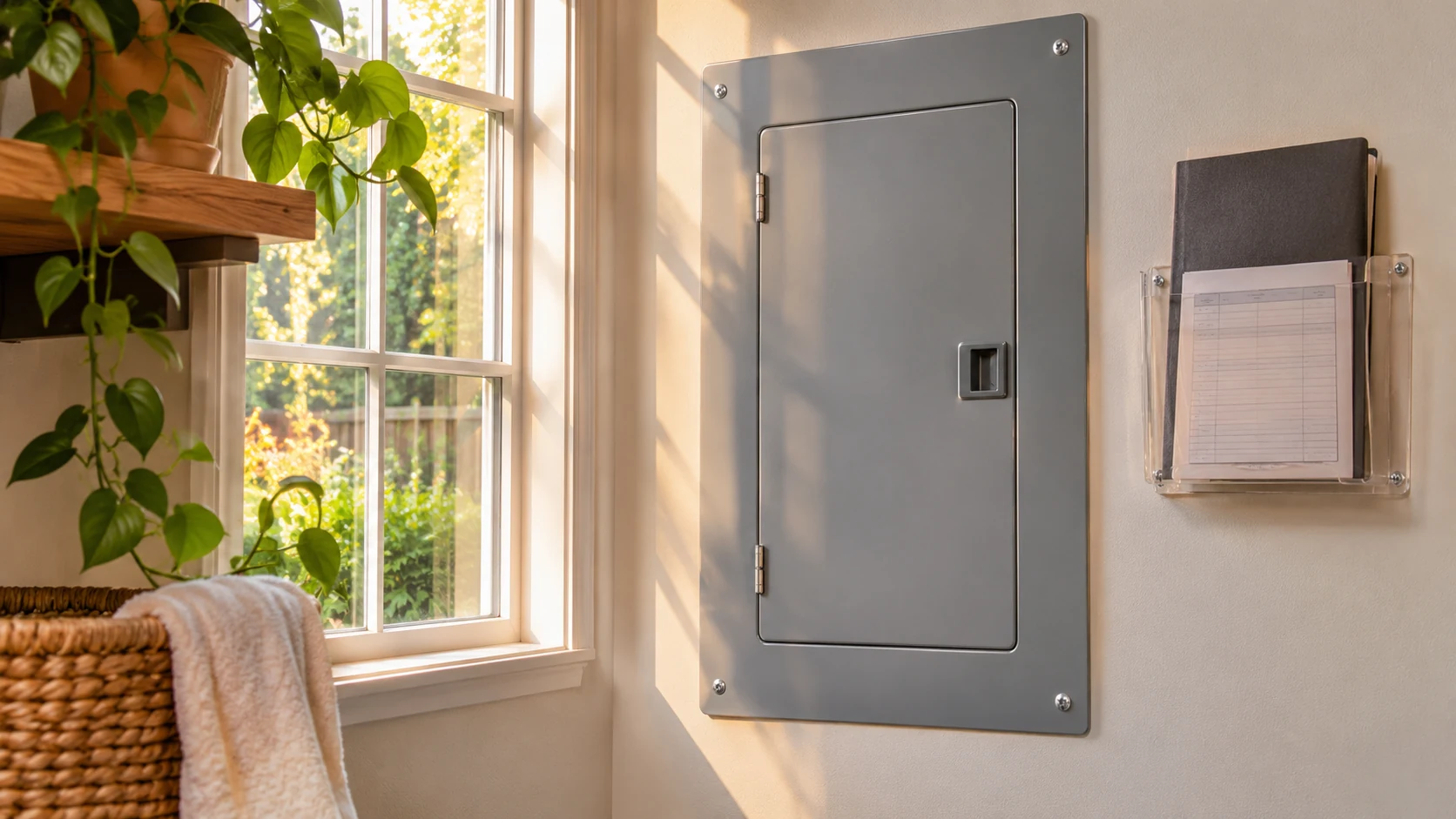
I’d start with the documents, not a screwdriver
This is a paperwork checklist. I would use supplied manuals, directory copies and safely accessible exterior labels. I would not remove covers, reach into equipment, trace wiring, test circuits or toggle breakers to investigate a label.
That boundary reflects the manufacturer’s own warning: Schneider Electric’s QO and Homeline bulletin reserves installation and servicing for qualified electrical personnel. Its instructions also refer to separate documentation for certain breakers and accessories. The example is bulletin S1B33894, revision 02, May 2014, so I’d request the correct current instructions for the equipment actually supplied. Schneider Electric load-center bulletin (opens in a new tab)
For a Panama house, I’d ask the qualified local electrician to identify the applicable requirements and approval records. A US manufacturer example helps frame the conversation; it doesn’t establish Panama compliance.
Give every panel a name that survives the handover
If the supplied records describe several panels, I want to understand which is which without relying on “the one by the thing.”
I’d ask for a simple location list using the same panel identifiers throughout the documents. A panel called “Guest Building” on one sheet shouldn’t quietly become “Rear House” on another unless the connection is explained.
For layout, I’d want the electrician’s supplied panel schedule or directory to use the equipment’s actual position numbering. I wouldn’t redraw the arrangement from memory or assume two panels follow the same pattern. If a document shows an unused position, I’d ask what that description means rather than treating the blank as an invitation to add something.
This is also where I’d clear up room names. “North bedroom” may remain useful after someone swaps bedrooms. “Carlos’s room” depends on Carlos maintaining a lifelong commitment to that particular mattress.
Keep three different things separate
I’d organize the handover around three questions:
- Circuit directory: What does the electrician say each identified circuit serves?
- Diagram or as-built record: How is the installed arrangement documented, and which revision reflects completed changes?
- Verification record: Who checked the installation and its identification, when, and with what scope?
These documents can support each other, but they answer different questions. A neatly typed directory could still be inaccurate. A design drawing might predate a change. A record called “as-built” needs a clear explanation of what was confirmed, especially if some details remain unresolved.
I’d ask for specific descriptions where necessary: a room, an equipment name, or a clear group of loads. “Lights” could describe half a house. I’d also want any known uncertainty marked for the electrician to resolve, rather than quietly converted into a confident-looking label.
An outage doesn’t prove the equipment is safe
Here’s the distinction I would keep prominent in the folder: circuit identification helps people communicate. It does not prove that equipment is de-energized or safe to touch.
US workplace safety rule OSHA 1910.333 addresses all electrical energy sources and qualified verification before exposed electrical work. I’m using that as a safety principle, not a residential code claim for Panama or instructions for performing a test. An owner’s observation that a light went out is not that professional verification. OSHA electrical work practices (opens in a new tab)
If the house has solar, batteries, a generator or another supply, I’d ask the electrician for documentation identifying those systems and the relevant warnings. ESFI’s first-responder guidance notes that PV wiring can remain energized and that energy storage can retain hazardous energy after shutdown. I would not turn that responder guidance into a homemade shutdown sequence. ESFI photovoltaic safety (opens in a new tab)
Instead, I’d request the system-specific owner information, clear limits on owner actions and a service contact.
My handover questions would fit on one page
| What I’d ask | What I’d want in the folder |
|---|---|
| Which panel does this record describe? | Matching identifier and location |
| Are the circuit descriptions confirmed? | Electrician-confirmed directory and date |
| What changed from the design? | Current installed-record revision and unresolved items |
| Are there additional power sources? | Source identification, relevant warnings and owner documentation |
| Which equipment instructions apply? | Exact model details and matching manuals |
| Who keeps this current? | Named responsibility and service contact |
Three records, three questions
Separate document roles. No wiring diagram.
-
Directory
What does each identified circuit serve?
-
Installed record
Which revision describes the completed arrangement?
-
Verification record
Who checked what, and when?
Records support communication. They do not prove equipment is de-energized.
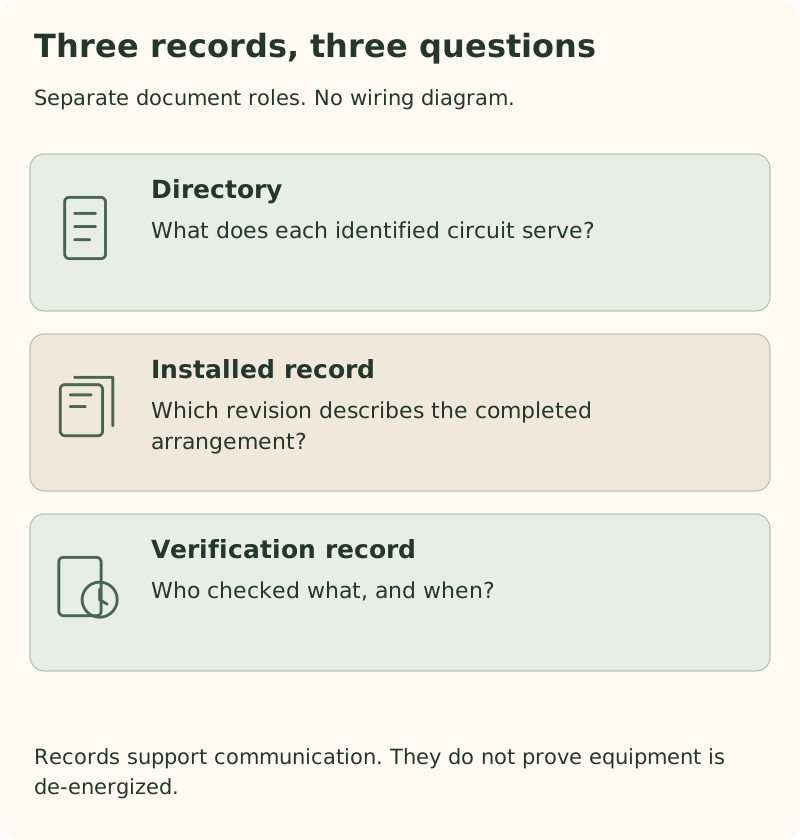
I’d keep this as an owner’s conversation sheet, not a substitute for inspections or an official compliance form.
Spare space needs its own conversation
Suppose I’m considering another air conditioner later. I’d write that proposed equipment into a future-work note and ask for a qualified assessment. I wouldn’t infer electrical capacity from an empty-looking position or a “spare” entry in the directory.
The useful handover answer is what has actually been assessed, what assumptions were used and what must be checked before an addition. If nobody has assessed the future equipment, I’d rather the record say so plainly.
Finally, I’d keep a readable digital copy and a practical offline copy of the handover documents. After electrical changes, I’d ask for the affected records to be updated and older versions clearly marked as superseded.
That’s the result I want: a folder that helps the next conversation start with facts. The electrician can handle the electrical investigation. I can handle retiring the word “Other.”
Sources behind the questions
Research checked 2026-11-08. External source links open in a new tab. Foreign sources explain principles, not Panama project requirements. Local examples do not replace confirmation for the property.
-
Schneider Electric load-center bulletin (opens in a new tab)
Principle or local example only; scope and limitations are explained beside the claim.
-
OSHA electrical work practices (opens in a new tab)
Principle or local example only; scope and limitations are explained beside the claim.
-
ESFI photovoltaic safety (opens in a new tab)
Principle or local example only; scope and limitations are explained beside the claim.