Water Around Air-Conditioning Ducts: Understand the Possible Paths
By Best House Ideas · November 8, 2026
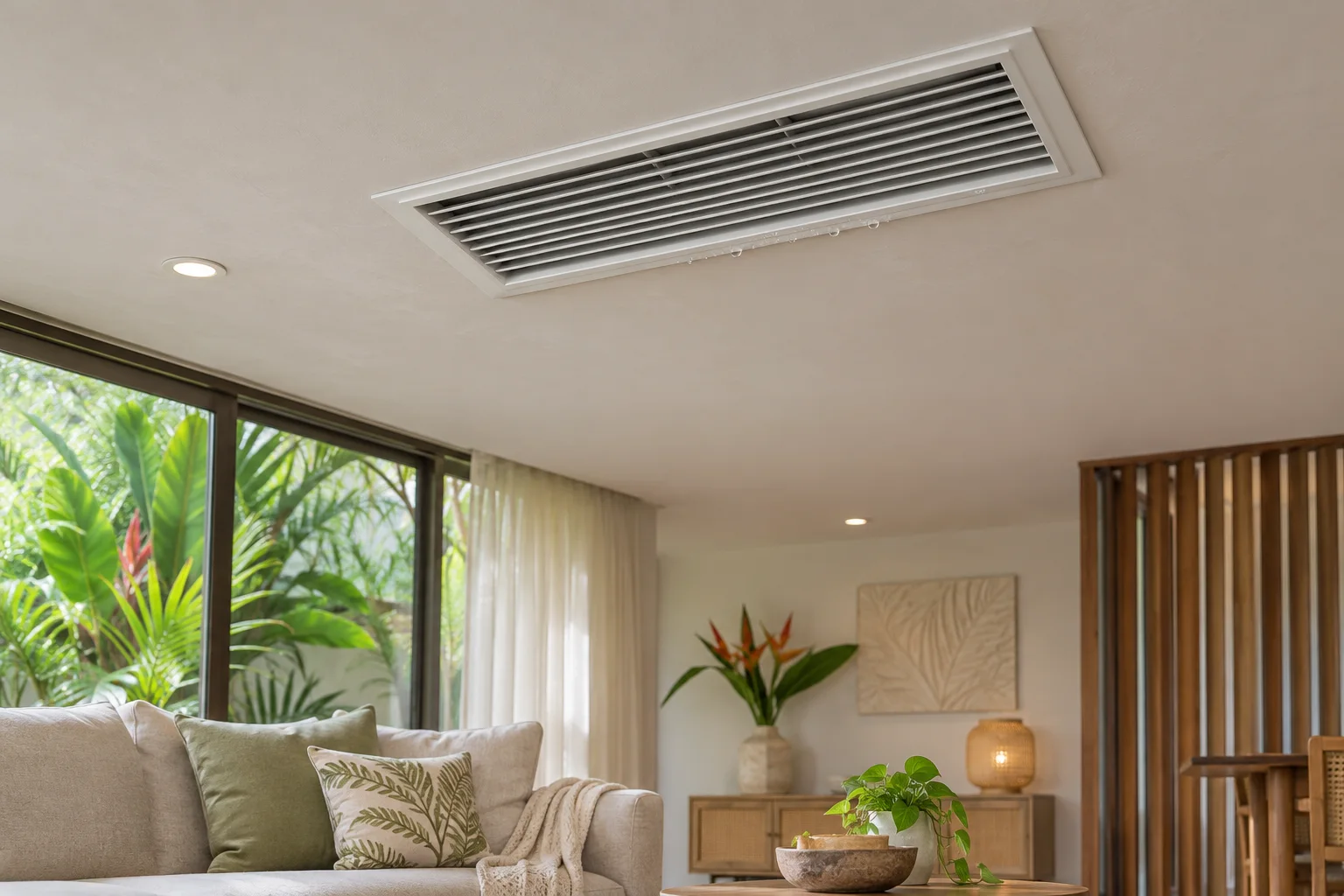
AI-generated illustrative scene of moisture at a ceiling air-conditioning grille, not an actual project or a diagnosis of its source. Not installation guidance.
External sources open in a new tab so you can keep your place.
A wet air-conditioning grille is a location, not a diagnosis. It tells you where water became visible. It does not yet tell you whether water formed there, arrived from equipment or came from another part of the building. Keeping those possibilities separate makes a service conversation more useful than immediately ordering insulation or duct cleaning.
This guide explains mechanisms and helps you record visible conditions from an ordinary, safe occupied area. It is not a troubleshooting procedure or a repair specification. Do not open ceilings, remove duct coverings, enter confined spaces or reach into equipment. A qualified HVAC professional, with other building specialists when necessary, should determine the source and the appropriate response.
Start with the surface and the air beside it
Condensation is water changing from vapor to liquid. It can form when humid air encounters a surface below that air's dew-point temperature. A cooling duct can provide the cold surface; the moisture can come from the air around it rather than from inside the duct. EPA illustrates condensation on an uninsulated air-conditioning duct among common building moisture problems. [1]
Dew point and relative humidity describe different aspects of that condition. Dew point is the temperature to which air would need to cool, at constant pressure, to become saturated. Relative humidity depends on temperature as well as moisture content. A change in relative humidity therefore does not necessarily mean that moisture was added or removed. [2]
The practical distinction is local: the relevant air is the air touching the surface. A bedroom sensor does not establish conditions around a duct in a roof space. Likewise, a weather app describes an outdoor observation or forecast, not the air immediately above a ceiling. Those readings can provide context, but cannot certify that an unseen duct is dry.
Avoid using a single household humidity reading as a pass/fail test. Record its location, time and whether cooling was operating. Leave surface-temperature measurement, sensor interpretation and any investigation outside normally accessible areas to the professional. There is no universal thermostat setting in this article that prevents every condensation problem.
Separate three jobs that can be confused
A duct carries air. Its thermal insulation limits heat transfer. Its vapor-control covering limits moisture movement toward colder parts of the assembly. These are related functions, but they are not interchangeable. DOE/PNNL discusses air sealing separately from insulation and explains why continuity of thermal and vapor protection matters to condensation control in humid conditions. [3]
This helps interpret a proposal. “Add insulation” describes only part of a possible scope. “Seal the duct” also needs clarification: which air path has been demonstrated, and what other conditions were assessed? A visible outer covering cannot establish the condition of everything behind it. An apparently tidy finish is not evidence of satisfactory airflow, moisture control or drainage.
These distinctions do not authorize peeling back coverings or applying a material over a wet surface. Request a finding tied to the actual assembly and equipment. The professional needs to decide whether there is damage, what caused it, and what site-specific work is suitable. Product details and installation methods belong in that professional scope, not in an owner observation checklist.
Air leakage can change the conditions without being a water pipe
Air leakage is movement of air through an unintended path. It can transport water vapor, and it can alter temperatures or pressure relationships. PNNL distinguishes moisture carried by air from bulk liquid-water movement and vapor diffusion through materials. These are different transport mechanisms, even when their visible result is the same damp patch. [4]
EPA's HVAC guidance notes that leakage from supply or return ductwork can contribute to condensation in building cavities or on nearby surfaces. [5] That supports considering air leakage during an assessment. It does not establish that every wet grille has a leaking connection, or that every air leak will produce visible water.
The distinction matters when reporting a draft or a noise. Write down what you actually noticed and when, rather than turning it into “the duct is leaking.” Do not use smoke, flames, powders or improvised pressure tests to hunt for a path. Do not close multiple grilles or change fan settings to try to force the problem to appear.
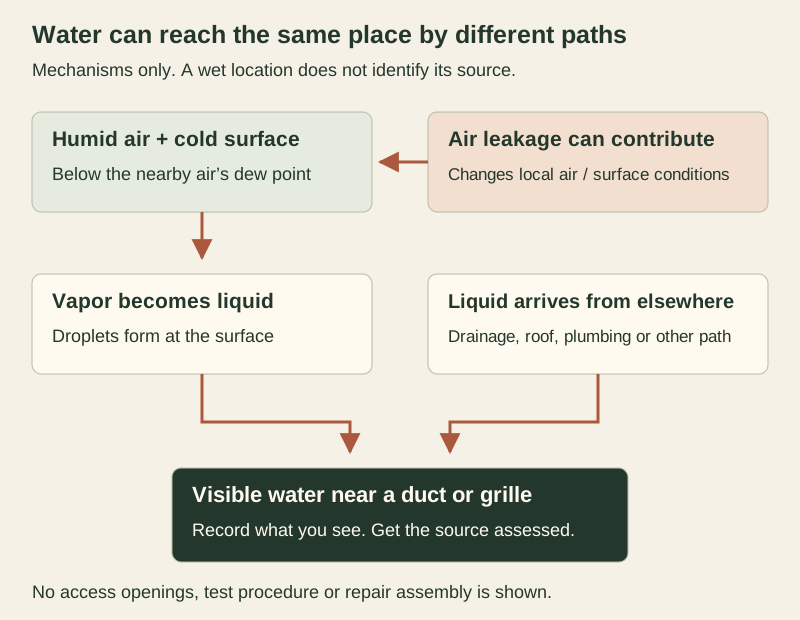
On a small screen, swipe or scroll the diagram horizontally to read every panel.
Original mechanism flow, not a diagnostic decision tree or duct assembly. Arrows distinguish local condensation from liquid arriving by another path. Air leakage can contribute to the conditions for condensation. No hidden route or repair is identified. Sources 1–6.
The arrows show how several mechanisms can converge on one observation. They do not rank the possibilities or identify the cause in a particular house. More than one mechanism may be present, so eliminating one possibility is not automatically a complete explanation.
Keep equipment drainage and other water sources in the picture
Water removed from air during cooling needs an intended collection and drainage route. ENERGY STAR includes condensate-drain inspection in professional maintenance and warns that a plugged drain can cause water damage. [6] Water escaping that route is different from droplets forming on the outside of a cold duct, although both can occur while cooling operates.
Roofs, plumbing and other building water paths also deserve consideration. EPA lists leaking roofs and leaking or condensing pipes among common moisture problems. [1] A stain near a grille is not enough to exclude those alternatives. Give the assessor relevant timing, such as rain or nearby plumbing use, without assuming that coincidence proves the source.
For example, a hypothetical record might say: “At the evening check, droplets were visible on the grille while cooling was operating; the surrounding ceiling looked unchanged from yesterday.” That is useful because it separates observations. “The air conditioner has a blocked drain” would add a conclusion the record cannot support.
Compare mechanisms, not appearances alone
This table is a conceptual comparison based on the sources above. The observation examples are prompts for documentation, not diagnostic signatures. None is sufficient to choose a repair.
Possible water mechanisms and limits of visible evidence
Possible mechanism
What moves or changes
Useful visible context
What the observation cannot establish
Cold-surface condensation
Vapor becomes liquid at a sufficiently cold surface. [1] [2]
Droplets seen on an accessible grille; cooling state and observation time
Surface temperature, nearby dew point or why the surface became wet
Air leakage contributing to moisture
Unintended airflow changes local moisture or thermal conditions. [4] [5]
A previously noticed draft or recurring pattern during normal operation
The leak location, direction, magnitude or a suitable sealing detail
Condensate drainage problem
Water collected during cooling does not follow its intended drainage route. [6]
Water appearing near equipment, observed without opening it
Whether a blockage, damaged component or another condition is responsible
Other building water source
Liquid water arrives through a roof, plumbing or another path. [1]
Timing relative to rain or plumbing use; other visible affected areas
The origin or hidden route of the water
On a small screen, swipe the table horizontally to see every column.
A repair proposal should explain which mechanism was found, how the conclusion was reached and what remains uncertain. If the finding is provisional, ask what further assessment is required before concealing or finishing the affected area.
Make a small observation worksheet
Use one entry per occurrence. The aim is a reliable sequence, not a large set of readings. Do not delay a needed service call while waiting to complete the sheet.
Date, time and exact visible location: ______. Identify the room and surface in ordinary language, such as “ceiling beside hallway grille.”
Appearance from a safe position: ______. Distinguish separate droplets, a spreading wet patch, discoloration and active dripping. Do not touch suspected contamination to identify it.
Normal operating context: ______. Note whether cooling was already running, recently stopped or of unknown status. Record settings only if available through normal user controls; do not change them for the test.
Other context already known: ______. Note recent rain, ordinary nearby plumbing use or a recent service visit. Mark anything reported by someone else rather than observed firsthand.
Optional existing room-sensor reading: ______. Include temperature, relative humidity, device location and time together. Leave blank if no suitable reading is already available.
Comparison with the previous entry: ______. State what is new, unchanged or no longer visible. “Not visible now” is more accurate than “fixed.”
Service contact and next agreed action: ______. Record who will assess it and any safe operating instructions they provide for the actual equipment.
Keep an unedited version of the observations. If a professional later identifies the cause, add that finding with its date rather than rewriting earlier entries as if the answer had been known from the start. This preserves the sequence if conditions recur.
Know when observation should stop
Active water near electrical equipment, a visibly sagging ceiling or an area that cannot be approached safely is a reason to keep clear and obtain urgent appropriate help, not to improve the log. Do not touch wet controls, fittings or wiring, and do not climb into a roof space to follow a stain. Ask the service provider for equipment-specific safe-use instructions.
Persistent wetting also deserves attention even when the amount looks small. EPA emphasizes controlling moisture to limit mold growth; appearance alone cannot reliably establish that a substance in ducts is mold. [7] Avoid scraping, sampling or spraying suspect material as an owner investigation. The needed assessment may extend beyond the visible surface.
Ask the professional to separate source control, assessment of affected materials and verification after work. Cleaning or repainting a visible mark should not become the only documented outcome. Request a clear explanation of what was checked and which remaining conditions would require another visit.
Close the loop with evidence
At follow-up, use the same visible locations and describe normal operating conditions. A dry observation on a different-weather day is encouraging but does not, on its own, prove that the original cause is resolved. Agree with the professional how the result will be checked under relevant conditions and who to contact if water returns.
The humidity observation guide covers broader room patterns. The air-conditioning sizing guide concerns design assumptions and equipment selection. This guide's narrower purpose is to separate possible water paths before a repair is chosen. For physical access planning, see the service-access guide.
A useful service record ends with a supported explanation and an agreed next step. It does not require the owner to become a duct installer or to investigate hidden spaces.
Sources checked November 8, 2026. U.S. sources support general mechanisms, not local code requirements or a diagnosis. School guidance is used only for the airflow/condensation relationship, not residential design specifications. Installation details and numerical criteria in source documents are intentionally not reproduced. The diagram, comparison and worksheet are original educational tools; examples are hypothetical, not reports from a house or project.