Building science · Moisture observations
Humidity in a Tropical House: What to Measure and What to Ask
By Best House Ideas · November 7, 2026
External sources open in a new tab so you can keep your place.
A comfortable temperature does not tell the whole story of a room. If you are concerned about dampness, start by recording what happens, where and when. A few careful observations are more useful than immediately choosing a coating, opening every window or replacing equipment.
This guide helps an owner prepare for a conversation with a qualified professional. It does not diagnose a building from a stain or prescribe a treatment.
Put humidity readings in context
EPA guidance recommends keeping indoor relative humidity below 60 percent, ideally between 30 and 50 percent where possible. Treat these as general moisture-control guidance, not a promise that an open tropical room will maintain those conditions. EPA also explains that humid air can condense when it contacts a cold surface. [1]
| Reference | Value | Conditions and limits | Source |
|---|---|---|---|
| EPA general indoor-humidity guidance | Below 60% relative humidity | General moisture control; a reading alone does not diagnose a building | EPA [1] |
| EPA preferred range where possible | 30–50% relative humidity | Not a guarantee for open-air tropical spaces or a project specification | EPA [1] |
On a small screen, swipe the table horizontally to see every column.
Record temperature in °C and relative humidity in % together. Include the instrument, location, time and operating conditions. A single reading should not be presented as the normal performance of the whole house.
Distinguish the possible moisture paths
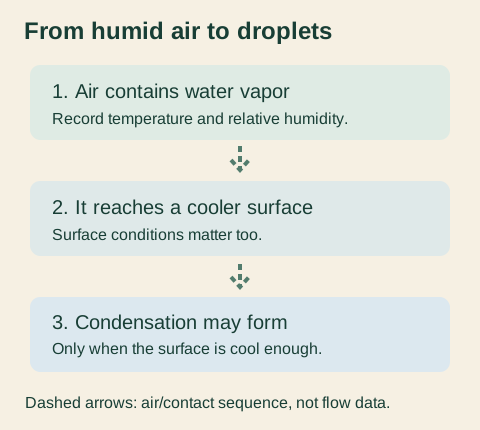
Your Home explains that condensation can occur on visible surfaces or inside building assemblies. In hot-humid climates, humid outside air reaching cooled areas can create a particular concern. The appropriate design depends on the climate, construction and operation. [2]
A wet patch therefore needs investigation, not a confident diagnosis based on appearance. Note whether it follows rain, occurs during cooling operation or seems associated with plumbing use. Those observations can help a professional decide what to inspect; they do not prove a cause.
Do not assume a new coating will resolve an unresolved water source. Ask what evidence supports the diagnosis and how the proposed work addresses it.
Keep a useful observation log
| Date/time | Room or surface | Air temperature, °C | Relative humidity, % | Weather and room operation | Observation |
|---|---|---|---|---|---|
| Not recorded | Not recorded | Not measured | Not measured | Windows, cooling, recent rain or water use | Visible dampness, condensation or odor, if present |
On a small screen, swipe the table horizontally to see every column.
This is a blank record, not an example of measured performance. Include the instrument model and keep photographs dated and tied to the same location. Avoid publishing private household information in a public case study.
If symptoms persist, share the log with the appropriate building or HVAC professional. Ask whether further measurements or inspection are needed before work is specified.
Opening windows is an operating decision
Outdoor air is not automatically drying air. DOE-hosted building-science guidance notes that ventilation can increase indoor moisture when the incoming air contains more moisture than the indoor air. [3] This does not mean windows should always stay closed; it means the right choice depends on conditions and the way the room is designed to operate.
For a cooled room, ask how outdoor air, air leakage, moisture removal and equipment controls work together. For an open room, discuss shade, airflow and the realistic limits of indoor humidity control. Do not switch between those operating patterns without considering the building's moisture design.
Plan for occupied and empty periods
Write down who will notice a leak or persistent dampness when the house is empty. Ask the responsible professionals for an operating and maintenance plan appropriate to the actual equipment and building. Include access for inspection and a clear contact if something changes.
The goal is a record that leads to a sound decision. No universal humidity reading, coating or ventilation habit can replace understanding the source and the assembly.
Read choosing a tropical roof, review pre-build planning questions, or explore Arthur's projects.