Field notes · Exterior care · Material matters
Brick, Stucco or Fiber Cement: What Will I Actually Be Maintaining?
A handsome wall deserves a useful care conversation.
For entertainment and general understanding. These illustrations and questions are not a construction specification or a legal, engineering or site-specific professional assessment.
I like a handsome wall. I like it even more when its future care involves something more useful than “just give it a wash.” Before choosing an exterior finish, I would ask the supplier to walk me through an ordinary dirty patch, a damaged joint and a repair that needs to match. That little conversation can reveal more than a large display of spotless samples.
My whole-wall comparison explains what sits behind the appearance. Here I want to look at ownership: which parts need attention, what a repair might involve, and why a tube of sealant is not a universal peace treaty with the weather.
The examples below concern fired-clay brick, cement-plaster stucco and named exterior fiber-cement products. They are educational references from North American organizations and manufacturers, not Panama approvals or a maintenance specification for your house.

First, give the wall a proper name
“Fiber cement” is a family name. Ask for the manufacturer, exterior product, profile, finish and applicable market documentation. A factory-finished plank and a primed product painted on site need an accurately identified finish record. James Hardie's FAQ distinguishes primed products from its ColorPlus finish and describes dedicated touch-up products. That is a useful example of why the finish belongs in the paperwork. James Hardie product FAQ (opens in a new tab)
I would keep a small wall passport: product label, finish name, installer, installation date if known, care document and photos of the completed appearance. Add the paint information if painting was part of the work. Nothing glamorous here, but “the cream-colored one” is not a particularly good purchasing specification five years later.
For stucco, establish the existing coating and substrate as well as the plaster. For brick, establish whether the proposal is fired-clay anchored veneer rather than concrete brick or thin adhered brick. Similar photographs do not make the care instructions interchangeable. BIA expressly limits its technical guidance to fired-clay brick. BIA technical-note scope (opens in a new tab)
The fiber-cement joint I would leave alone
Here is a specific example worth pausing over. James Hardie's June 2014 Technical Bulletin 9 discusses its lap siding. It advises against caulk at HardiePlank ColorPlus butt joints and against caulking horizontal overlaps. The bulletin explains that sealing those overlaps can interfere with drainage and drying. Hardie Bulletin 9 (opens in a new tab)
That does not mean every joint on every fiber-cement wall should remain unsealed. It means the joint's job must be identified before someone changes it. A plank end, a panel joint, a trim interface and a penetration are different questions. The cited bulletin is an older manufacturer example, not the current specification for an unidentified wall.
My question for the installer would be: “Show me which joints use sealant, which have another treatment, and which openings must remain clear under the applicable instructions.” Have that answer tied to the exact product and reviewed project details. I would want the same explanation passed to a future painter or maintenance contractor.
If an existing joint looks different from the document, ask for assessment. Don't excavate it to discover what is behind it. The useful owner action is to flag the discrepancy, not improvise a new wall detail.
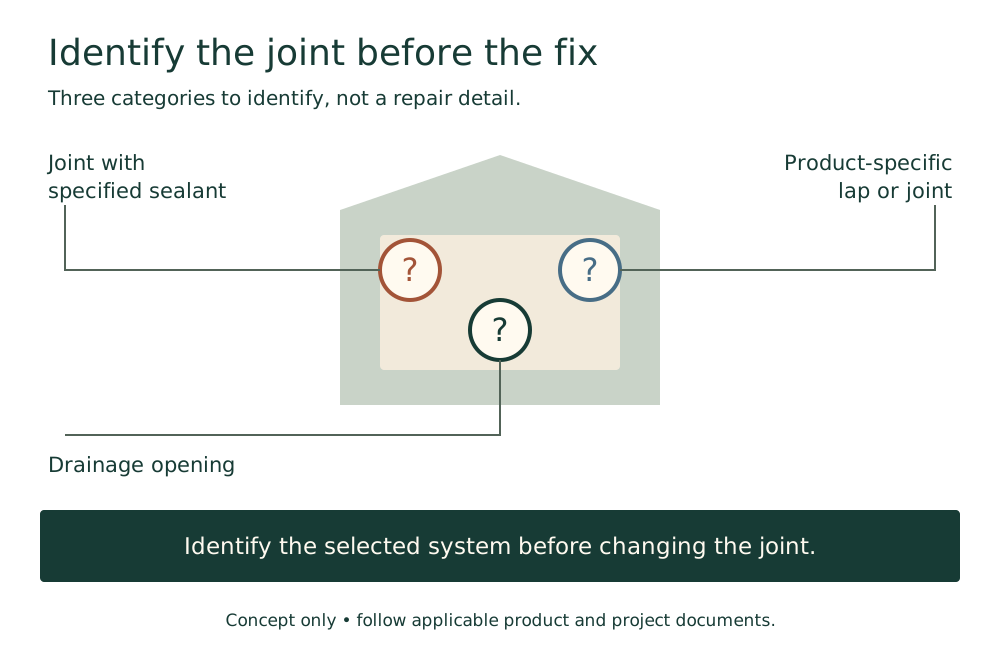
Identify the joint before the fix
Three categories to identify, not a repair detail.
Identify the selected system before changing the joint.
-
Joint with specified sealant
Confirm the applicable product and project instructions.
-
Drainage opening
Identify its function before altering it.
-
Product-specific lap or joint
Ask what the selected system requires.
Concept only • follow applicable product and project documents.
Exposure changes the care conversation
One side of a house can face a different set of conditions from another. I would mark the elevations on a simple sketch and ask about the actual exposure: sheltered areas, vegetation, irrigation, nearby dirt and any coastal conditions. These are questions for the selected product's supplier, not reasons to invent a cleaning schedule.
Hardie's November 2018 cleaning bulletin explicitly links maintenance to geography, exposure and finish type. It separates different surface contaminants and warns that improper cleaning can affect warranty coverage. Its treatment of ordinary dirt is not a license to use the same chemical on every stain. Hardie Bulletin 20 (opens in a new tab)
Before a contractor cleans the whole elevation, I would want the current product instructions, the identified finish and an agreed discreet trial area. Ask what appearance change is acceptable and how surrounding materials will be protected. No universal detergent, pressure-washer setting or calendar interval belongs in that conversation before the wall is identified.
Compare the work, not the promise
This is a qualitative ownership comparison. The practical questions are my planning prompts, not a ranking of durability or total cost.
| Exterior | Maintenance attention | Repair discussion | What I would ask before choosing |
|---|---|---|---|
| Fired-clay brick masonry | Mortar condition, sealants, drainage openings and persistent moisture signs | Compatible mortar and replacement brick; cause of distress before cosmetic work | Who can assess the masonry and provide a convincing repair sample? |
| Cement-plaster stucco | Cracks, loose or deteriorated areas, sealant interfaces and any coating | Cause and movement of cracking, compatible repair material, finish match | Will the repair address the cause, and what area must be refinished? |
| Named fiber-cement siding | Finish condition, damaged boards and product-specific joint treatments | Correct replacement profile, finish and approved treatment of affected interfaces | Can the exact product and finish still be sourced, and who checks the adjoining details? |
The brick and stucco entries draw on BIA's maintenance note (opens in a new tab) and IMI's stucco restoration guidance (opens in a new tab). The fiber-cement entry combines the Hardie documents above with owner questions; it does not claim that every brand shares those details.
Brick has more to inspect than the bricks
BIA's maintenance guidance covers mortar, sealants, weeps and replacement of damaged units. It calls for investigating moisture sources before repairing water penetration, and flags persistent efflorescence for scrutiny. White deposits are therefore a reason to ask a question, not automatically order a coating. BIA Technical Note 46, December 2017 (opens in a new tab)
I would ask a mason to separate appearance work from repairs to the wall's function. “Refresh the joints” is vague. Which joints are deteriorated? What material is appropriate? Will a sample establish the expected color and texture? Keep the quotation clear about those answers and about access to the work.
Leave drainage openings alone until the wall's arrangement is understood. A small opening can be intentional. Making every visible gap disappear might please the photograph while upsetting the wall.
Stucco needs a diagnosis before a makeover
IMI explains that stucco damage can have different causes, including bond problems and corrosion of supporting lath. Crack repair depends partly on whether movement continues. It also cautions that some coatings can restrict drying and that new coatings must be compatible with what is already there. IMI stucco restoration (opens in a new tab)
So I would not select a repair from the width of a crack in a phone photo. Ask the qualified assessor what was found, what remains uncertain and whether a local repair or broader work is justified. A repair sample should address texture as well as color. Sunlight is very good at finding the patch everyone promised would disappear.
Make future care part of the purchase
Before committing, I would request three concrete things: the applicable care documents, an explanation of likely repair work, and a local contact capable of doing it. Ask whether matching material is available and how professional access will work after landscaping is finished. Keep warranty exclusions separate from any sales promise about low maintenance.
For an older or unidentified wall, get suitable professional assessment before disturbing it. Appearance alone does not identify its composition. Cutting, sanding, drilling, demolition and hazardous-material assessment are outside this guide. Loose cladding or suspected instability warrants keeping people clear and obtaining qualified help.
My preferred exterior would be the one whose care I can understand and realistically arrange. The sample earns its place on the mood board. The maintenance explanation earns its place on the house.
Sources checked November 8, 2026. Older dated documents illustrate product-specific distinctions; confirm the applicable current instructions locally. No service-life, maintenance-frequency or universal performance ranking is implied.
Sources behind the questions
Research checked 2026-11-08. External source links open in a new tab. Foreign sources explain principles, not Panama project requirements. No illustration establishes the performance of a real house.
-
James Hardie product FAQ (opens in a new tab)
Principle or local example only; scope and limitations are explained beside the claim.
-
BIA technical-note scope (opens in a new tab)
Principle or local example only; scope and limitations are explained beside the claim.
-
Hardie Bulletin 9 (opens in a new tab)
Principle or local example only; scope and limitations are explained beside the claim.
-
Hardie Bulletin 20 (opens in a new tab)
Principle or local example only; scope and limitations are explained beside the claim.
-
BIA's maintenance note (opens in a new tab)
Principle or local example only; scope and limitations are explained beside the claim.
-
IMI's stucco restoration guidance (opens in a new tab)
Principle or local example only; scope and limitations are explained beside the claim.