Field notes · Before the work begins
A Damp Wall Deserves Better Than a Fresh Coat of Guesswork
A wall mark deserves a clearer question before a new color.
For entertainment and general understanding. These illustrations and questions are not a construction specification or a legal, engineering or site-specific professional assessment.
I can understand the temptation. There is an ugly mark on a wall, and the paint shop offers several attractive ways to stop looking at it.
Before choosing a color, I would want someone to answer a less decorative question: where is the moisture coming from?
That answer might involve the outside of the house, the ground beside it, plumbing, room conditions, or more than one of those. My useful contribution would be a clear record for a qualified building professional. The wall does not need me arriving with a drill and a detective hat.
This is an owner’s assessment brief, not a diagnosis or a repair recipe. I would arrange help promptly for active leaks, recurring dampness or suspected mold, rather than wait to complete every box below.
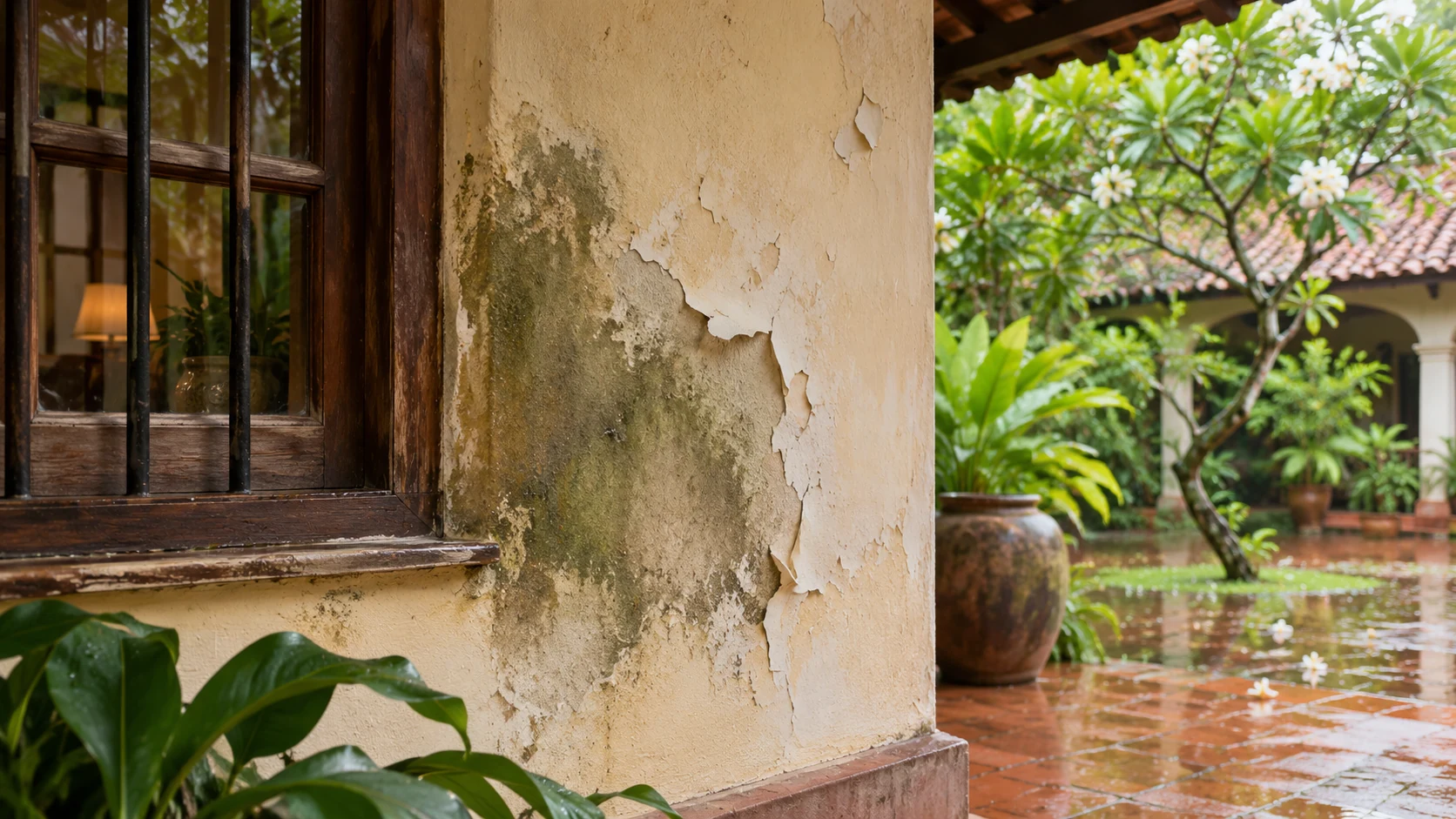
Start with the whole wall
A mark is something to record. Its outline does not give me permission to name the cause.
Historic England’s 2026 guidance explains that diagnosis becomes more complicated when several moisture sources are involved. It asks professionals to consider construction, location, services, maintenance and use together. That guide concerns historic buildings in England, so I am borrowing its careful approach, not applying its repair details to a modern tropical house. Historic England: assessing damp (opens in a new tab)
I would give the assessor a simple room sketch with the affected wall marked. Add what is on the other side, if known: a bathroom, outdoor paving, a garden bed, another room. Include existing plans and old repair records. Write “unknown” where the construction is unknown.
I would also ask who should coordinate the investigation. A building-envelope specialist, plumber and cooling professional may answer different parts of the same question. I want their findings to meet in one explanation, rather than receive three separate offers for three separate guesses.
Give the ground its own conversation
Ground moisture deserves more than a quick glance at the skirting.
Water can move upward through porous materials by capillary action. The Society for the Protection of Ancient Buildings describes this as rising damp, while warning that it is frequently misdiagnosed in old buildings. I would not label a low patch “rising damp” from a photograph or a meter reading. SPAB: what rising damp means (opens in a new tab)
There is also the broader ground-and-foundation question. Rain reaches the surrounding land; water can accumulate near a building; below-ground construction has to manage the conditions beside it. EPA’s moisture guide discusses site drainage, foundations and interruptions to capillary movement as connected design concerns. This is US guidance, published in 2013, rather than a Panama foundation specification. EPA moisture-control guide, official text edition (opens in a new tab)
From an ordinary, safe ground-level position, I would note visible standing water, recent landscaping, new paving, irrigation changes and where downpipes appear to discharge. Those are observations to share, not instructions to excavate, lower ground levels or alter drainage.
My question for the assessor would be: “What do the actual ground, floor and wall arrangements tell you, and what remains concealed?” A drawing showing a moisture barrier is useful background. Whether that drawing matches the house is a separate question.
Keep four possibilities open
Here is the conversation table I would bring. It is deliberately organized around evidence to discuss, rather than stains to identify.
| Possible source | What I can record safely | What I would ask the professional |
|---|---|---|
| Rain entry | When rain occurred; which accessible areas changed afterward | Which roof, opening, wall and rainwater-disposal interfaces need assessment? |
| Ground-related moisture | Visible surface water; known changes to paving, soil or irrigation | How do site conditions connect to the actual foundation and wall? |
| Plumbing or drainage | Known leaks, repairs and ordinary water-use timing | Which services need qualified investigation, including concealed routes? |
| Condensation | Cooling and window use; when visible droplets or dampness appear | What air, surface and assembly conditions need checking? |
The joint RICS, Historic England and PCA investigation statement includes external, internal, ground, services and drains among relevant moisture sources. EPA explains that condensation occurs when humid air reaches a sufficiently cold surface. Neither principle tells us which source explains a particular mark. Joint investigation principles (opens in a new tab) · EPA condensation explanation (opens in a new tab)
I would keep ordinary operation ordinary. No hose experiments, deliberate flooding or changing several room conditions to see what happens. The professional can decide whether controlled investigation is needed.
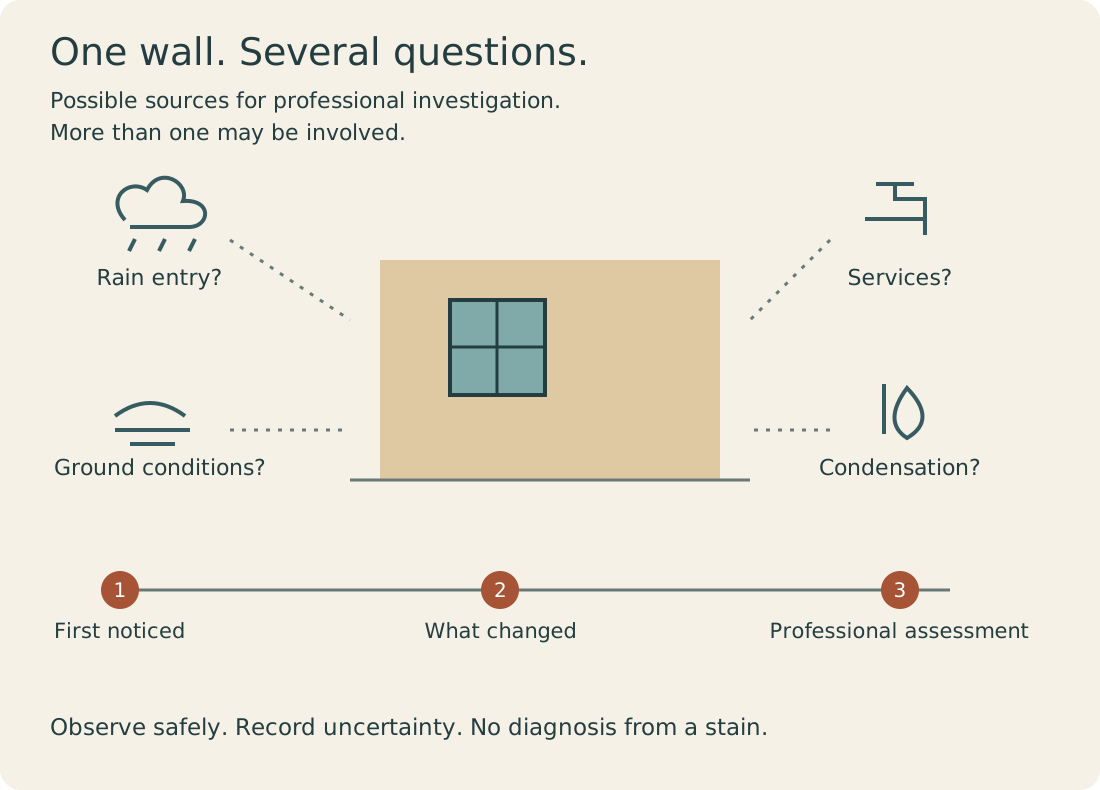
One wall. Several questions.
Possible sources for professional investigation.
More than one may be involved.
-
Rain entry?
A possibility for professional investigation.
-
Ground conditions?
A possibility for professional investigation.
-
Services?
A possibility for professional investigation.
-
Condensation?
A possibility for professional investigation.
- First noticed
- What changed
- Professional assessment
Observe safely. Record uncertainty. No diagnosis from a stain.
Make a small timeline, not a courtroom drama
My record would have a date, location, photograph reference, weather note, room-use note and a plain description of what I saw. “Mark looked darker after overnight rain” is useful. “Roof definitely leaking” jumps ahead of the evidence.
Take an overview and a closer photograph from safe accessible positions. Give the location a consistent name so next week’s picture can be compared with this week’s. Avoid pressing on finishes, moving heavy furniture or opening cavities to improve the photograph.
I would include the first date I noticed the problem, even if the actual start date is unknown. Then list changes: repainting, window work, a plumbing repair, new cooling equipment or alterations outside. Separate “contractor reported repaired” from “professionally checked afterward.”
An absence can be worth recording too: “Not observed during this visit” is more honest than “gone.” I would keep this brief enough that somebody will actually read it.
Ask what a moisture number means
I would want measurements interpreted, not simply announced.
Historic England explains that electrical resistance readings in masonry do not have the straightforward relationship to moisture content that people might expect. Salts can influence readings; other meter methods can be affected by material properties. Some instruments display a reference scale rather than an actual percentage of moisture in that wall. Historic England, measurement methods, printed pages 46–47 (opens in a new tab)
So my questions would be simple: Which instrument and method were used? What material was assessed? What does the displayed number represent? What can it establish, and what can it not establish?
I would also ask how room-air readings relate to the material investigation. A humidity reading describes the air at that place and time; it should not quietly become a conclusion about the entire wall. Any further testing, sampling or opening belongs with the appropriate professional and an agreed scope.
Leave the paint decision until the explanation makes sense
A new surface cannot tell me whether the water arrived through a roof junction, from the ground, from plumbing or through condensation. That is why I would ask for the diagnosis before approving a cosmetic solution.
If mold is present or suspected, I would seek appropriate professional advice and avoid disturbing concealed areas. EPA warns that hidden-mold investigation can release spores and that correcting the water problem matters to preventing recurrence. This is no place for a homemade chemical recipe or a claim that a small-looking patch is harmless. EPA guide to mold and moisture (opens in a new tab)
The report I would want separates observations, likely causes, uncertainties, proposed action and follow-up. Ask what will be checked after the work and what would trigger another investigation. The joint investigation statement supports addressing causes and reassessing in stages where appropriate. Joint diagnosis and reporting principles (opens in a new tab)
Then the color samples can return. I would much rather argue about whether “warm white” looks slightly yellow than pay for the same mystery in a different shade.
General information and an original owner-planning worksheet. Foreign sources explain principles, not local approvals or a diagnosis of your house. Sources checked November 8, 2026.
Sources behind the questions
Research checked 2026-11-08. External source links open in a new tab. Foreign sources explain principles, not Panama project requirements. No illustration establishes the performance of a real house.
-
Historic England: assessing damp (opens in a new tab)
Principle or local example only; scope and limitations are explained beside the claim.
-
SPAB: what rising damp means (opens in a new tab)
Principle or local example only; scope and limitations are explained beside the claim.
-
EPA moisture-control guide, official text edition (opens in a new tab)
Principle or local example only; scope and limitations are explained beside the claim.
-
Joint investigation principles (opens in a new tab)
Principle or local example only; scope and limitations are explained beside the claim.
-
Historic England, measurement methods, printed pages 46–47 (opens in a new tab)
Principle or local example only; scope and limitations are explained beside the claim.
-
EPA guide to mold and moisture (opens in a new tab)
Principle or local example only; scope and limitations are explained beside the claim.