Comfort · Occupied spaces
Ceiling-Fan Planning: Start With the People, Not the Room Center
By Best House Ideas · November 7, 2026
External sources open in a new tab so you can keep your place.
The middle of a ceiling is easy to mark on a plan. It may not be where someone reads, sleeps or works. Start a ceiling-fan brief with those occupied positions, then have the designer and installer assess the room, fan and mounting arrangement together.
This is a selection and coordination guide, not an installation procedure or a recommended fan size. The examples explain what to ask; they do not establish product availability, electrical suitability or compliance in Panama.
Be clear about the job
ENERGY STAR explains that ceiling fans cool people through air movement rather than lowering the room's temperature. For ordinary occupant cooling, it recommends turning the fan off when the room is empty. [1] A fan running all afternoon in an unused bedroom should not be assumed to have pre-cooled that room for bedtime.
Keep the fan's comfort role distinct from the house's ventilation, moisture control and air-conditioning arrangements. Ask the services designer how they work together. Do not treat a ceiling fan as a guaranteed substitute for cooling during dangerous heat or as evidence that the room's humidity problem has been solved.
The tropical cooling guide is the starting point for deciding how each room operates. The fan brief should support that decision rather than quietly change it.
Mark the occupied places
On the furnished plan, mark the bed, reading seat, desk and dining positions that matter. Add the hours of use and any place where someone does not want strong air movement. A household may want a gentle setting for sleep and a different setting for a lively afternoon room.
UC Berkeley's Center for the Built Environment developed its fan-design tool from laboratory measurements to assess airspeeds for combinations of fans and rooms. Its layouts account for conditions beyond a decorative center point. [2] This supports asking for a room-and-occupant assessment rather than assuming that a catalog photograph demonstrates coverage.
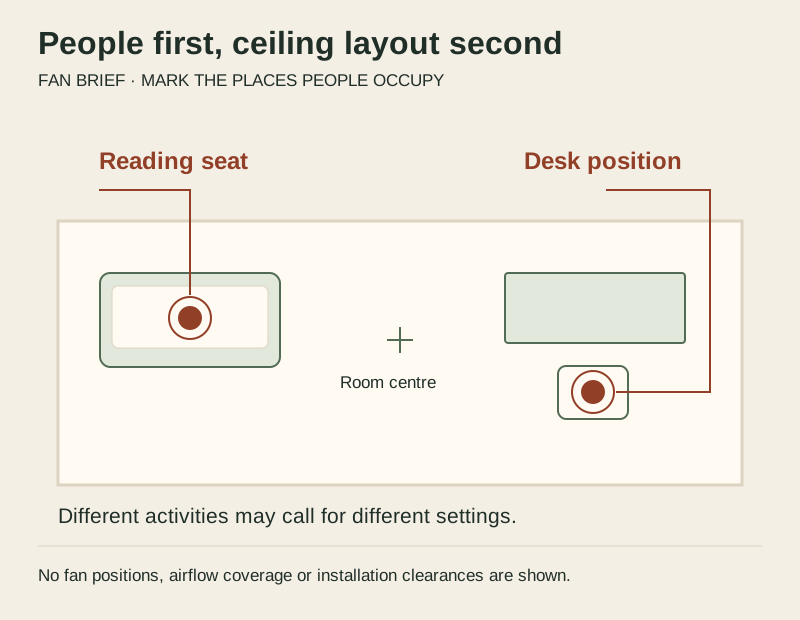
The diagram marks questions to investigate, not a fan location or an airflow map. Ask the designer what evidence supports the proposed arrangement and what has not been evaluated. A result from a design tool is also not a measurement from the finished room.
Read airflow and efficiency separately
Airflow indicates how much air the fan moves under the stated test conditions. Efficiency relates airflow to electrical input. ENERGY STAR defines its ceiling-fan efficiency metric as a weighted measure across speeds and standby, expressed in cubic feet per minute per watt, or CFM/W. [3]
Ask for the exact model's documented airflow, power and efficiency information, including the operating settings and test basis. Do not compare one fan's maximum airflow with another fan's low-speed value as though they describe the same condition. A single headline number does not answer how the selected fan will feel at the desk or bed.
Keep any light kit's information separate enough to understand what the numbers include. Ask the supplier to explain ambiguous labels rather than filling in missing data with assumptions. No specific model is recommended here.
Pay attention to the lowest useful setting
A powerful maximum setting is not the whole control range. CBE's fan guide notes that a fan whose minimum speed is still high may create unwanted drafts for people directly below it, while more usable low-speed control can help suit different conditions. [4]
For a bedroom or desk, ask about the lowest setting as well as the highest. If possible, assess a suitable demonstration at comparable settings and note its limits: a showroom with different dimensions, mounting and background noise is not your completed room.
Discuss where controls will live and who can use them. Can someone adjust the fan from the bed or normal seat? What happens if a remote is misplaced or an internet connection is unavailable? Have the supplier identify the actual control options and compatibility before the electrical plan is finalized.
Match the rating to the exposure
An outdoor-looking finish is not an exposure rating. Hunter's guidance, for example, distinguishes damp-rated fans protected from direct water exposure from wet-rated fans intended to handle direct rain. [5] That manufacturer example does not confirm the suitability of an unspecified model at a particular veranda.
Ask the supplier and qualified installer to assess the actual location, including whether wind-driven rain can reach the fan. Obtain the chosen model's instructions and applicable rating. For a coastal site, ask separately about corrosion, maintenance and warranty conditions; a water-exposure label alone does not answer every durability question.
Use the veranda planning guide to keep the seating, screens and normal use in the same discussion. Do not generalize a covered-room assumption from a roof outline without reviewing the actual exposure.
Compare complete proposals
The following original worksheet organizes a supplier and design meeting. Record an answer and its supporting document for each serious option. An unanswered field should stay open, not become a favorable score.
| Review item | What to compare | Question for the responsible person |
|---|---|---|
| Occupied locations | Furnished plan and times of use | Which seats or sleeping positions were assessed? |
| Performance information | Exact model, settings and test basis | Are airflow, power and efficiency being compared consistently? |
| Speed and controls | Lowest useful setting and control options | Can the occupants adjust it in normal use? |
| Exposure | Product rating and actual location | Is this specific model suitable for these conditions? |
| Installation coordination | Ceiling, structure, lighting and other equipment | Who has checked mounting, clearances and compatibility? |
| Ownership | Instructions, service access and local support | Who will clean, service or replace it safely? |
On a small screen, swipe the table horizontally to see every column.
Coordinate before buying, then verify normal use
Have qualified professionals determine the mounting, electrical supply, clearances and compatibility of the selected product. Include nearby lights, doors, tall furniture and other ceiling-mounted equipment in their review. Do not use a generic article's dimensions or an existing light fitting as proof that a fan can be installed there.
Ask how cleaning and servicing will be carried out safely. The service-access guide helps organize those questions before finishes are fixed. The owner should not need to improvise access, alter blades or open electrical equipment to make a new installation usable.
At handover, ask the installer to demonstrate the intended controls and settings, provide the actual manual and identify the support contact. Record unresolved noise, vibration or operating concerns for the installer to assess rather than attempting a repair yourself.
The useful outcome is a coordinated choice: appropriate for the location, supported by comparable information and controllable by the people who will use it. Appearance still matters, but it should not be the only part of the decision that has been checked.
Sources and further reading
- ENERGY STAR, Ceiling Fan Installation and Usage Tips
- UC Berkeley CBE, Advanced Ceiling Fan Design Tool Research
- ENERGY STAR, Ceiling Fans Key Product Criteria
- CBE, Fans for Cooling People Guidebook, Ceiling Fans and Speed Control
- Hunter, Wet-Rated Versus Damp-Rated Fans
Sources checked November 7, 2026. Manufacturer guidance is an example, not a product endorsement or confirmation of local availability. The diagram and worksheet are original planning tools, not airflow measurements, mounting instructions or a comfort guarantee. Use the exact product instructions and qualified local installation advice.