Materials · Coastal roof documents
Coastal Roof Warranties: Check More Than the Number of Years
By Best House Ideas · November 7, 2026
External sources open in a new tab so you can keep your place.
A long warranty headline is a poor starting point for a coastal roof comparison. First establish whether the proposed product and installation qualify at the actual site. Then read what failure is covered, what remedy is offered, what conditions apply and who will issue the final document.
This guide is a document-review brief for an owner and project team, not a product recommendation or legal interpretation. The manufacturer examples come from Australia and the United States. They illustrate questions to ask; they do not establish availability or warranty coverage for a house in Panama.
Identify exactly what is being offered
Ask the supplier to identify the manufacturer, panel product, base material, coating or finish, color and intended application in the quotation. Keep the corresponding technical sheet and warranty version with that offer. “Metal roof with a long warranty” leaves too much unspecified for a useful comparison.
McElroy Metal cautions that a longer warranty period does not, by itself, establish better performance. Its finish discussion also distinguishes film integrity from fading and chalking: a coating can remain attached while its appearance changes. The owner therefore needs the covered condition and its limits, not just the largest number printed on the brochure. [1]
Keep the broader tropical roof selection decision separate. A warranty review does not establish structural suitability, wind performance, thermal comfort, sound control or a complete weatherproof design. Ask the appropriate professionals to resolve those questions for the proposed assembly.
Ask how this site is classified
Send the supplier a clear description of the actual project location and ask for written confirmation of the proposed product's eligibility there. Have the responsible professional supply the exposure information required by the manufacturer. A generic assurance that a product is suitable “near the sea” does not identify the conditions behind that assurance.
COLORBOND's Australian marine-selection guidance, for example, distinguishes exposure conditions and notes that local wind and unwashed areas affect performance. It also explains the basis used for measuring distance from the water. Those are product-specific rules, not distances that can be copied into another manufacturer's specification. [2]
Ask the supplier to identify which current document supports its answer and whether any site assessment or written acceptance is still outstanding. If the supplier cannot confirm the actual location, mark eligibility as unresolved. Do not silently turn an unresolved answer into a comparison-table “yes.”
Separate the promises being compared
Read each document under its own heading. Use these as questions to organize the review, rather than assuming every roof package provides all four kinds of protection:
- Finish: Which changes in appearance or coating condition are covered, and how are they assessed?
- Base material: Is there separate coverage for the underlying metal, and what event triggers it?
- Weathertightness: Is any protection against specified leaks offered for the installed system?
- Workmanship: What written responsibility does the installing contractor accept, and under which agreement?
McElroy's weathertightness program demonstrates why leak coverage needs its own review. It describes project-specific acceptance, drawing review, inspection and final-issuance steps. A finish document is not evidence that those separate steps have occurred or that the installed roof has the same coverage. [3]
Ask who receives a claim, who investigates and which party must respond under each document. Have the supplier or a suitable adviser explain unclear terms. Do not assume the manufacturer, distributor and installer are interchangeable just because all three names appear in the project file.
Make maintenance feasible before ordering
Ask for the maintenance instructions that apply to the exact product and exposure. Then ask how that work will be carried out safely at this house, who can provide it and what records the owner should retain. Include the likely service arrangement in the budget before comparing purchase prices.
COLORBOND's maintenance guidance distinguishes surfaces washed by rain from sheltered areas such as those under eaves and on gutter undersides. This is a useful warning against assuming that a rainy climate automatically provides every part of a roof assembly with the care its manufacturer requires. Follow the applicable product instructions rather than borrowing a cleaning interval or method from another product. [4]
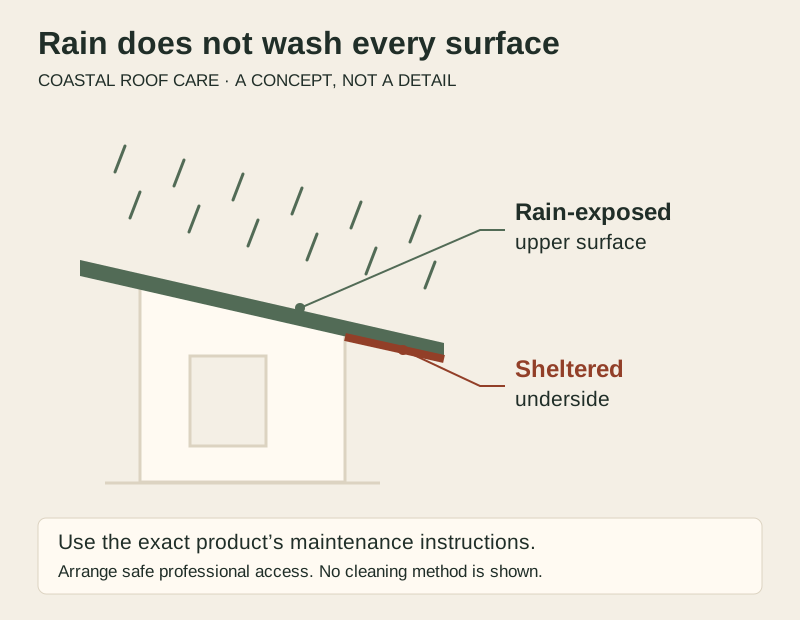
The illustration is a concept, not a maintenance procedure. Do not climb onto a roof or reach into unsafe areas to complete a record. Ask a qualified service provider to address access and provide the documentation needed for the agreed maintenance plan.
Use a warranty comparison worksheet
Keep a separate row for each proposed product or system in your working comparison. Attach the documents and written answers; do not reduce a qualification to a tick box without retaining the explanation. The questions below are an editorial review aid, not a statement that any particular warranty contains these provisions.
| Review item | Question for the supplier or adviser | Evidence to retain |
|---|---|---|
| Product and place | Does this exact offer qualify at this actual site? | Product identification and written site response |
| Covered event | What must happen before a claim can be considered? | Applicable wording and any assessment criteria |
| Remedy and limits | What would be provided, and which costs or losses remain outside it? | Remedy, liability and exclusion clauses |
| Responsibilities | Which party handles each type of issue? | Named manufacturer, supplier and installer contacts |
| Care and changes | What upkeep or later alterations affect the terms? | Current maintenance and modification instructions |
| Issuance and claims | What deadlines, registrations, signatures or notices apply? | Required steps, responsible person and final documents |
On a small screen, swipe the table horizontally to see every column.
For example, ask whether an offered remedy addresses material only or also particular labor and access costs. Ask whether transfer to a later owner requires a process. These are questions to resolve in the actual wording, not promises of coverage. If an answer affects the buying decision and remains unclear, get it explained before proceeding.
Distinguish a sample from issued coverage
A downloadable sample can help compare terms. It does not, by itself, establish that a warranty has been issued for your project. Ask early who is responsible for applications, records, inspections and any final paperwork, and add those tasks to the purchasing and construction schedule.
PAC-CLAD's finish-warranty request process illustrates the importance of the purchasing trail: it asks for manufacturer invoice information and identifies requirements involving the purchasing customer. McElroy's separate weathertightness process includes inspection documentation before final issuance. The practical lesson is to obtain the actual process for the selected offer rather than wait until handover to discover it. [5] [3]
Keep the quotation, order, delivered-product identification and issued documents consistent. If someone proposes a substitution, ask the supplier and designer to review the warranty implications before accepting it. Record the decision in the construction change record, including any unanswered eligibility or document questions.
Build a small, usable roof record
At closeout, request the documents promised in the purchase and installation agreements. Label each file by product, project and date so that a future owner or service provider can find the right version. A folder of unrelated brochure downloads is less useful than a short index pointing to the actual documents.
- Keep the accepted product description and the supplier's site-specific response.
- Separate sample terms, application records and final issued documents.
- Save the installed-product identification and the responsible parties' contact details.
- Include applicable care instructions and service records as work is completed.
- Record unresolved paperwork as open work rather than marking the folder complete.
Keep these with the house handover records. If a problem appears, use the applicable reporting instructions and seek qualified assessment rather than improvising a repair that could obscure the issue or create a safety risk.
A useful comparison ends with a clear description of what is eligible, covered, excluded and still conditional. Only then does the term length become meaningful. The aim is an informed purchase and a manageable ownership plan, not the most impressive number on a quotation.
Sources and further reading
- McElroy Metal, Finish and Substrate Warranties
- COLORBOND, Choosing Products for Marine Exposure
- McElroy Metal, Weathertightness Warranties and Process
- COLORBOND, Maintenance
- PAC-CLAD, Finish Warranty Request
Sources checked November 7, 2026. Manufacturer examples illustrate document-review questions, not product recommendations or confirmation of eligibility in Panama. Terms can change; obtain the current documents for the exact offer. The diagram and worksheet are original editorial tools, not installation details, legal advice or a project warranty.