Building science · Roof decisions
Choosing a Roof for a Tropical House
By Best House Ideas · November 7, 2026
External sources open in a new tab so you can keep your place.
A roof choice becomes clearer when you compare the whole installed system. The outer covering is only one part of the decision. Ask how the proposed roof will handle heat, rain, moisture, maintenance and access to equipment over the life of the house.
Start with the rooms below it. An open veranda and an air-conditioned bedroom should not be treated as identical situations. Give the designer that operating brief before selecting a covering from a catalogue.
Read the heat-performance information
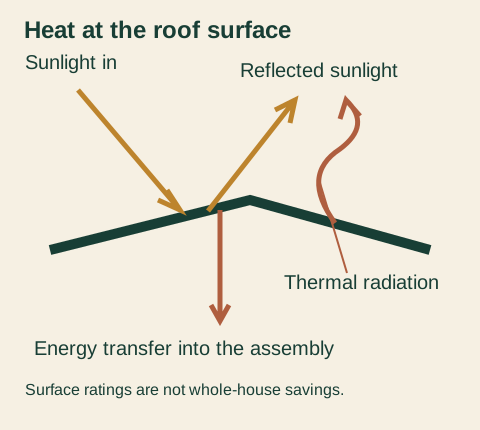
The U.S. Department of Energy distinguishes solar reflectance, the fraction of sunlight reflected by a surface, from thermal emittance, how effectively the surface releases thermal radiation. Both are relevant to a cool-roof discussion. [1]
Ask for documented product ratings rather than judging by appearance alone. DOE notes that unpainted metal can have high reflectance but low thermal emittance. Its guidance also discusses how dirt and biological growth can affect reflectance and why cleaning should follow the manufacturer's instructions. [2]
| Property | What it tells you | What to record for a fair comparison | Source |
|---|---|---|---|
| Solar reflectance | How much incident sunlight the surface reflects | Product, color, reported value and test basis; distinguish initial from aged values if supplied | DOE [1, 2] |
| Thermal emittance | How effectively a surface releases thermal radiation | Reported value and test basis for the same product finish | DOE [1, 2] |
| Whole-house energy savings | The outcome for a particular building and operating pattern | A project-specific assessment, not an assumption from a surface rating | No project data supplied |
On a small screen, swipe the table horizontally to see every column.
No product ratings or energy-saving percentages have been inserted here. They must come from the exact product documentation or a suitable project assessment.
Keep rain and condensation separate
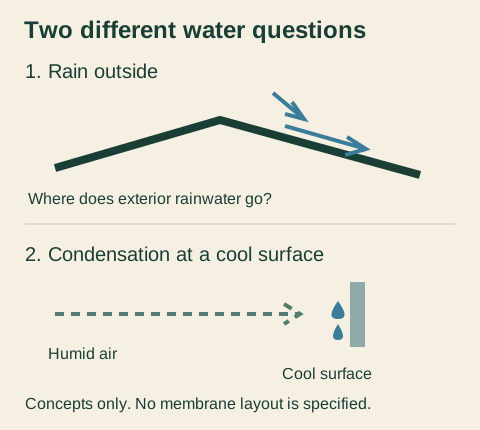
A roof has to manage rain arriving from outside. Moisture can also form when humid air reaches a surface cold enough for condensation. Your Home notes that condensation can occur on the underside of metal roofing in tropical conditions, and that air-conditioned spaces introduce additional moisture-design considerations. [3]
Ask the designer to explain the intended water paths and moisture strategy. Which layers handle rain entry? Where could condensation form? How is moisture kept away from vulnerable components? Membranes, insulation and air control must be considered together; this article does not prescribe their position or a universal roof detail.
Make the supplier answer the same questions
Before comparing quotations, ask each supplier or contractor for:
- The complete proposed assembly and exact product names.
- Documents covering permitted exposure and any coastal warranty restrictions.
- The basis for heat or acoustic performance claims.
- Details of who designs supports, fixings and connections.
- The scope of flashings, drainage, penetrations and installation.
- Inspection, cleaning and replacement requirements.
- The installed price, currency, date and exclusions.
For a bedroom, ask what evidence supports any rain-noise claim. For a coastal house, ask whether the warranty actually covers the site's exposure. For a roof carrying equipment, have the relevant professionals coordinate loads, penetrations and safe maintenance access.
Compare choices on the same basis
Keep a simple decision record: option, documented advantages, unresolved questions, installed scope and maintenance obligations. Mark missing evidence as 'not verified.' Do not award a material a permanent advantage based on an unspecified coating, an incomplete price or a result measured on a different assembly.
The final choice should fit the house, site and available workmanship. Local professionals must resolve structural, drainage and code requirements. U.S. and Australian sources explain principles; they do not establish Panama compliance.
Continue with humidity in a tropical house, pre-build planning, and Arthur's project overview.