A lower electricity bill is welcome, but it does not by itself prove that a new roof, air conditioner or operating routine saved energy. The bill may cover fewer days, the household may have been away, or the charges may have changed.
A useful home record starts by separating the amount of energy, the period it covers and the money charged. You can then ask better questions about what changed, without presenting a simple comparison as a controlled performance test.
Keep power, energy and cost separate
EIA distinguishes power, measured in watts or kilowatts, from energy used over time, measured in watt-hours or kilowatt-hours. [1] For an electricity-use log, copy the stated kWh for the period. Do not substitute a device's kW rating or the amount of money paid.
Keep the bill and its explanation of charges with the record. If the amount paid changes, check what changed in the tariff, fees, credits or adjustments before calling the difference an energy saving. Ask the provider to explain unclear entries rather than reconstructing its billing rules from the total alone.
Record each fuel or energy source separately in its original units. Do not add unlike units into one “energy total” without a stated, appropriate conversion and a clear purpose.
Confirm the meter and period being compared
Use the start and end dates associated with the consumption record, not just the month printed on the invoice. Identify the meter or account and what it supplies. A workshop, rental unit, pump or newly connected building can change the boundary of the comparison.
ASHRAE recommends retaining meter-reading dates and noting periods based on estimates rather than measurements. [2] Keep corrections and missing records visible. Do not silently replace an estimated bill or fill a gap with an invented reading.
If the property has on-site generation, storage or export, ask the provider or installer what each reported quantity means. Do not label an imported or net-billed figure “total household use” until the measurement boundary has been confirmed. Keep system changes and their dates beside the data.
Adjust for billing days, then stop short of a bigger claim
Divide the recorded kWh by the number of days it covers to calculate an average kWh per day. This addresses different period lengths. It does not adjust for weather, occupancy, equipment changes or the timing of use within each day.
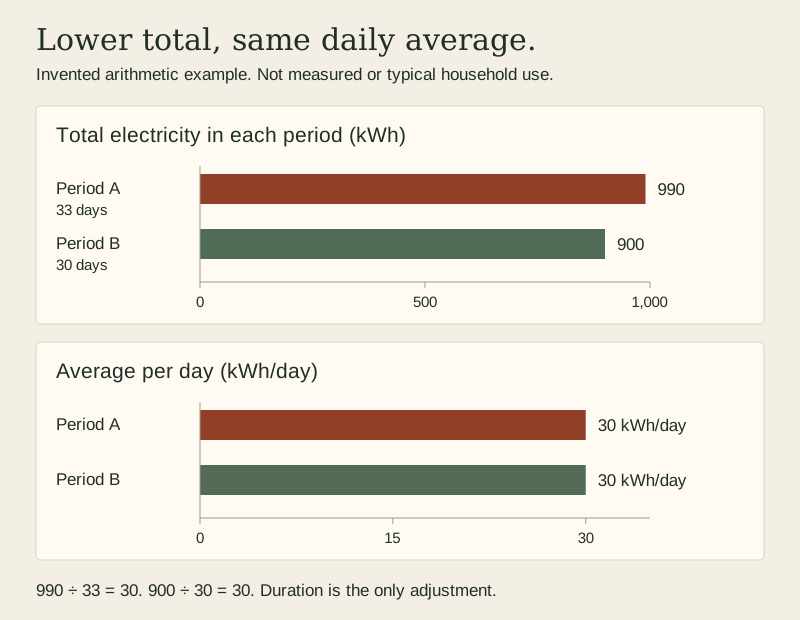
Consider an invented example: Period A records 990 kWh over 33 days. Period B records 900 kWh over 30 days. Both average 30 kWh per day. The second period has a lower total, but this calculation shows no reduction in its average daily use.
Invented arithmetic example, not measured household data or a consumption benchmark. 990 ÷ 33 = 30 and 900 ÷ 30 = 30 kWh per day. Duration is the only adjustment shown.
These numbers are arithmetic examples only. They are not Arthur's measurements, typical consumption for a tropical house or an efficiency benchmark. Even equal daily averages can conceal different patterns within the periods.
The calculation is useful because it removes one obvious mismatch. It cannot establish why use changed, and it should not be relabeled “weather-normalized” data.
Keep context that could change the interpretation
Retain a short dated note of important changes: more people staying in the house, time away, a new appliance, a changed cooling schedule, a repair or a different set of rooms in use. Make the note when the change occurs instead of relying on memory months later.
For example, if a household replaces an air conditioner and then spends much of the next billing period away, a lower total cannot be assigned to the new equipment alone. This is a hypothetical example, not a finding about any particular system.
Weather also matters. ENERGY STAR's technical reference describes weather normalization as a method that relates a building's energy records to weather data, rather than simply comparing two bill totals. [3] The method requires an appropriate data set and analysis. Writing “hot month” beside a bill is context, not a completed weather adjustment.
Keep local weather information with its source and dates if it is used in a comparison. Ask a qualified assessor what data are appropriate to the question. Do not assume that a temperature-only shortcut captures every influence on a humid-climate house.
Use a log that preserves the evidence
This worksheet is an original owner record, not a certification form. Keep the detailed bills and data exports available so someone reviewing the summary can trace each entry.
A household energy comparison record
Field
What to record
Why it belongs in the comparison
Supply and boundary
Meter/account reference kept privately, and the areas or systems supplied
Shows whether the same use is being compared
Period
Start date, end date and stated number of days
Makes differences in billing duration visible
Electricity quantity
kWh, source record and actual/estimated/adjusted status
Separates measured information from an assumption
Daily average
Period kWh divided by period days
Adjusts duration only
Cost
Charges, currency and relevant tariff or billing changes
Keeps expenditure separate from energy quantity
Household and equipment
Dated changes in occupancy, operation and installed systems
Identifies other possible explanations
Weather and comfort
Relevant sourced weather data and any recorded comfort or humidity observations
Preserves context without claiming an adjustment has been made
Review outcome
Question raised, person consulted and finding or remaining uncertainty
Prevents an observation becoming an unsupported conclusion
On a small screen, swipe the table horizontally to see every column.
Keep account numbers, addresses and detailed occupancy records private. If you later share a public case study, remove identifiers and use only the information needed to explain the comparison.
Compare like periods without assuming they are identical
The same season in another year can be a useful starting point, but it does not guarantee matching weather or household use. Review the context before interpreting the difference. A longer record helps reveal patterns that a single before-and-after pair may miss.
ASHRAE's energy-management guidance treats operating conditions as relevant data and cautions that influences on consumption need not be directly proportional. [2] For an owner, the practical implication is to keep the evidence separate before trying to explain it with one factor.
If a formal savings claim is important, ask the assessor to define the baseline, comparison period, measurement boundary, adjustments and uncertainty. Record which result is measured, which is calculated and which is a forecast. A product rating, a modeled saving and a change in a household bill are different kinds of evidence.
Use an unusual pattern to ask a focused question
First check the records for a changed period, estimated reading, correction, boundary or operating condition. If a concern remains, give the provider or relevant professional the source records and the dated change log. Describe what you observed without diagnosing a failing appliance from the bill alone.
DOE's Building America guidance describes a professional home-performance assessment as a review that considers interactions between the home's systems. [4] That is a different task from reading a bill total, and it can be appropriate when planning an upgrade or investigating a persistent problem.
Do not open electrical panels, attach improvised meters or disable ventilation, moisture control or safety equipment to produce a lower number. Any equipment testing or change in operation should follow its instructions and the appropriate professional advice.
Keep comfort and usefulness in the outcome
A house is not performing better for its occupants merely because less electricity passed through one meter. Record whether the spaces remained usable and comfortable, and whether any moisture or maintenance concern arose. The humidity guide helps distinguish measurements from explanations, while the cooling-planning guide keeps the household's actual needs in view.
Use energy records to refine decisions, not to manufacture certainty. If you are evaluating a proposed purchase, place its cost assumptions beside the whole-project budget and keep any forecast saving clearly labeled until suitable evidence exists.
Sources checked November 7, 2026. Technical references support the stated measurement principles; this household worksheet is not an ENERGY STAR rating, a weather-normalization model or a verified savings study. The numerical illustration is invented and labeled, and no actual household results or equipment-saving claims are supplied.