A builder's quotation can be accurate for the work it describes and still be smaller than the amount an owner needs to complete the project. The gap is not necessarily a pricing mistake. It may be work bought separately, professional services, site requirements or items that were never included in that quotation.
Start with the whole outcome you intend to fund, then identify where each cost belongs. This guide is a planning framework, not a project estimate, financial recommendation or interpretation of your contracts. Use current local quotations and the relevant professional advice for the actual amounts and obligations.
Define where the budget starts and ends
Write a short boundary statement before adding numbers. Does the budget include acquiring the land, or does it begin with a plot already owned? Does “complete” mean the contracted building works, a legally usable house with essential services, or a furnished home ready for the household to move into?
Keep both the overall project cost and the amount still needed visible if some expenses have already been paid. A survey bought last year can belong in the project record without being counted again as a future payment.
This boundary is a practical planning choice. It does not decide when a building is legally ready for occupation. Have the local team identify the required approvals, inspections and completion documents, then include their associated scope and costs where applicable.
Look beyond the main construction package
The NSW Government's home-planning guidance identifies surveys, specialist reports, design selections and advisory fees among costs to check, including whether the builder's package covers them. [1] Those categories are useful prompts; NSW-specific processes and payment rules do not automatically apply elsewhere.
Your Home, the Australian Government's housing guide, also asks buyers to account for preliminary work, site and finishing costs, requested additions and unexpected costs. [2] The relevant lesson is to make exclusions visible, not to assume every project has the same extras.
Walk through the intended outcome with the designer and builder. Ask what must be obtained, built, connected, checked or supplied for that outcome to exist. Then ask who is pricing each part. An unanswered question should become a named follow-up, not a zero in the budget.
Give each cost one home in the record
Use a clear scope description, a source document and a responsible person for every entry. Mark whether the item sits inside the builder's price, in a separate agreement or in an owner purchase. If an allowance already covers part of an item, show how the later amount replaces or changes it.
For example, an owner might purchase a particular appliance while the building contract includes some related installation work. This is a hypothetical coordination example, not an actual project cost. Confirm the split, including the tasks and charges that remain unresolved, before adding the two figures together.
The same discipline prevents double counting. Do not add a complete supplier quotation on top of a contract amount that already includes the same product without reconciling the overlap.
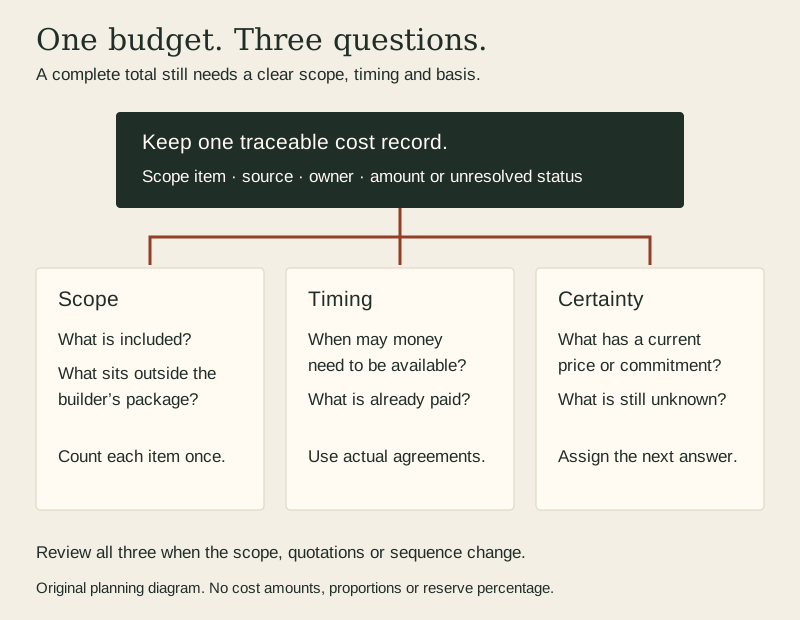
Original editorial budget-review diagram. It shows different views of the same record, not cost shares, contract terms or a recommended reserve.
The diagram shows three views of one budget. It contains no cost proportions or recommended reserve. A convincing total is not enough if its timing and unresolved items remain unclear.
Use a whole-project scope worksheet
The categories below are prompts, not a required package. Adapt them to the project and keep the actual contracts and quotations beside the entries.
A whole-project scope worksheet
Budget area
Question to resolve
Record to keep
Land and acquisition, if included
Where does this budget begin, and which acquisition-related costs belong in it?
Boundary statement and relevant adviser-confirmed amounts
Investigations and professional work
Which surveys, assessments, designs and reviews are required for this project?
Appointment scope, dated fee proposal and exclusions
Approvals and service connections
What must the local authorities and providers confirm?
Applicable requirements, quoted charges and responsible party
Building and site works
Which construction, access, drainage and external works are actually included?
Current drawings, specification and agreed scope references
Owner purchases and completion
What is supplied separately, and what makes the intended first phase usable?
Item list with supply, delivery, installation and completion responsibilities
Temporary arrangements
What accommodation, storage or other temporary needs arise from this plan?
Duration assumptions and current quotations where relevant
Uncertainty and changes
Which costs are unresolved, and what reserve has been agreed for the risks?
Risk list, estimate basis, review date and approved changes
On a small screen, swipe the table horizontally to see every column.
Keep currency and tax treatment explicit. If documents use different currencies, preserve the original amounts and date any conversion used in your working summary. Have the relevant adviser confirm taxes, duties and financial charges rather than copying another project's assumptions.
Distinguish a price from an estimate and a missing answer
A dated quotation, an agreed commitment, an early estimate and an unpriced item do not have the same certainty. Give each entry a status that says what evidence exists. Note expiry dates and the assumptions that would trigger a fresh price.
Keep a separate list of unresolved items, each with someone responsible for the next answer. If you use an interim allowance, label its basis and review date. A number entered for planning should not quietly become a claimed fixed price.
Discuss contingency with the appropriate cost professional in relation to the project's actual uncertainties. This article does not recommend a universal percentage. An allowance for an unidentified risk is also not a substitute for investigating a known site issue or pricing omitted work.
When the scope changes, update the cost record through the construction-change process. Retain the earlier basis so the revised total can be explained.
Put timing beside the total
Prepare a payment forecast from the actual agreements and expected milestones. Separate amounts already paid, agreed amounts still to be paid, and costs that have not yet been committed. Check that the categories do not overlap before adding them.
Record what makes each payment due and who verifies the supporting information. A forecast is not permission to pay, proof that work is complete or a replacement for the contract. Payment and financing questions should be reviewed with the relevant advisers.
Ask what happens to the forecast if a delivery or decision moves. A project can have an unchanged total but a different pattern of payments. Likewise, a postponed purchase may move expenditure later without removing it from the eventual project cost.
Test the first phase as a complete, usable outcome
If the plan is to build in stages, describe what the first stage includes and what genuinely can wait. Ask the design team to identify any dependencies between the stages, including services, safe access, weather protection and approvals. Do not assume a deferred finish or external work is optional merely because it appears late in the schedule.
MBIE's building-process guidance recommends distinguishing priorities and reviewing plans and budget before advancing. [3] Use those reviews to make deliberate scope decisions rather than trim isolated line items without checking their consequences.
Keep a visible “later phase” list with its own scope assumptions. This makes the first-stage budget clearer without presenting deferred work as a saving already achieved.
Keep running costs visible without pretending to predict them
Your Home distinguishes upfront spending from ongoing operation and maintenance, and recommends checking the assumptions behind suppliers' operating-cost claims. [4] Maintain a separate view of the recurring costs that matter to your household, such as servicing, utilities and replacement planning.
Do not mix an unsupported future saving into the construction total as if it were cash already available. Ask for the basis, conditions and uncertainty of any operating-cost estimate. The home energy-record guide explains why a later bill comparison also needs context.
Finish each budget review with three answers: what is in scope, what remains unresolved, and what decisions are due next. For comparing bidders within that scope, use the building-quote comparison guide. The whole-project record and the quote comparison serve different jobs and should stay connected.
Sources checked November 7, 2026. Overseas guidance is used for stated planning principles, not local legal requirements, current prices, financing advice or standard budget percentages. The worksheet, diagram and appliance example are original editorial tools; no actual project costs are supplied.