A roof quotation may show a reflectance value, an SRI number or a “cool” label. These can help a comparison, provided you know what was measured, which product the result describes and whether both quotations use the same basis.
This guide focuses on reading those ratings. The broader tropical roof guide covers rain, moisture and the complete roof decision. Here, the useful next step is to turn a marketing claim into a traceable product record, without predicting a room temperature or electricity bill from one number.
Keep the three terms separate
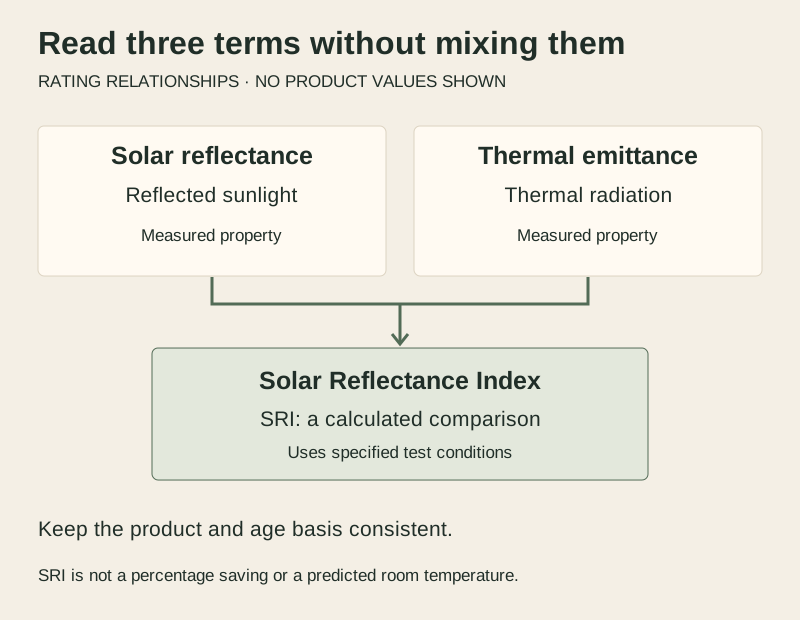
Solar reflectance, often abbreviated SR, describes the fraction of incoming solar energy reflected by the surface. Thermal emittance, or TE, describes how effectively the surface releases energy as thermal radiation. ENERGY STAR explains why both matter to a roof's ability to stay cooler in sunlight. [1]
Solar Reflectance Index, or SRI, combines those two measured properties in a calculation under specified conditions. CRRC's technical explanation makes clear that SRI is different from measured solar reflectance. Its scale can include values below zero or above 100. [2]
An SRI of 100 therefore does not mean that a roof reflects 100 percent of sunlight. Nor is SRI a temperature in degrees. If a quotation says only “reflectivity 90,” ask which metric, units and test record the supplier means before comparing it with another offer.
Original relationship diagram based on the definitions in sources 1 and 2. It is not a certification label, a calculation or a prediction of energy savings. Compare the same product finish and age basis.
The diagram shows a relationship between terms, not the calculation itself. Ask for the published values rather than trying to reconstruct a product rating from a rounded brochure number.
Identify the finish that was actually rated
Record the manufacturer, product name, exact color or finish, rating identifier and date checked. A result for one coating or color should not silently become the result for every panel in the same range.
Color is a starting point for a question, not a substitute for evidence. ENERGY STAR notes that lighter roofs tend to have favorable radiative properties, while some other colors also use reflective materials or coatings. [1] Ask for the values of the actual proposed finish rather than choosing from a photograph.
Where the supplier refers to the CRRC directory, ask for the matching product record. The directory describes radiative performance; it is not a product ranking, project approval or guarantee of local availability. [3] A supplier still needs to confirm what can actually be delivered for the project.
Keep a copy or dated reference with the quotation. If the offer changes to a different finish, request the matching evidence again rather than leaving the original rating beside the revised product name.
Compare initial values with initial values
Initial and aged ratings describe different states. A newly produced surface and a weathered one should not be treated as the same comparison simply because both numbers appear under a heading called performance.
CRRC's program distinguishes initial results, measured three-year aged results and interim laboratory-aged Rapid Ratings. The interim results are replaced when the required outdoor weathering and aged testing are complete. Some products have aged values marked pending. [4]
In a comparison sheet, give the status its own field. Write “initial,” “measured three-year aged,” “interim Rapid Rating” or the status actually supplied. Leave missing information visible. A pending result is not zero, and it is not a measured aged value.
For example, imagine one proposal highlights initial SRI while another highlights measured aged SRI. This is a hypothetical document mismatch, not evidence that either roof is better. Request a common basis before making a ranking, and ask the designer how uncertainty in the available information affects the decision.
Read the rating separately from a compliance claim
CRRC does not set a minimum SR or TE for a product to appear in its rating program. Different codes and programs can set different requirements. [4] A directory listing alone therefore cannot establish that the proposed roof meets the rules for a particular location.
If a quotation claims compliance, ask the responsible local professional to identify the applicable requirement and show how the exact product and assembly satisfy it. Keep that explanation separate from the product's radiative data.
For a house in Panama, do not adopt a minimum value from a California requirement or a voluntary building program merely because it appears in a search result. This article supplies no local minimum and makes no compliance determination.
Separate a cooler surface from a household saving
CRRC cautions that ratings are determined under fixed conditions and do not necessarily establish seasonal energy performance. [3] They are useful inputs, but the house below the roof still matters.
ENERGY STAR identifies climate and roof insulation as factors affecting the benefit. [1] Ask an assessor to consider the actual building, the existing and proposed roof, and the way the rooms will be cooled. An open veranda and a regularly air-conditioned room do not represent the same electricity-use question.
DOE's consumer guide recommends considering long-term radiative performance, any extra initial cost and the cost of keeping the roof reflective. [5] A credible financial comparison should state those assumptions instead of turning a surface-rating difference directly into a percentage saving.
If a contractor supplies a saving estimate, request the method, comparison case, inputs and limitations. Ask which charges and energy prices it uses and whether it includes maintenance. Keep estimates labeled as estimates. After occupancy, the home energy-use guide explains why a lower bill alone does not prove the cause.
Use a rating-comparison record
The original worksheet below is designed for collecting evidence, not awarding points. Complete it for each exact offer and keep the supporting documents beside it.
Cool-roof rating comparison record
Field to record
What to keep together
Mismatch to resolve
Product identity
Manufacturer, product, color or finish, identifier
A different finish or a generic product-family claim
Solar reflectance
Reported value and stated condition
A reflectance fraction compared with an SRI number
Thermal emittance
Value for the same product and condition
A missing value or evidence from another surface
Solar Reflectance Index
Published SRI and calculation or rating reference
A number presented as a percentage saving
Age and status
Initial, measured aged, interim or pending
New-product data ranked against weathered data
Project outcome
Separate assessment and stated assumptions
A product rating presented as a house-specific result
On a small screen, swipe the table horizontally to see every column.
Do not fill a missing field with an average for the material. If a supplier cannot provide comparable evidence, record that limit and ask the designer what can reasonably be concluded.
Keep the rest of the roof in the decision
A radiative comparison leaves other requirements to be resolved. Ask the project team to review the complete assembly, structural design, rain management, moisture behavior, product compatibility and safe maintenance arrangements.
For an existing roof, have its condition and any proposed coating assessed before treating recoating as a simple performance upgrade. Obtain the current product instructions and warranty position for that actual substrate and exposure. The coastal warranty guide provides a separate document-review framework.
Do not climb onto a roof to check a finish or improvise a cleaning method to preserve a rating. Arrange qualified inspection and maintenance appropriate to the product and site.
The goal is a clear comparison: the same metric, the same age basis, the exact proposed finish and an honest account of what remains unknown. That makes a cool-roof rating useful without asking it to prove more than it measures.
Sources checked November 7, 2026. General rating principles are used; foreign code thresholds, older incentive information and generic saving claims are not applied to Panama. No particular product, rating or project outcome is endorsed. The diagram and worksheet are original explanatory tools, not certification labels or a thermal model.