Field notes · Under the roof · Every function deserves a name
Roof Membranes and Insulation: What I Would Ask About the Whole Assembly
A beautiful roof catches my eye. A clear proposal keeps my attention.
For entertainment and general understanding. These illustrations and questions are not a construction specification or a legal, engineering or site-specific professional assessment.
A roof quotation can sound reassuring while leaving the important parts unnamed. “Premium membrane.” “Thermal insulation.” Lovely words. I would still like to know which products are arriving, what each one does and whether they belong together. Otherwise, the quotation has introduced the guests without telling us who is cooking dinner.
In my broader tropical roof guide, I ask you to compare the whole installed system. Here I want to slow down over that phrase. The useful next step is a conversation about functions, evidence and responsibility, rather than choosing a roll of material by its most impressive adjective.
This is an owner’s discussion guide. The actual roof needs local professional design for its climate, structure, use and applicable requirements. I am not offering a layer sequence or an installation recipe.
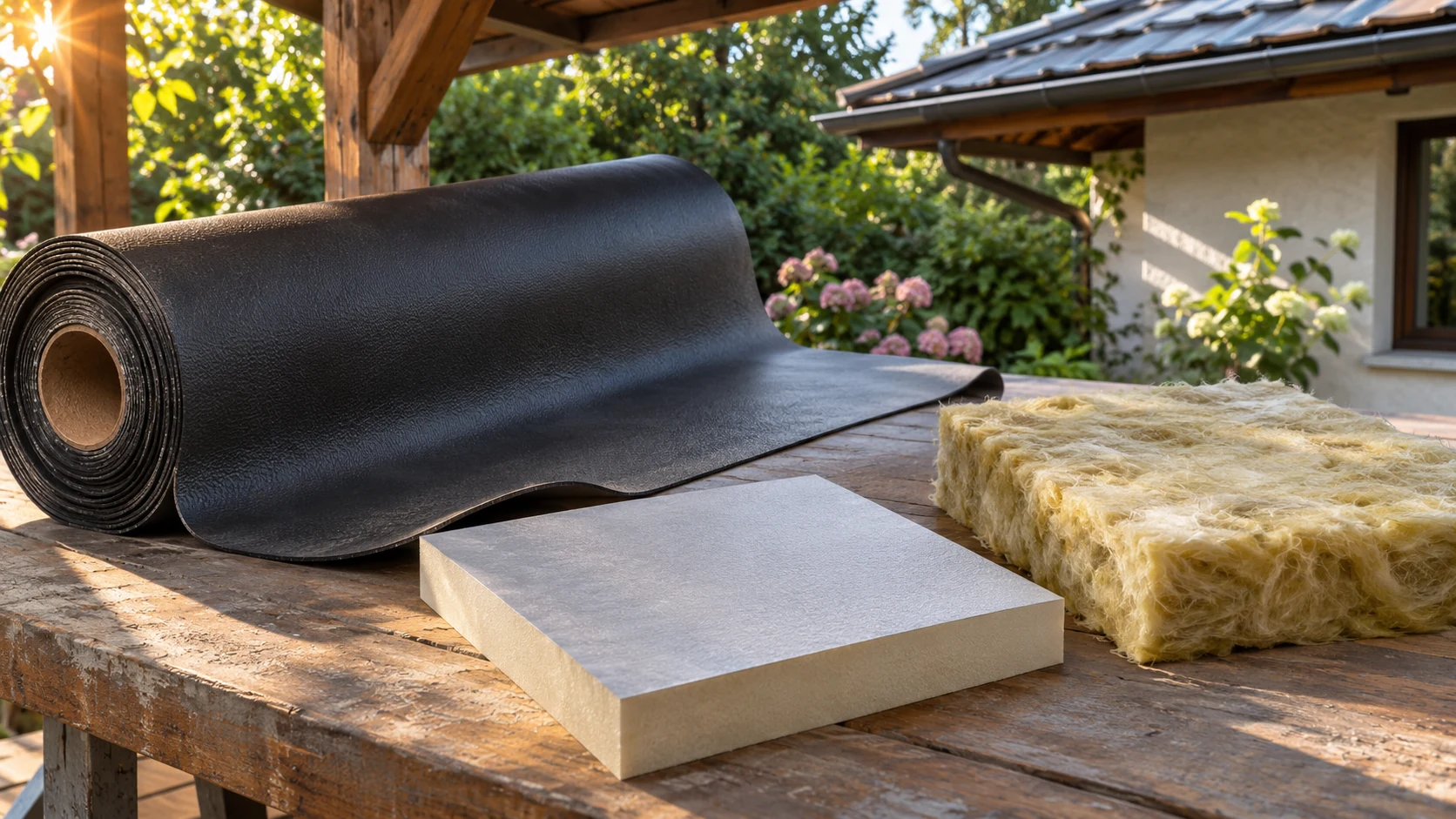
Start with the room underneath
Tell the designer how the house will operate. Which rooms will regularly use air conditioning? Which will usually be open? Could that change later? Include the proposed ceiling, roof-space arrangement and any equipment that affects the design.
I would write those answers beside the proposal, not leave them as a conversation somebody vaguely remembers. Ask each bidder to use the same brief. A recommendation based on occasional cooling should not quietly become the recommendation for a room kept cool every night.
Your Home explains that condensation risk changes with climate and indoor conditions; humid outdoor air reaching cooled parts of a building can create problems. That makes the operating brief relevant to moisture design, not just comfort. Australian Government: Condensation (opens in a new tab).
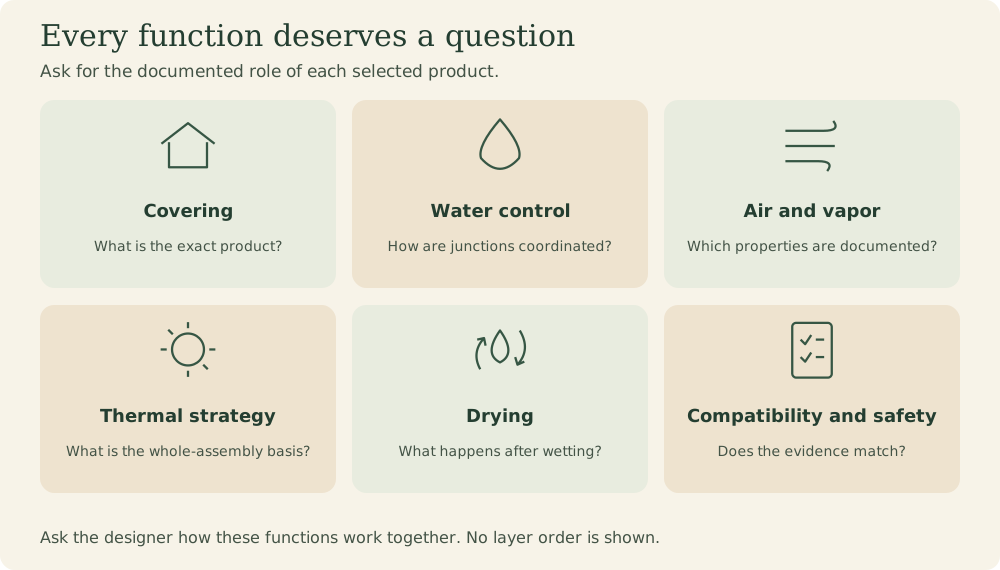
Every function deserves a question
Ask for the documented role of each selected product.
Six topics, not six construction layers
-
Covering
What is the exact product?
-
Water control
How are junctions coordinated?
-
Air and vapor
Which properties are documented?
-
Thermal strategy
What is the whole-assembly basis?
-
Drying
What happens after wetting?
-
Compatibility and safety
Does the evidence match?
Ask the designer how these functions work together. No layer order is shown.
Give every function a name
I would ask the designer to describe the covering first: the exposed roof surface, its exact product and finish, and its intended role. Then ask which components manage water beneath or around it. A membrane might be an exposed roofing product or a concealed part of another system. The word alone is not a specification.
The EPA treats the roof-and-ceiling assembly as the combined provision for rain protection, insulation, air control and condensation management. Those functions need not all sit at the same level. U.S. EPA: Moisture Control Guidance, roof and ceiling assemblies (opens in a new tab).
My question would be: “For this proposal, can you identify what does each job?” One product may have several documented functions. Several products may share a task. Neither arrangement earns approval from its simplicity or complexity alone.
For rain control, ask where water is expected to travel and how roof edges, junctions and penetrations are included. Who coordinates a future equipment opening with that design? Keep the answer connected to the drainage proposal rather than ending the discussion at the membrane brand.
Separate air movement from vapor movement
Air leakage and water-vapor diffusion are different routes for moisture. Your Home distinguishes moisture carried through unintended air paths from vapor passing through materials. A material can resist liquid water while allowing vapor transmission. Australian Government: Condensation (opens in a new tab).
That is why I would ask what a supplier means by “breathable.” Does the documentation describe vapor behavior, air leakage, water resistance or something else? Ask for the stated property and test basis rather than accepting the word as a complete explanation.
Keep planned room ventilation separate from unintended leakage through the roof enclosure, too. Ask the designer to explain both. “The house needs air” does not answer where that air should travel.
I would also resist copying a vapor-barrier position from an unfamiliar roof drawing. Moisture movement and drying depend on climate, indoor conditions and the assembly. Have the designer explain the chosen strategy for this house, including any proposed changes in its use.
Read the insulation claim in context
Your Home distinguishes an insulation product’s thermal resistance from the performance of the roof-and-ceiling assembly. It also identifies thermal bridges and installation conditions as influences on the result. Reflective products depend on their surrounding arrangement, including an appropriate adjacent air space. Australian Government: Insulation (opens in a new tab).
I would therefore request the basis for the complete proposal, including the units and assumptions behind any thermal claim. Is the quoted figure for a product or an assembly? Does the assessment include the proposed framing and interruptions? Are both competing quotations describing comparable conditions?
Leave outer-surface reflectance and emittance to the separate cool-roof ratings guide. Here, ask how that chosen surface fits the broader thermal strategy. A product label should not become a promised bedroom temperature or electricity saving without a suitable project assessment.
Ask how the roof can dry
Keeping moisture out and allowing appropriate drying deserve separate questions. Your Home discusses drying potential alongside control of moisture entry; restricting vapor movement without considering the rest of the assembly can leave that discussion incomplete. Australian Government: Condensation (opens in a new tab).
Ask what happens if materials become wet during construction or a leak develops later. Who checks their condition before they are concealed? How would an investigation reach the affected area? What would need removal or replacement?
I would want the answer before approving a substitution. A different facing, coating or membrane needs review in context, even when its headline thermal claim looks similar. Ask the responsible designer whether moisture analysis is needed and what uncertainty remains.
Compare the evidence, not the adjectives
Here is the record I would bring to a proposal review. It is a questions table, not a recommended assembly.
| Part of the decision | Evidence I would request | Question to resolve |
|---|---|---|
| Covering and water control | Exact products and intended functions | How are junctions and drainage coordinated? |
| Air and vapor control | Documented properties and design explanation | What moisture routes has the designer assessed? |
| Thermal strategy | Whole-assembly basis and assumptions | Are the competing claims comparable? |
| Drying and repair | Moisture review and investigation plan | What happens after unintended wetting? |
| Compatibility and safety | Manufacturer limits and relevant system evidence | Does the evidence match this proposal? |
| Handover | Final specification and responsible contacts | Who reviews changes and future work? |
Keep compatibility and safety in the same review
Ask for written confirmation of compatibility between the selected covering, membrane, insulation, substrate and associated products. Request current manufacturer limits for exposure, use and maintenance. If evidence covers a tested system, ask whether its components and conditions match what is actually proposed.
Fire and electrical safety also need professional review. Your Home flags insulation-related risks around electrical services and fittings. I would ask the qualified team to resolve the applicable requirements for the complete assembly, rather than infer safety from one material’s label. Australian Government: Insulation (opens in a new tab).
Before ordering, name the person responsible for coordinating these answers. Keep the final specification, approved changes and maintenance information together. If something is missing, record it as unresolved rather than letting a confident description fill the gap.
The Australian and U.S. sources explain principles, not Panama compliance. What I want at the end is straightforward: a roof proposal whose parts have clear jobs, whose claims have a basis and whose unanswered questions still have someone’s name beside them.
Sources behind the questions
Research checked 2026-11-08. External source links open in a new tab. Foreign sources explain principles, not Panama project requirements. No illustration establishes the performance of a real house.
-
Australian Government: Condensation (opens in a new tab)
Principle or local example only; scope and limitations are explained beside the claim.
-
U.S. EPA: Moisture Control Guidance, roof and ceiling assemblies (opens in a new tab)
Principle or local example only; scope and limitations are explained beside the claim.
-
Australian Government: Insulation (opens in a new tab)
Principle or local example only; scope and limitations are explained beside the claim.