Before the Electrical Plan, I’d Make a List of What the House Will Actually Do
By Arthur · An illustrated owner’s guide
Plan for the household, including the forgotten freezer.
For entertainment and general understanding. These illustrations and questions are not a construction specification or a legal, engineering or site-specific professional assessment.
A house can have an impressive collection of electrical plans and still leave out the freezer somebody intends to put in the laundry room.
I would start with a quieter document: a list of appliances, equipment and how the household expects to use them. It helps avoid discovering that “ordinary kitchen use” meant three different things to three different people.
This inventory is information for qualified electrical and solar professionals. It is not a way to calculate circuit capacity, choose equipment sizes or prove an existing installation can take another appliance. I would keep my hands away from electrical covers, wiring and test instruments.
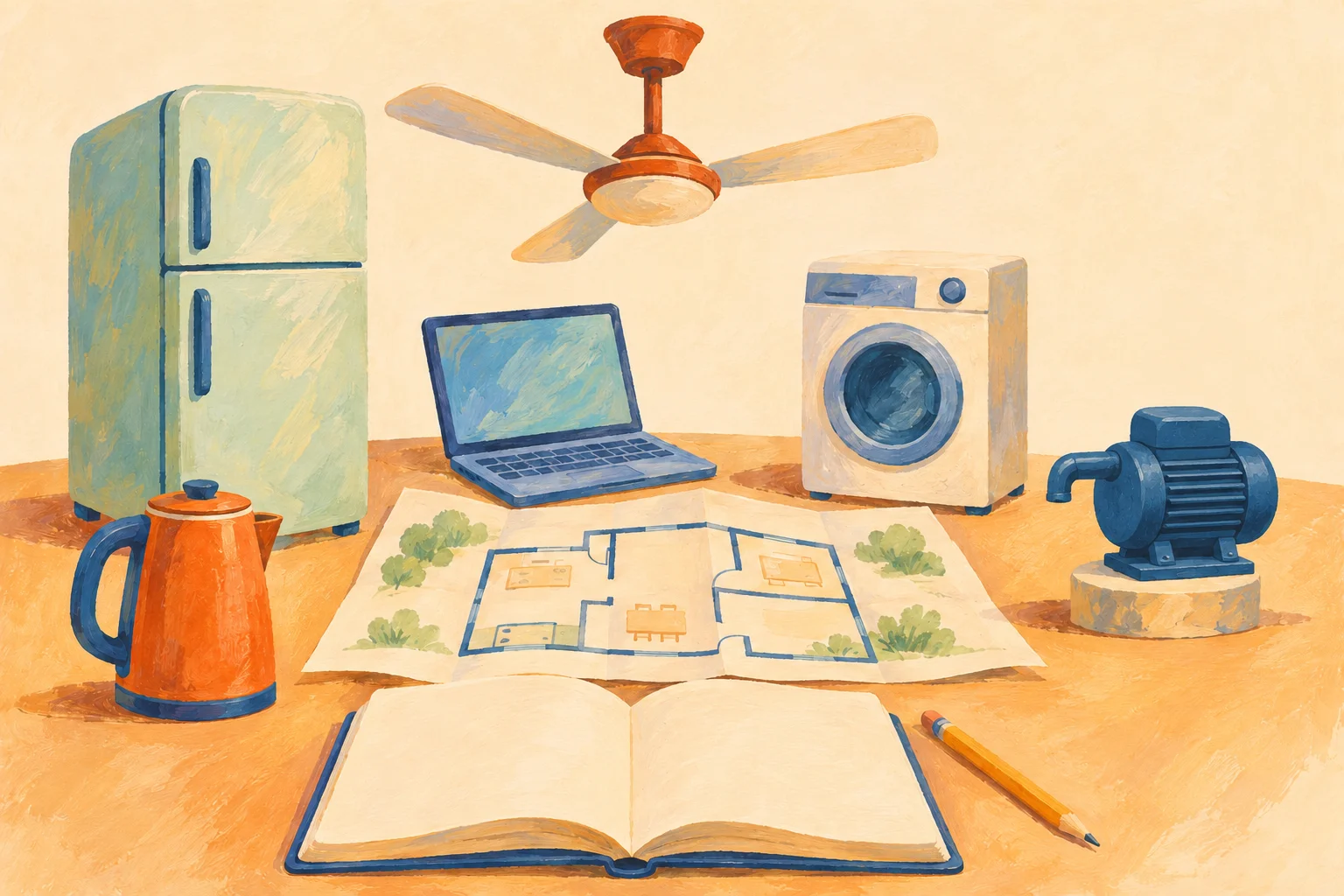
Household equipment gathered into one planning conversation.
Walk through the rooms on paper first
I would give each item a plain name and a stable location: kitchen refrigerator, guest-room air conditioner, laundry dryer. Start with rooms, then add equipment that does not sit politely inside one: water pumping, outdoor lighting, gates, pool equipment or a separate workshop, if present.
Include quantity. Two identical-looking air conditioners still belong to two locations. For groups such as lamps or office devices, record what the group includes rather than hide everything under “miscellaneous.” That word has a remarkable appetite.
For each entry, I would mark its status: installed, purchased but not installed, selected for purchase, or only being considered. An appliance that exists in a shopping tab should not silently become an installed load.
On a new-house project, I would use intended room activities to find missing entries. How will water be heated? Where will laundry happen? Is cooking electric, gas, or a combination with electrical components? The answers belong in the brief before anybody guesses the equipment.
Keep identity attached to the numbers
I would record manufacturer, exact model, quantity and the matching manual or technical-sheet reference. Add a photograph of a nameplate only if it is safely accessible without moving heavy equipment, removing covers, climbing or reaching into a service area. Otherwise, ask the installer or supplier for the information.
Virginia Cooperative Extension identifies nameplates as a source of appliance power information and notes that actual power use can depend on operating settings. I would copy the information with its units and labels intact, then let the professional interpret it. Virginia Cooperative Extension: appliance energy use ↗ (opens in a new tab)
If a quotation permits substitutions, I would ask for the selected model before the design assumptions are finalized. Keep an uncertain model clearly marked, with a person assigned to confirm it.
Where available, I would save an energy label separately. The US EnergyGuide label helps compare similar appliances; its operating-cost figure is an estimate based on typical use and an average energy price. It is not a prediction of my local bill. FTC: using the EnergyGuide label ↗ (opens in a new tab)
Give the inventory somewhere to hold real life
Here is the working table I would use. The example entries describe an imagined household, not my equipment or measured consumption.
Example inventory: information for professional review
Item and status
Identity or document to attach
Intended use and overlap
Priority or open question
Kitchen refrigerator, existing
Exact model and available label
Normally left on; available during cooking
Backup requested; designer to confirm feasibility
Bedroom cooling, proposed
Supplier’s selected equipment, still pending
Used overnight; other bedrooms may also be cooled
Confirm rooms and normal schedule
Laundry equipment, selected
Separate washer and dryer documents
Weekend use may overlap with cooking
Household may accept postponing during outages
Water pump, existing
Installer’s equipment record
Needed when the household uses water
Confirm dependent equipment and start behavior
Vehicle charging, possible future addition
Vehicle and charging arrangement not selected
Intended parking location and likely use times
Future scenario only; no capacity assumed
I would add a document date and an “information missing” field to the private working copy. Serial numbers and household routines do not need to appear in a public article or a broadly shared presentation.
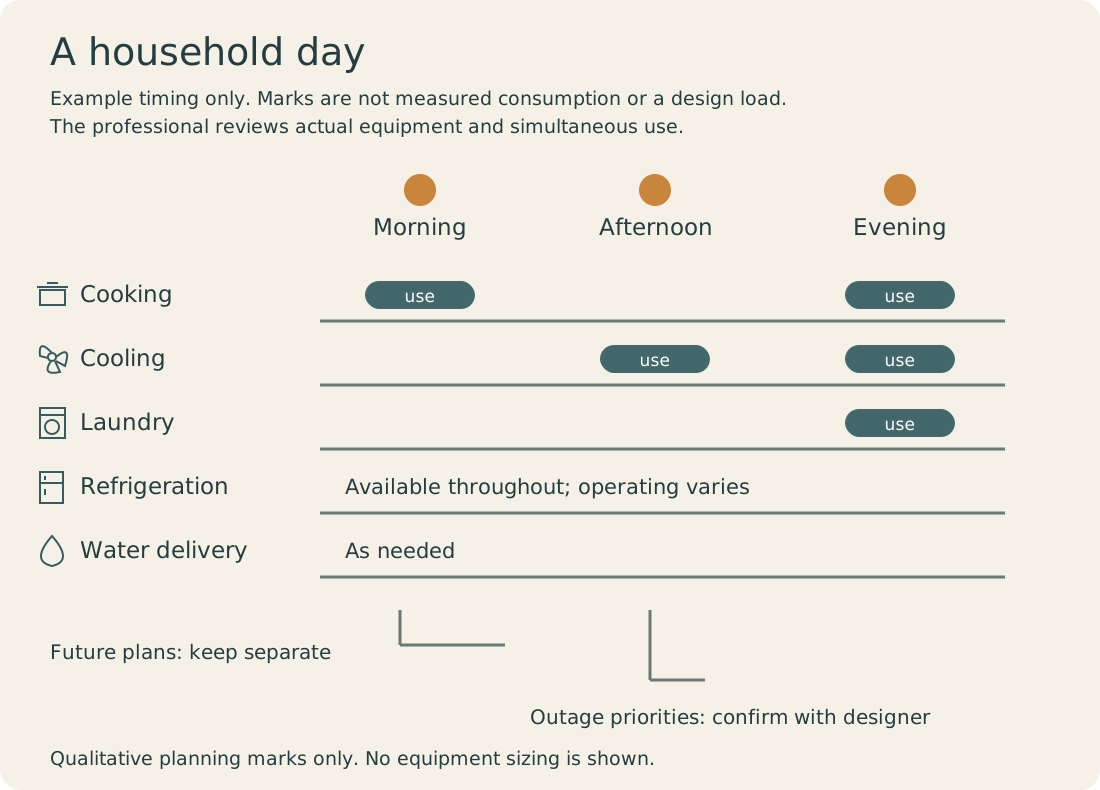
A household day
Morning → Afternoon → Evening
Example timing only. Marks are not measured consumption or a design load.
The professional reviews actual equipment and simultaneous use.
Cooking
Morning and evening: example use.
Cooling
Afternoon and evening: example use.
Laundry
Evening: example use.
Refrigeration
Available throughout; operating varies
Water delivery
As needed
Future plans: keep separate
Outage priorities: confirm with designer
Qualitative planning marks only. No equipment sizing is shown.
Example timing only. Marks are not measured consumption or a design load. The professional reviews actual equipment and simultaneous use.
Describe the busy moments as well as the usual day
“Used daily” is a thin description. I would explain when, roughly how long, and whether that means the appliance is available, actively working or running a particular cycle.
For example, an imagined evening might involve cooking, cooling bedrooms, laundry and a water pump responding to water use. I would write that as a normal-use scenario, without asking anyone to switch everything on for a test.
Then add a quieter weekday, a guest-filled weekend or a season when use changes, if those genuinely fit the household. Let people who use the rooms contribute, including the person who works nights.
I would separate “usually used together” from “could be postponed.” If everyone agrees laundry can wait during an outage, record that preference. Do not assume the same compromise is acceptable every evening just because it makes a proposal easier.
Energy over time and demand at a moment answer different questions
Watts or kilowatts describe power. Watt-hours or kilowatt-hours describe energy used over time. EIA explains that distinction directly. In this conversation, demand means the power the household may need at a given moment, not a particular utility billing tariff. EIA: measuring electricity ↗ (opens in a new tab)
That is why I would bring both the equipment list and representative bills or existing usage records. A monthly total does not describe which appliances operated together. An annual energy-label figure does not establish the highest simultaneous demand.
Some equipment also has starting behavior to consider. Virginia Cooperative Extension notes that a motor can draw more current while starting than while running. I would flag motors and compressors for product-specific professional review, without applying a universal multiplier or trying to measure the start myself. Virginia Cooperative Extension: motor starting distinction ↗ (opens in a new tab)
I would not add nameplate figures and call the result a design. The professional needs to interpret the actual equipment, operation and applicable local requirements.
Put tomorrow and an outage on separate pages
Future cooling, a workshop, electric cooking or vehicle charging can change the brief. I would label each proposal with its confidence and likely timing: committed, probable or simply an option. “Maybe someday” should stay visible without becoming an expensive secret assumption.
For backup, I would list the functions I want preserved, the equipment they depend on and what can wait. Refrigeration, communications and water delivery may deserve separate conversations. If medical or accessibility equipment is involved, flag it for a dedicated continuity plan with the relevant care team and equipment provider, rather than treating it as an ordinary comfort preference.
A “backup requested” entry is not a promise of backup. The Australian guidance warns that many grid-connected solar systems, and even some battery systems, will not supply a house during an outage. The proposed arrangement needs an explicit answer. Australian Government: outage-supply limits ↗ (opens in a new tab)
Hand over a useful brief, then keep it current
I would send the dated inventory, exact-product documents, normal-use scenarios, future options and backup priorities to the qualified local electrical professional. The solar or backup designer should work from the same version and coordinate with that electrical assessment.
Ask which assumptions they accepted, which need checking and which changes would require another review. Request a clear distinction between the owner’s desired use and the arrangement actually designed and verified.
When a model changes, update the entry before purchase or installation decisions rely on the old one. The result I want is simple: everybody plans for the same household, including that laundry-room freezer.
An original owner-planning framework for general understanding. US and Australian sources support the stated distinctions, not Panama electrical rules, equipment sizing or a site-specific design. Sources checked November 8, 2026.
Sources behind the questions
Research checked 2026-11-08. External source links open in a new tab. Foreign sources explain principles, not Panama project requirements. No illustration establishes the performance of a real house.