Plan Home Backup Power Around Essential Household Needs
By Best House Ideas · November 8, 2026
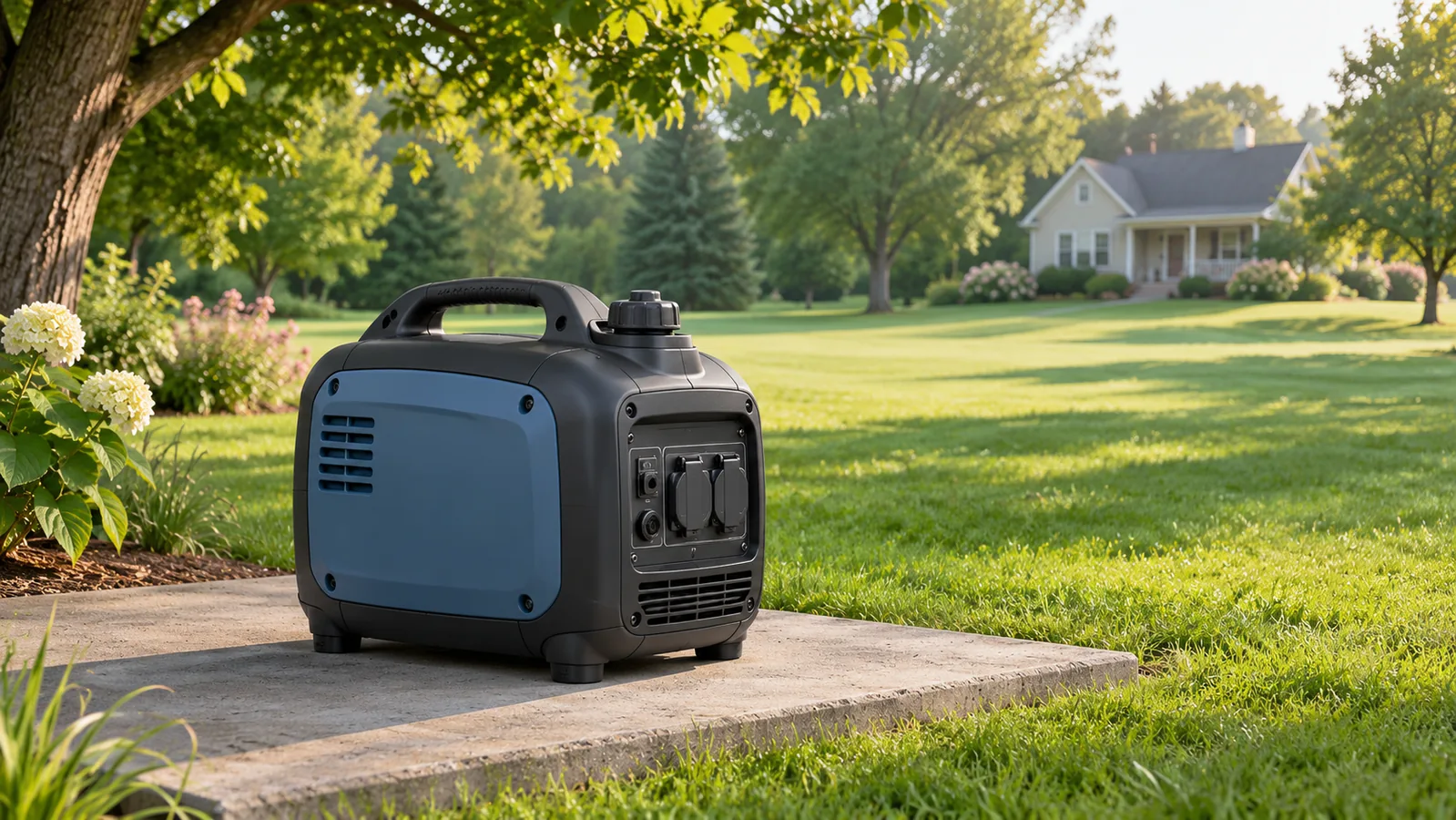
AI-generated editorial illustration of a portable generator outdoors. For actual use, follow the equipment instructions for safe clearances, exhaust direction and weather protection. See the generator safety guidance below.
External sources open in a new tab so you can keep your place.
The useful first question about backup power is what the household needs to keep doing when electricity stops. Calling, seeing a safe route through the house, keeping essential equipment available and managing food are different needs. A promise to “back up the house” leaves too much undefined.
Start with an outage brief before comparing products. This guide helps an owner describe priorities, question proposals and prepare a fallback. It does not size a generator or battery, approve a location, or explain electrical connections. System design, installation and commissioning belong with appropriately qualified professionals and the instructions for the actual equipment.
Describe the interruption before choosing the equipment
Write down the situations you want the proposal to address: a short daytime interruption, an overnight outage, and an extended event that also disrupts roads, communications or fuel deliveries. These are planning scenarios, not predictions. Record observed outages separately, including their dates and approximate durations, so a recollection does not become a promised design condition.
For each scenario, ask who is at home and who could operate the system. A plan that depends on a particular person being present needs an alternative for their absence. Include visitors, accessibility needs and pets where relevant. Avoid assuming that everyone can move portable equipment, read a small display or follow instructions in darkness.
CDC's preparation guidance identifies emergency lighting and backup sources for devices, appliances and medical equipment. It also includes battery-backed alarms and refrigerator or freezer thermometers. [1] Those categories are a useful starting point for a household conversation, rather than a requirement to buy one large system that powers everything.
Make a service list, then identify its dependencies
Use descriptions such as “contact family,” “keep the essential medical device available” or “maintain access to stored water.” Next identify the actual equipment involved. A phone, router and upstream communications service are separate parts of making a call. A water tank and the equipment needed to deliver its contents are separate questions.
Sort the list into needs requiring a dedicated contingency, needs you want available with an agreed interruption, and activities that can be postponed. These are owner priorities to review with the relevant professionals, not electrical circuit groups. A room label such as “kitchen” is too broad to explain which appliances matter and when.
Give the designer the relevant appliance identification and documentation you already have. Describe normal use and any known starting or restart behavior without measuring inside electrical equipment. Ask which missing information needs professional verification. Do not convert a monthly bill into a backup-system size: an average conceals what is operating together and when.
The separate home energy-record guide explains billing comparisons. Here the purpose is different: establish the service expected during an interruption, including the limits the household agrees to accept.
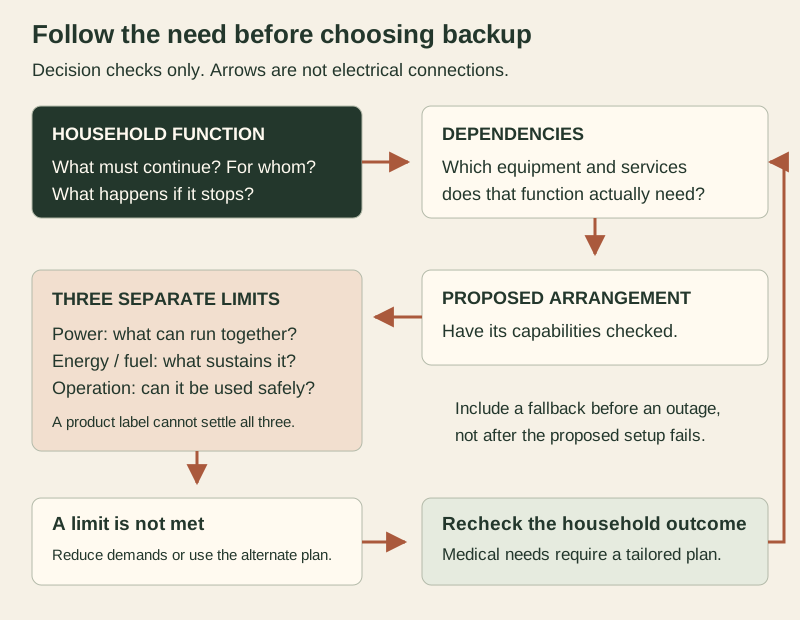
On a small screen, swipe or scroll the diagram horizontally to read every panel.
Original outage-planning logic. Arrows describe decision checks, not electricity or wiring connections. No runtime, capacity, compatibility or safe operating site is established by this diagram.
This original decision map follows a household need through its equipment dependencies, the proposed outage service and a fallback if that service is unavailable. Arrows represent questions, not power flow or wiring. No ranking in the diagram overrides medical advice or a professional design.
Put medical and accessibility needs on their own track
If anyone relies on powered medical equipment, ask their healthcare team and equipment provider for a device-specific emergency plan before treating an ordinary home backup proposal as sufficient. The FDA advises checking the user instructions or contacting the distributor or manufacturer to establish whether a device can operate from batteries or a generator. It also warns that settings may change after power returns. [2]
Ask who should be contacted, what preparations are appropriate and when the person should move to an identified place of care. Keep those decisions in the person's private plan. If a life-sustaining device is unavailable during an emergency, seek emergency assistance immediately rather than troubleshooting household power while waiting for the situation to improve. [2]
Have the electrical designer coordinate the agreed device requirements with the equipment provider. An advertising phrase such as “medical backup” is not a substitute for compatibility and interruption requirements. Keep personal medical details out of public project notes; provide the professionals only what is necessary for their roles.
Compare arrangements by the service they must demonstrate
The table is an original proposal-comparison worksheet. Its rows describe approaches to discuss, not a complete product list, a cost ranking or a recommendation for a particular property.
Backup arrangements and owner questions
Approach to discuss
Energy source and basic limit
Useful question for the proposal
Limitation to resolve before purchase
Dedicated battery-powered lights and device backups
Stored energy supports specific devices; batteries need replacement or recharging as applicable. [1]
Which specific tasks can continue independently of the house installation?
Charging routine, device compatibility and what happens when the stored energy is depleted
Portable fuel-powered generator
Fuel is used to generate electricity; operation creates a carbon-monoxide hazard. [5][6]
Who can operate it safely, and what approved equipment will it supply?
Outdoor operating arrangement, exhaust, weather, fuel handling and professional connection advice
Professionally installed standby generation
Fuel-powered generation needs an available fuel supply; ask the proposal to identify its fuel supply and operating limits.
Which household services are included and what intervention is expected?
Fuel availability, service support, site suitability and behavior during faults or depleted fuel
Installed battery backup
Rechargeable stored energy has separate power and energy limits; a battery must be configured for outage supply. [3][8]
Which loads and operating states are included in the proposed backup service?
Initial charge, concurrent demand, depletion, recovery and product-specific installation requirements
Solar combined with a designed backup arrangement
Solar generation depends on sunlight; actual outage supply depends on the system design and available energy. [3][8]
What can operate during a grid outage, and under what sunlight and stored-energy assumptions?
Actual outage capability, recharge conditions and behavior if solar production is insufficient
On a small screen, swipe the table horizontally to see every column.
Compare written answers to the same household scenarios. A proposal covering fewer services may suit the agreed brief, but it should not appear equivalent to another simply because both use the word “backup.” Ask each supplier to identify exclusions and the assumptions behind its claims.
Ask separately about power, stored energy and recovery
DOE distinguishes a storage system's power capacity (commonly expressed in kW), how quickly energy can be delivered, from its energy capacity (commonly expressed in kWh), the amount stored. [3] For an owner, the practical questions are “What can operate together?” and “Under what assumptions can that service continue?” Let the designer make the calculations and explain their limits.
Ask the supplier to describe the starting condition behind any runtime illustration. What charge or fuel condition is assumed? Which loads are included? What user actions are expected? How does the answer change if the interruption lasts longer? A duration stated without those conditions is difficult to compare and should not become a household promise.
Solar generation changes with sunlight and conditions including clouds, shading and time of day. DOE explains storage as a way to use energy at a different time from when it is generated. [3] Ask how a proposed backup arrangement recovers after depletion and what it can do during unfavorable conditions, rather than assuming each new morning resets the plan.
Rooftop panels alone do not establish that a home can operate during an outage. DOE's 2020 explanation describes the distinction between ordinary grid-connected solar and arrangements designed to continue supplying power when the grid is unavailable. [4] Use that source for the principle, not current product capabilities or interconnection rules. The Australian Government's Solar Consumer Guide also cautions that some battery systems do not supply power during an outage. [8] Ask the supplier to confirm the actual system's behavior in writing.
Treat portable-generator safety as a decision gate
CPSC says portable generators must operate outdoors, at least 20 feet from the home, with exhaust directed away from nearby buildings. Never operate one inside a home, garage, basement or shed. It also advises switching the generator off and allowing it to cool before refueling. [5] Opening a garage door or using fans does not make indoor operation safe. [6]
CPSC recommends CO alarms on every level and outside sleeping areas, with battery power or battery backup. [5] Alarms do not make an unsuitable generator location acceptable. If a CO alarm sounds, go outside immediately and contact emergency services; do not remain inside investigating the cause. [7]
Never power household wiring by plugging a generator into a wall outlet. CPSC calls this backfeeding and warns of electrocution risks to utility workers and neighbors. [6] Ask a qualified electrical professional to design any connection to household circuits. This article supplies no transfer-device selection or installation procedure.
Before purchasing, have the supplier and appropriate professionals resolve safe outdoor operation, weather exposure and fuel handling for the real site. Do not improvise an enclosure or move equipment indoors during rain. If safe operation cannot be established, choose another contingency rather than treating safety as a detail to solve during the outage.
Walk through failure and recovery as well as normal use
Consider this hypothetical planning example: a household prioritizes communications, refrigeration and a water-delivery function, while postponing laundry. During review, it discovers that its communication plan assumes an external service will remain available. The useful revision is an alternative way to receive information or contact help, not an unsupported claim that a larger battery solves the problem.
Ask the designer to walk through loss of supply, operation on backup, depletion or fault, and return of normal supply. Have them explain which actions an owner may perform and which require service. Request a supervised demonstration appropriate to the installation; do not simulate an outage by opening panels or improvising switching yourself.
Agree who keeps portable devices charged, arranges servicing and checks that the plan still fits the household. Ask for product-specific battery care, siting, environmental limits and emergency guidance rather than adopting a universal indoor or outdoor rule. Keep operating information accessible without relying only on an online account that may be unavailable.
Before accepting the proposal, make sure the household can name the services included, the assumptions behind their duration, the person responsible for safe operation, and the fallback when backup is unavailable. Retain the confirmed instructions in the house handover file. The goal is an understandable plan for interruption, not an equipment purchase that leaves the difficult decisions unresolved.
Sources checked November 8, 2026. U.S. and Australian government sources support the cited general principles and safety warnings; they do not establish local installation rules. The older DOE article is used only for the solar-outage distinction, and the older CPSC leaflet only for enduring indoor-operation and backfeeding warnings, alongside current CPSC guidance. The comparison, diagram and hypothetical example are original owner-planning tools. No system has been sized, professionally reviewed, certified or endorsed by this article.