El Espino · Electrical planning
GE TM4020CCU or Smart Breakers? What I Would Compare for El Espino
External sources open in a new tab so you can keep your place.

For the El Espino house, I would start the electrical-panel conversation with a rather unglamorous question: what does this house actually need?
We have a house of about 2,580 sq ft (240 m²) on a roughly 21,500 sq ft (2,000 m²) finca. That gives the project context, but it does not tell us the electrical demand, the available utility supply, or how many circuits belong in the panel. Those answers come from the equipment, the plans, and a proper load calculation. The floor area cannot do the electrician’s homework.
The GE TM4020CCU is the conventional load center in this comparison. A smart-breaker system adds another set of possibilities, especially circuit-by-circuit energy information and supported remote controls. Here is how I would compare them before turning a model number into a purchase decision.
Start with the panel, then the features
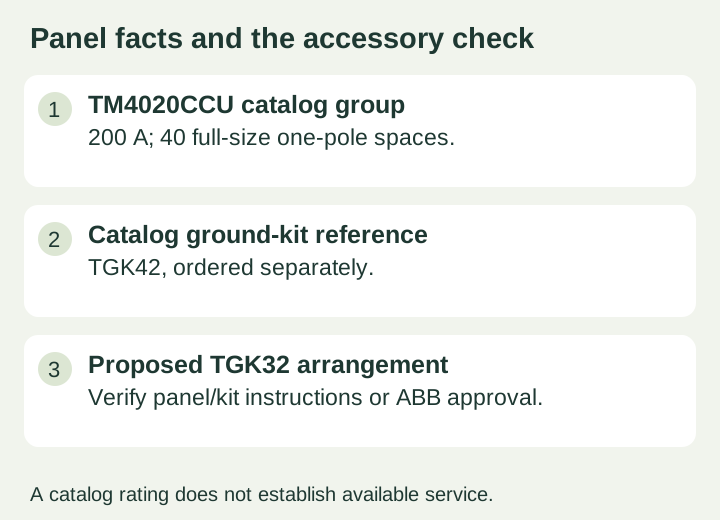
ABB’s PowerMark Gold catalog places the TM4020CCU in its 200 A main-breaker group and lists 40 full-size one-pole spaces. Those are useful starting facts.
But a 200 A rating does not mean the utility delivers 200 A to the house. It also does not approve a feeder size or prove that the proposed loads fit. The supply arrangement and load calculation still have to agree with the equipment.
I would also keep “spaces” separate from a promised circuit count. Some breakers use more than one space, and any use of tandem breakers depends on the actual panel label and approved equipment. Forty spaces are not permission to improvise forty more.
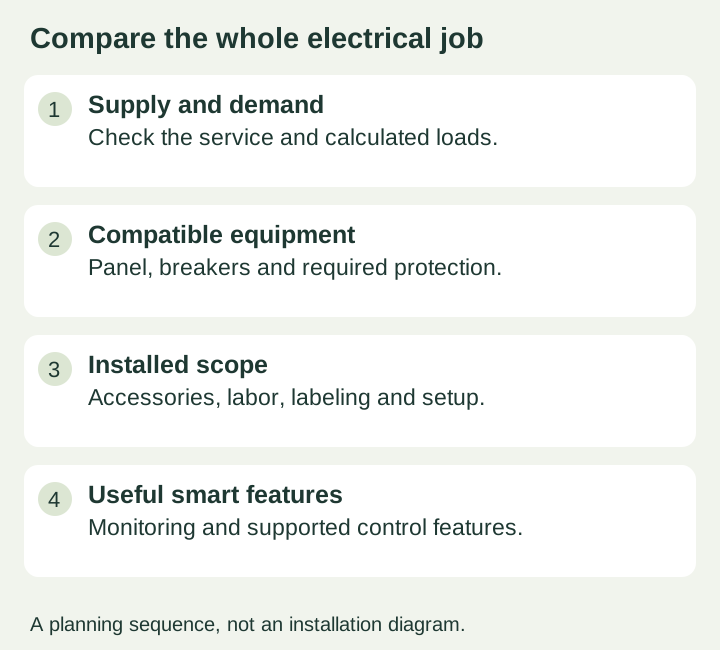
Before comparing apps, I would want the electrician to check:
- The actual service and calculated demand.
- The panel’s voltage and fault-current ratings for the installation.
- The breakers the panel is listed to accept, including required protective functions.
- Space for the proposed circuits and sensible future expansion.
- An appropriate enclosure and location for the conditions.
That list is less exciting than a dashboard on a phone. It is also the part that makes the dashboard worth having.
A conventional panel still needs the right protection
“Standard panel” can be a misleading phrase. It does not mean ordinary breakers everywhere, with shock protection left off the shopping list.
GFCI, AFCI, and any other required protective functions depend on the circuits, equipment instructions, and applicable rules. They need to be included in both options. A comparison that prices a basic conventional panel against a fully equipped smart system is comparing two different jobs.
The same goes for safety claims. I would not call a conventional panel inherently safer just because it has fewer connected features. Nor would I assume a smart breaker stops providing its protective function when the Wi-Fi disappears. Communications features and electrical protection have different jobs; the chosen product’s documentation needs to explain both.
What would the smart features actually do for me?
The most useful smart-panel question is specific: what information or control would change a decision?
Circuit-level energy monitoring could help identify which loads are using electricity and when. Historical views could make it easier to compare operating patterns. Supported remote switching could be useful in some situations, provided the equipment and use case allow it.
But “smart breaker” is not one universal product. Leviton, for example, distinguishes its generations. Its second-generation smart breakers support remote on and off with the LWHEM interface. Its first-generation products could be remotely tripped but not remotely turned back on.
There is another important distinction in Leviton’s guidance: a breaker that has tripped requires manual restoration. Remotely switching a circuit during normal operation is different from restoring power after a protective trip. An app should never become a way to ignore the reason something shut down.
For my comparison, I would write down the exact feature, the compatible hardware, and the extra setup it needs. “Smart” on the box is a beginning, not a specification.
Compare the whole installed job
A useful quote would include the enclosure, compatible breakers, required protection, accessories, installation, labeling, and commissioning. For the smart option, it would also include the required interface and communications setup.
Then I would ask about replacements: which exact parts would be available locally, what would have to be ordered, and who would service the system? These are questions to verify in Panama, not assumptions to make from a US catalog.
An energy monitor added later is another possibility to investigate. It is a separate compatibility question, though. I would not promise that any sensor or monitoring kit fits the TM4020CCU or that monitoring alone provides the remote-control features of a smart-breaker system.
Without matched quotes, I would leave dollar savings out of the article. A confident-looking price comparison built from different scopes is still a bad comparison.
| Question | Conventional option | Smart option |
|---|---|---|
| Protective functions | Include all required compatible protection. | Include all required compatible protection. |
| Energy visibility | Optional compatible monitor assessed separately. | Check exact monitoring hardware and capabilities. |
| Remote switching | Not assumed. | Depends on product and generation. |
| Installed cost | Include accessories, labor and commissioning. | Also include required interface and setup. |
The ground-bar detail deserves its own check
This is where a small catalog detail matters. ABB’s catalog associates the TM4020CCU with the TGK42 equipment ground kit, ordered separately.
The TGK32 is a real 32-hole ground-bar kit, but its product description alone does not establish that it is approved for this panel. A proposal to use two TGK32 bars needs the panel and accessory instructions, or manufacturer confirmation. Neat wiring is welcome. Neat wiring with the wrong accessory is not an upgrade.
The panel’s role matters too. Service equipment and a downstream distribution panel have different neutral-to-ground bonding requirements. Extra ground bars do not increase electrical capacity, and they do not authorize a new neutral-to-ground connection downstream.
This is a label-and-instructions check for the qualified installer, not a reason to remove a live panel cover for a better photograph.
My decision checklist
For El Espino, I would put the decision in this order: a correctly designed electrical system, compatible protective equipment, practical service support, a complete installed price, and then features I would genuinely use.
A conventional GE load center deserves consideration on those terms. So does a properly specified smart alternative. The useful result is a system that suits the house, with the choice explained by real project needs rather than a general argument about whether everything should have an app.
Even the circuit directory has a role here. Whichever panel is selected, “miscellaneous” is not the label I would want to read while trying to find the refrigerator circuit.
Sources and scope
- ABB PowerMark Gold load-center catalog: TM4020CCU catalog configuration and ground-kit reference.
- ABB TGK32 product record: kit description, not evidence of this panel pairing.
- Leviton remote-control capabilities by generation.
- Leviton monitoring and breaker status.
This is a planning comparison for our El Espino project. Final equipment selection and installation must follow the actual labels, manufacturer instructions, utility requirements, and applicable local rules with a qualified electrician.