Materials · Exterior timber
Choosing Exterior Timber: Match the Wood, Treatment and Exposure
By Best House Ideas · November 8, 2026
External sources open in a new tab so you can keep your place.
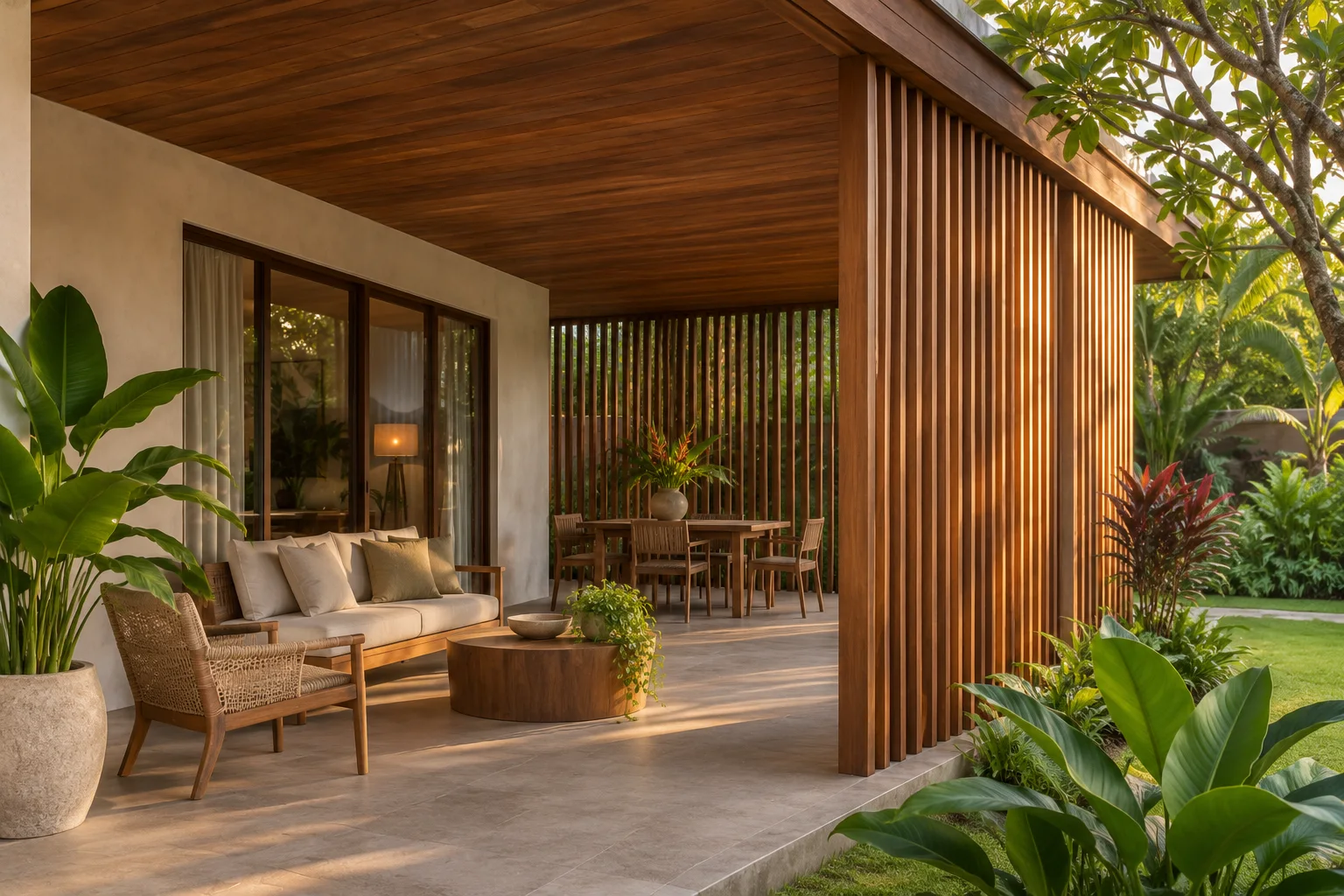
A timber screen sheltered beneath a veranda roof and a board repeatedly wetted beside a garden may look similar on a materials list. They face different conditions. Choosing wood by color, a familiar species name or the word “treated” leaves much of the decision unanswered.
The useful comparison connects three things: the wood being supplied, the basis for its resistance to biological attack, and the conditions it will encounter. This guide explains those connections for an owner reviewing exterior timber proposals. U.S. Forest Products Laboratory research and AWPA standards provide educational examples, not Panama approvals or a specification for your house.
Start with the part of the house
List the actual timber components before asking which species is best. Separate a decorative screen from a load-bearing member, and a sheltered soffit from exposed decking. Describe where rain, splash, irrigation, soil or accumulated leaves may reach each component. Include whether the wood can dry and whether it can be inspected or replaced.
This changes the purchasing conversation. “Timber for the veranda” becomes several identifiable uses with different consequences if a component deteriorates. A beautiful sample can help select an appearance, but the same sample cannot establish suitability for every location.
AWPA's Use Category System starts with expected service conditions, then considers the product, species and preservative together. [3] That is a useful order of questions even when the proposed product follows a different documented standard.
Understand what natural durability refers to
Decay fungi use wood's structural components as food. Their growth depends on suitable moisture, temperature and oxygen. The USDA Forest Products Laboratory explains that some heartwood has natural resistance associated with its extractives, the naturally occurring substances within the wood. The resistance varies with the wood and the attacking fungus. [1]
Heartwood is the inner wood of the tree; sapwood is the outer wood beneath the bark. For exterior purchasing, the important distinction is that a species' heartwood reputation does not automatically extend to its sapwood. The Wood Handbook reports low decay resistance in untreated sapwood of essentially all species. It also describes substantial variation within a species and even within one tree. [1]
Ask which species is being supplied, using the scientific name where available, and what the supplier can document about the heartwood and sapwood in the product. Do not try to settle the question from a photograph or color alone. In some species, heartwood and sapwood are difficult to distinguish visually. [1]
Read species examples with their limits attached
USDA's Table 14–1 groups woods by average heartwood decay resistance. These selected examples show why a broad sales description is inadequate; they are not recommendations or a local availability list. [1]
| Entry in the USDA table | Heartwood group in that table | What an owner should take from it |
|---|---|---|
| Ipe, also listed as lapacho | Very resistant | The evidence concerns identified heartwood, not every board sold under a familiar trade name. |
| Teak, old growth; teak, young growth | Very resistant; moderately resistant, respectively | Even one familiar name can conceal materially different evidence. This is not a recommendation to buy old-growth timber. |
| Balsa and cativo | Slightly or nonresistant | A tropical wood name alone is not evidence of high decay resistance. |
On a small screen, swipe the table horizontally to see every column.
The table's own notes warn of variability, limited data for some entries and potentially lower resistance in warm, humid or ground-contact conditions. [1] Use it to sharpen a supplier question, not to assign a guaranteed lifespan. Nor should a fungal-decay classification be relabeled as a universal termite rating. Keep the specific biological hazard attached to the claim.
Understand what preservative treatment adds
Preservative treatment introduces a wood-protection system rather than relying only on natural resistance. Its effectiveness depends on the preservative and on appropriate penetration and retention: how it enters the wood and the amount retained. Species differ in treatability; heartwood generally resists treatment more than sapwood. [2]
That creates an important distinction. A wood zone with stronger natural resistance is not necessarily the easiest zone to treat. “Pressure-treated” names a treatment process, but it does not identify the complete product or prove suitability for every exposure. Ask for the species, preservative, treatment standard and intended use together.
On a small screen, swipe or scroll the diagram horizontally to read every panel.
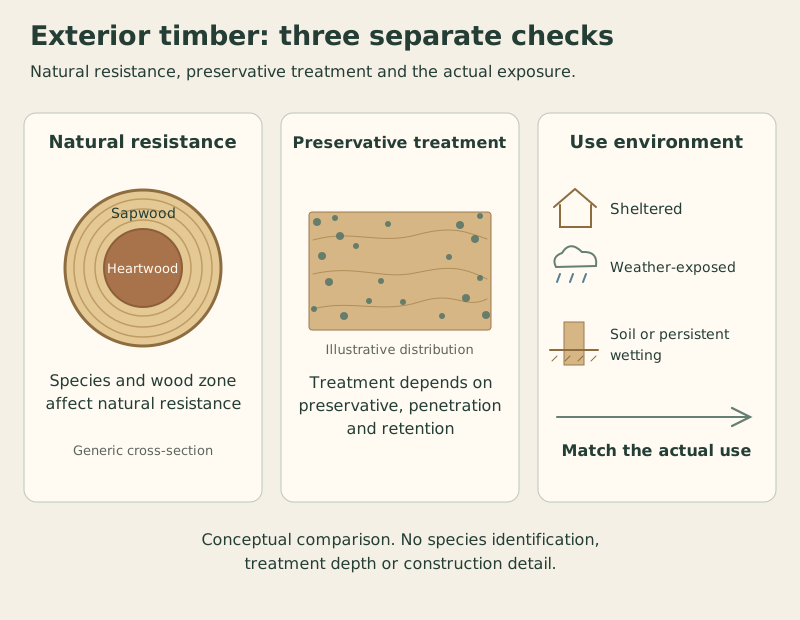
The diagram separates the wood's natural characteristics, treatment evidence and service exposure. It does not depict a guaranteed protective shell or an installation detail.
The Wood Handbook discusses several preservative systems because their properties and appropriate uses differ. [2] A larger retention number is therefore not a stand-alone score for a better product. Compare it against the requirements for that exact species, preservative, product and use, rather than ranking unlike chemicals by one number. AWPA's homeowner examples make that dependence explicit. [5]
Read a use category as a description of service
AWPA categories are helpful when a supplier offers a product identified to that system. They are not a universal grading scale for all timber. AWPA publishes annual standards, so the project record needs the applicable edition and product requirements, not just a copied internet chart. [3]
The following are orientation examples from AWPA's publicly linked U1-24 excerpt. They deliberately omit treatment quantities and detailed application rules. [4]
| Designation | General distinction it describes | Question to resolve |
|---|---|---|
| UC2 | Interior use with possible dampness, protected from weather | Is someone offering an interior-use product for an exterior location? |
| UC3A | Protected above-ground exterior uses, subject to the commodity-specific requirements | What protection and water-shedding assumptions support this selection? |
| UC3B | Exposed above-ground exterior uses | Do the actual conditions fall within this category, including its exclusions? |
| UC4A | Ground-contact general-use conditions and certain demanding above-ground sawn-product uses | Has the specification considered the exposure and consequences of replacement? |
On a small screen, swipe the table horizontally to see every column.
Above ground does not automatically mean UC3B. The excerpt has special requirements for sawn components, including tropical exposure, repeated wetting and some critical or difficult-to-replace uses. [4] Have the specifier resolve those conditions before accepting a category. This U.S. framework does not establish which treatment is authorized or suitable locally.
Separate biological protection from the finish
A proposal may combine naturally durable timber, preservative treatment and a surface finish. Ask what each contributes rather than treating them as interchangeable descriptions.
The Wood Handbook describes water-repellent preservatives as products that slow water entry, while explaining that their biological protection still depends on preservative penetration and retention. [2] A coating described as a stain or water repellent should carry only the functions its documentation supports. An attractive finished surface does not certify the treatment beneath it.
For the intended finish, request its exact product documents and compatibility requirements for the supplied wood. Keep desired color, weathering appearance and maintenance expectations in a separate part of the comparison. This prevents a color approval from becoming an accidental approval of the durability claim.
| Offer description | Evidence needed before comparing it | Separate question still open |
|---|---|---|
| Naturally durable timber | Species identity, supplied wood zone and relevant durability evidence | Does that evidence fit this exposure and component? |
| Preservative-treated timber | Identified treatment system and conformance documentation for the intended use | Is the specified product the one actually supplied? |
| Timber with a decorative or water-repellent finish | Exact coating and its documented functions | What establishes the wood's biological protection? |
On a small screen, swipe the table horizontally to see every column.
These are comparison prompts, not a ranking. The useful offer is the one whose evidence matches the work being proposed.
Keep the product identity through delivery
For AWPA-identified material, the association's specifier guidance lists the standard, use category, preservative name or code, retention and manufacturer/location as useful end-tag information. It also explains the inspection-agency mark associated with third-party quality control. [6] Retain legible copies with the order and identify the house components to which they belong.
If an offer uses another evaluation or standard, request that complete reference and have the project's reviewer assess it. Absence of an AWPA tag is not something this guide can turn into a verdict on every product sold in another market. It is a reason to establish what evidence actually supports the offer.
Before approving the timber package, close these questions:
- Which component and location does each product serve?
- What species and supplied heartwood/sapwood description are documented?
- Is the protection claim based on natural durability, treatment, or both?
- Which exposure assumptions, standard edition and product documents support the selection?
- Who has checked structural requirements and connections separately from durability?
- What finish, care instructions, warranty limits and replacement access are included?
- How will delivery identification remain linked to the installed material?
A product substitution should reopen those questions. Keep the revised evidence with the construction-change record, rather than accepting “equivalent treated wood” without an identity. For the house-wide pest plan, continue with termite-protection planning.
Sources and further reading
- USDA Forest Products Laboratory, Wood Handbook, Chapter 14: Biodeterioration of Wood, 2021, particularly pages 14–1 and 14–3 to 14–6 and Table 14–1.
- USDA Forest Products Laboratory, Wood Handbook, Chapter 15: Wood Preservatives, 2021, particularly pages 15–1 and 15–10 to 15–12.
- American Wood Protection Association: Use Category System. Explains the selection sequence and annual standards updates.
- AWPA: Public excerpt of Standard U1. The downloaded excerpt is marked U1-24, copyright 2024; used for limited explanatory examples, not claimed as the latest complete edition.
- AWPA: Information for Homeowners. Its preservative/retention table is specifically for Southern pine; numerical values are not reproduced here.
- AWPA: Information for Specifiers of Treated Wood Products. End-tag information and treatment identification.
Sources checked November 8, 2026. Species examples are research classifications, not lifespan predictions, recommendations to source old-growth wood or statements about Panama supply. No treatment recipe, application method, structural sizing or connection design is provided.