Durability · Termite planning
Termite Protection: What to Verify Before Building
By Best House Ideas · November 7, 2026
External sources open in a new tab so you can keep your place.
A termite-protection plan should identify the threat, explain what each measure is intended to do and make future inspection possible. A confident product claim is not enough.
Before choosing a detail, bring the builder and a qualified local pest-management professional into the same discussion. Ask who is responsible for design coordination, installation, inspection and the records the owner will receive.
A metal shield is not a stand-alone guarantee
Mississippi State University Extension explains that properly installed termite shields can help make infestations easier to detect, but are not effective stand-alone preventive treatments. Its guidance also emphasizes avoiding wood debris, soil-to-wood contact and moisture problems. [1]
That does not mean every physical barrier has the same function or evidence. Ask which exact system is proposed, what it has been tested for, and what its installation and inspection requirements are. A piece of metal described as a “termite shield” is not automatically equivalent to a tested complete system.
The university publication addresses Mississippi and subterranean termites. Its local treatment requirements, species assumptions and dimensions should not be copied into a Panama project.
Read the purpose on the product documentation
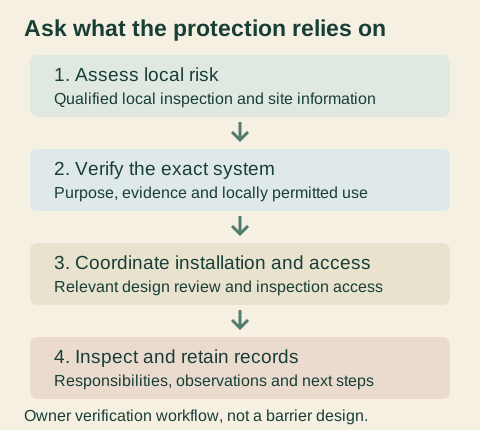
EPA distinguishes products intended to protect structures from products that merely kill termites they contact. It also stresses label directions and appropriate professional application. [2] Those U.S. rules do not establish authorization to use a product in Panama; local requirements still need checking.
A waterproofing additive, joint sealant or ordinary flashing should not be credited with structural termite protection without evidence for that application. Ask the supplier for the exact supporting document. If the evidence is missing, record the claim as unverified rather than building a detail around it.
Compare functions, not promises
| Proposed measure | What the evidence supports | What still needs verification |
|---|---|---|
| Metal termite shield | Can aid detection; not effective stand-alone prevention [1] | Suitability, details, inspection access and its role in the whole plan |
| Product labeled to kill termites | Killing contacted insects does not establish protection of a structure [2] | Exact labeled purpose and locally authorized use |
| Waterproofing or joint-sealing product | Its documented purpose must be checked; no termite performance assumed | Evidence specifically supporting any termite-protection claim |
| Inspection and maintenance plan | A way to keep observations and responsibilities current | Who inspects, what is accessible, and what triggers further action |
On a small screen, swipe the table horizontally to see every column.
The last two rows are owner verification questions, not certifications of any product. No service-life guarantee, installation dimension or treatment dose is supplied.
Plan for what happens after construction
EPA's prevention guidance includes addressing leaks, drainage, nearby wood debris and periodic inspection. [2] Discuss how those concerns will be managed on the actual property, including after landscaping or later additions.
Ask the professional to identify areas that must remain visible or accessible. Then check whether finishes, storage or planting could obstruct them. Do not alter a structural connection or create an inspection opening without the appropriate design review.
Keep the plan in the handover file
Request a short record with:
- The areas and risks assessed, including any limits on access.
- The specified system and exact product documents.
- Who performed the work and when.
- Photographs of visible work, with their limits clearly stated.
- Inspection responsibilities and conditions of any service agreement.
- The contact and next step if suspicious activity is noticed.
Do not treat a photograph, a clean-looking surface or a material name as proof that a house is protected. If you find possible evidence of termites, arrange a qualified inspection rather than relying on a web diagnosis.
This guide does not validate a particular barrier on Arthur's houses. It is an owner briefing based on cited sources; local pest expertise and applicable Panama requirements must guide the actual plan.
Continue with the house handover file, moisture observations, and pre-build planning.