El Espino · Cooling equipment planning
Is the Bosch SM048 Worth Considering for My El Espino House?
External sources open in a new tab so you can keep your place.
My house in El Espino is about 2,580 sq ft (240 m²), on a finca of about 21,530 sq ft (2,000 m²). That is the setting for this cooling comparison. The question that matters is: would a Bosch SM048 make sense here?
It’s tempting to jump straight to the equipment. Find a model, compare an efficiency number, and imagine a comfortable house with smaller electric bills. With this particular Bosch, I would slow down one step earlier. The full model identity, the water loop, and the person who can service it locally all belong in the conversation before the price.
This is my planning evaluation for El Espino, not a hands-on review. I don’t have verified installation records or measured savings to share. Here’s how I would separate a promising idea from an expensive assumption.
First, which SM048 are we talking about?
“Bosch SM048” sounds specific. For comparing equipment, it still leaves important details open.
Bosch’s discontinued-product documentation separates SM Rev A/B, SM Rev C, and SM Split equipment. Those distinctions matter. A feature on the Rev C page cannot simply be attached to every older unit carrying an SM name. A split system also has separate equipment identities to match, rather than one packaged cabinet supplying the entire answer.
The Rev C page describes two-stage water-to-air equipment and its own diagnostic features. That is useful background, but I would want the full nameplate before choosing a manual or quoting a performance table for an actual machine.
Here’s the comparison I would keep beside any offer:
| What I need to establish | Why it changes the decision |
|---|---|
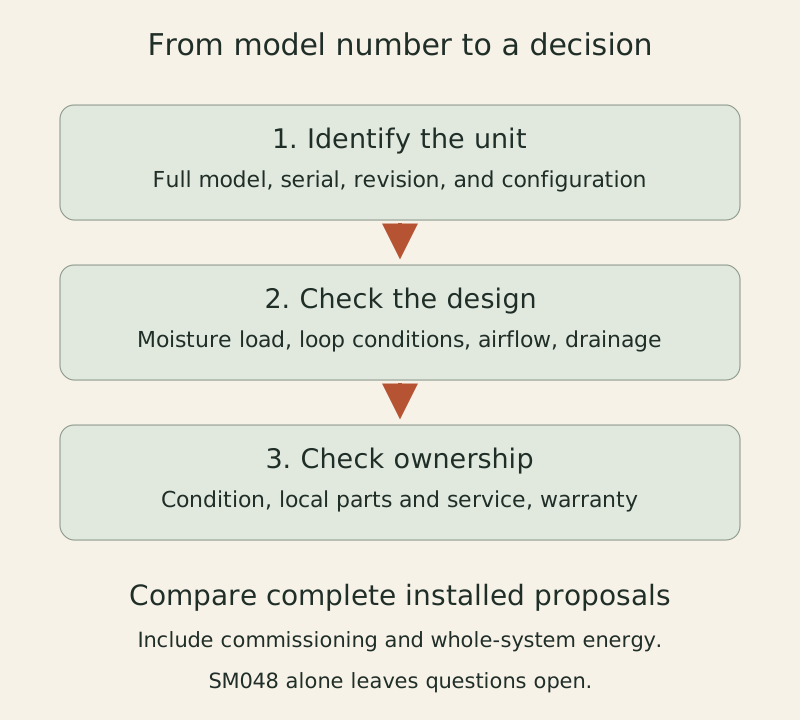
| Full model, serial number, and revision | Identifies applicable documentation and replacement components |
| Packaged or split configuration | Determines which equipment and matched components are involved |
| Electrical and refrigerant information | Lets the installer check compatibility and service requirements |
| New old stock, used, or already operating | Changes the questions about condition, commissioning, and support |
| Written local parts and service arrangements | Shows how a repair would actually happen |
A short model number in a listing cannot do all of that work.
The water has to carry the heat somewhere
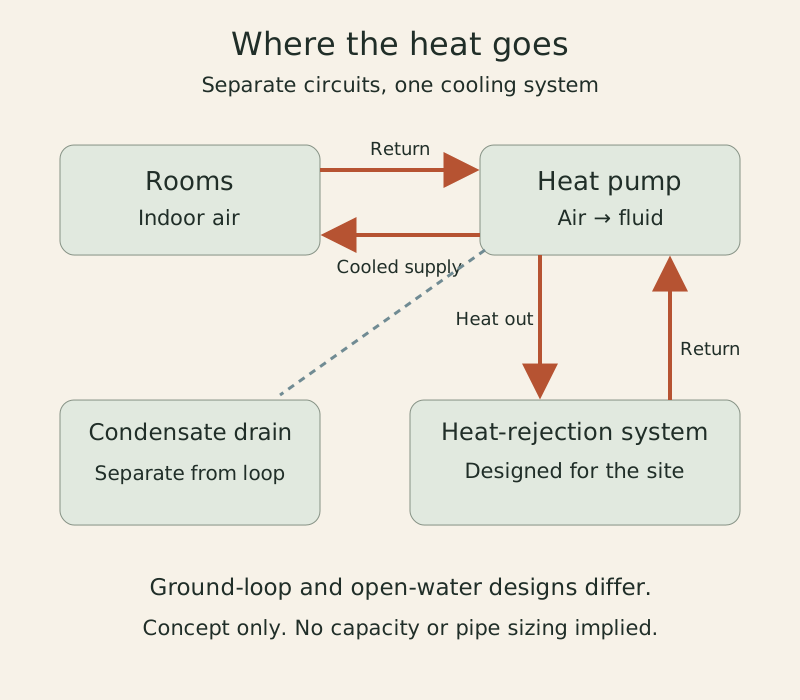
A water-to-air heat pump removes heat from indoor air and transfers it into a water or fluid circuit during cooling. That circuit needs a designed way to release the heat. Calling the equipment “geothermal” doesn’t establish how that will happen on my finca.
For a closed ground loop, the buried circuit and surrounding ground become part of the cooling system. An open-water arrangement raises different questions about water supply, discharge, quality, permissions, and maintenance. These are different designs, not interchangeable plumbing options.
The size of my lot is useful context for a site discussion. It does not tell me the available ground conditions, suitable drilling or trenching locations, or how much heat a proposed loop can reject. I would need a site assessment and a loop design based on the actual building load.
The same applies to the house. I would not turn 2,580 sq ft (240 m²) into a cooling capacity by using a floor-area shortcut. Roof construction, shade, glass, air leakage, occupancy, and ventilation all affect the result.
For El Espino, humidity belongs in the main calculation
A comfortable room needs more than a lower temperature. There is also moisture to remove, especially when outdoor air enters through ventilation, leaks, or open doors.
Cooling equipment has both sensible capacity, which lowers air temperature, and latent capacity, which removes moisture. The balance depends on operating conditions and the complete installation. Two-stage operation can be useful, but the words “two stage” alone don’t guarantee good humidity control.
I would ask the designer to show what happens during humid periods with a modest temperature load. That is where equipment selection, airflow, controls, and operating time have to work together. An oversized system can satisfy the thermostat quickly while leaving a moisture problem behind.
Condensate also needs a dependable route out of the house. Drain access, cleaning access, and protection against overflow are practical details worth settling while the installation is still on paper. Cold duct surfaces and poorly sealed insulation can create another source of unwanted water, separate from what collects in the drain pan.
An efficiency number needs its conditions attached
The useful comparison is how the proposed system will perform at the water and air conditions it will actually see.
Manufacturer ratings are taken under specified test conditions. They are not a prediction of my El Espino electric bill. Water temperature, water flow, entering air conditions, and airflow all influence cooling performance. Loop circulation also uses electricity, so a unit rating is only one part of the whole-system energy picture.
I would want the engineer to compare the exact unit against expected loop temperatures across the cooling season, including sustained hot-weather operation. A water loop that looks attractive at the beginning of a calculation still needs to carry repeated heat rejection over time.
Before I compare performance figures, I need the engineering table for the exact unit and the water and air conditions behind each number.
Discontinued equipment changes the ownership question
Bosch lists the SM families discussed here among its discontinued geothermal products. That doesn’t prove that parts are unavailable or that an existing installation is a bad investment. It does make support something to verify before relying on an offer.
An already-running system with known maintenance and an experienced technician is a different proposition from importing an unfamiliar discontinued unit for a new installation.
For El Espino, I would ask who can identify and obtain the correct controls, blower components, compressor, and heat exchanger for the serial number in question. I would also want realistic lead times, the applicable warranty in writing, and confirmation of who handles a claim where the equipment will be installed.
An archived manual is helpful. It is not proof of parts sitting on a nearby shelf.
Water quality belongs in that ownership discussion too. The exchanger material and the exact manufacturer requirements matter. A different exchanger alloy is not blanket permission to use any available water, and certainly not a reason to assume seawater is acceptable.
Would I put it on the shortlist?
Yes, as a conditional candidate for a properly designed, locally supportable system. I would compare a complete installed proposal against a currently supported alternative, including loop work, electrical work, ductwork, controls, commissioning, and maintenance access.
The interesting number is the cost of a working system that can stay working. A low equipment price can lose its appeal if the rest of the design is unresolved. Equally, I wouldn’t dismiss a sound existing installation just because its product line has been discontinued.
To turn this planning article into a personal review, I need a clear photograph of the complete nameplate and confirmation of whether the equipment is proposed, purchased, installed, or operating. For an operating system, commissioning readings, maintenance history, indoor temperature and humidity records, and electricity data would let me discuss actual results. A savings claim would also need a credible comparison and the other changes that affected consumption.
For now, my answer for El Espino stays practical: identify the exact machine, design the water and air sides together, and establish local support. Then the SM048 can be judged on a real proposal rather than the promise of a model number.
Sources and scope
- Bosch discontinued geothermal products: product-family and discontinuation reference.
- Bosch SM Rev C product documentation: Rev C description; its features must not be generalized to other revisions.
This is an equipment-planning discussion, not a site design, installation instruction, or report of measured performance.