A Home Battery Needs a Place in the Plan, Not Just a Spare Wall
By Arthur · An illustrated owner’s guide
Find the place while it is still a drawing.
For entertainment and general understanding. These illustrations and questions are not a construction specification or a legal, engineering or site-specific professional assessment.
Imagine choosing a home battery and then discovering that its proposed home is the little cupboard already occupied by beach chairs, cleaning supplies and a ladder with strong opinions about personal space.
I would settle the location conversation earlier. A stationary battery is equipment with a particular identity, operating limits and installation requirements. “There’s a wall over there” is a beginning, but quite a lot of planning belongs between that sentence and an order.
Here I’m discussing permanently installed home energy storage, not a fuel-burning generator or a portable power pack. I would leave system sizing, connections, mounting, separation and ventilation design to qualified professionals. My role is to bring useful questions and ask for documented answers.
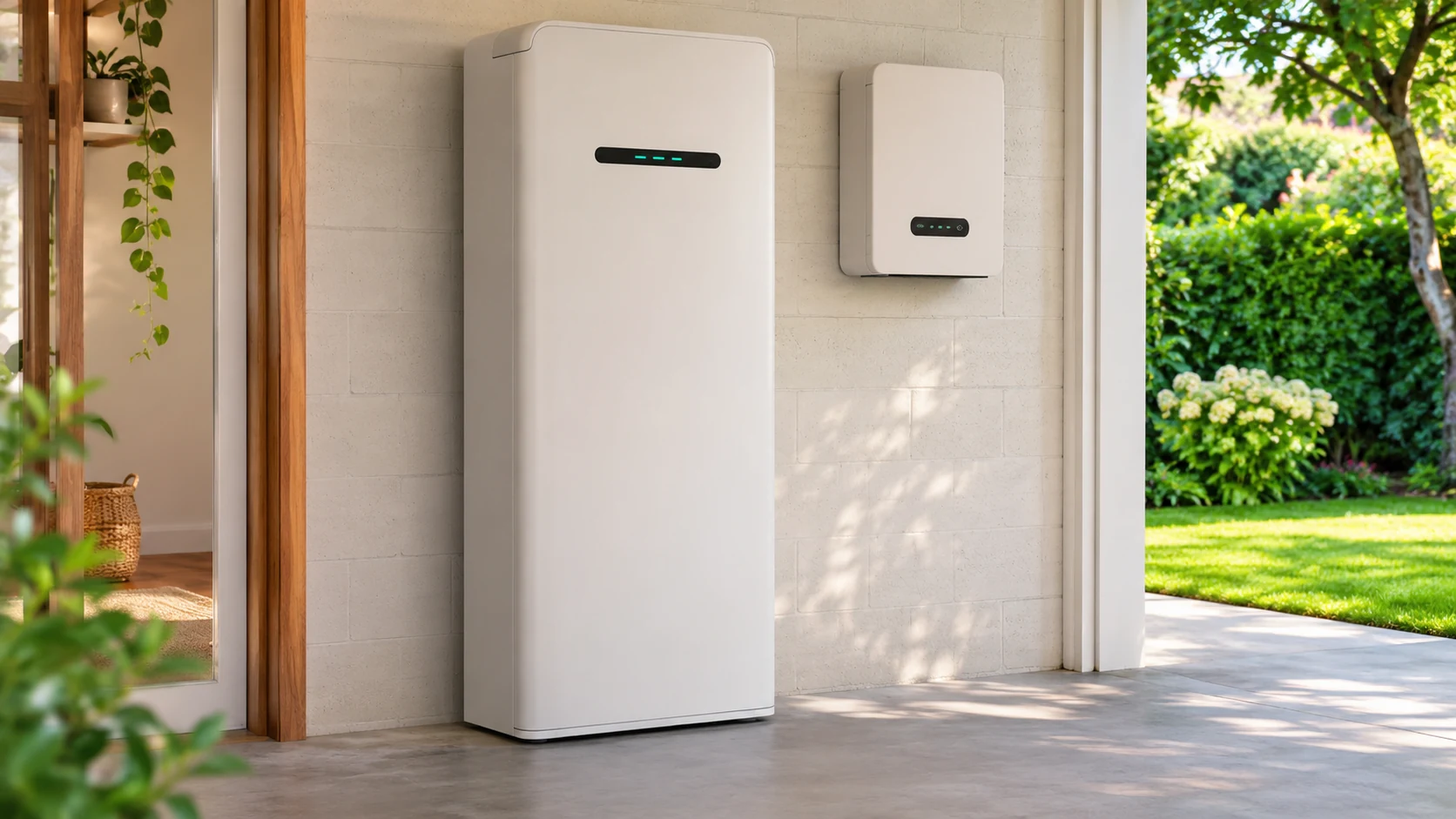
A home-battery service area. Installation requirements need qualified review.
First, I’d put an exact name on the equipment
I’d ask for the manufacturer, model, battery technology and proposed system components. If the proposal says only “lithium battery,” I’d send that description back for more detail. I would not assume different chemistries or products have identical hazards, controls or environmental permissions.
The current installation manual and owner manual should match the exact model and the market in which it will be supplied. I’d also ask whether the proposed inverter, controls and any expansion units are part of the documented system. A familiar brand name does not answer every compatibility question.
For a Panama home, I’d ask the local designer to identify the electrical, building, utility and fire-authority requirements that apply. A US or Australian document can reveal useful questions without becoming Panama law.
I’d read the temperature line and its footnotes
A tropical location deserves more than a check against the weather app. I’d ask the designer how the proposed position will behave through the day, including direct sun and heat trapped around the equipment. I wouldn’t select a cooling arrangement myself.
One concrete example shows why the details matter. The US Powerwall 3 specification for model family 1707000-xx-y lists operation from −20°C to 50°C and humidity up to 100%, condensing. Those are that product’s operating figures, not a rule for home batteries generally. Its storage conditions are listed separately. Tesla: Powerwall 3 Specifications, environmental section ↗ (opens in a new tab)
The US installation guidance also says charging and discharging power may be reduced between 40°C and 50°C. Where temperatures regularly exceed 40°C, Tesla recommends keeping this model out of direct sun. “Within the operating range” therefore does not promise unchanged performance. I’d ask the supplier to explain the expected behavior of the actual proposed system. Tesla: Powerwall 3 Operating Temperature Range, US Gateway 3 manual ↗ (opens in a new tab)
For another model, I’d start again with its own documentation. This reading example is not a product recommendation or confirmation of local availability.
Rain, salt and flooding need separate answers
I’d make a short exposure list: humidity and condensation, wind-driven rain, direct sun, salt-laden air, runoff, irrigation and any flood history. Then I’d ask which conditions the exact equipment permits and which need a different location or professional design response.
An enclosure rating would not end that conversation. In the same US Powerwall 3 specification, the battery and power-electronics compartment has a different ingress rating from the wiring compartment. I would not describe the entire assembled system using the most impressive number on the page. Tesla: compartment-specific environmental ratings ↗ (opens in a new tab)
For coastal exposure, I’d request written confirmation covering the actual model, proposed site conditions and warranty limitations. If the supplied manual leaves salt exposure unresolved, that is a question for the manufacturer. I wouldn’t fill the gap with a seller’s general description of “tropical suitability.”
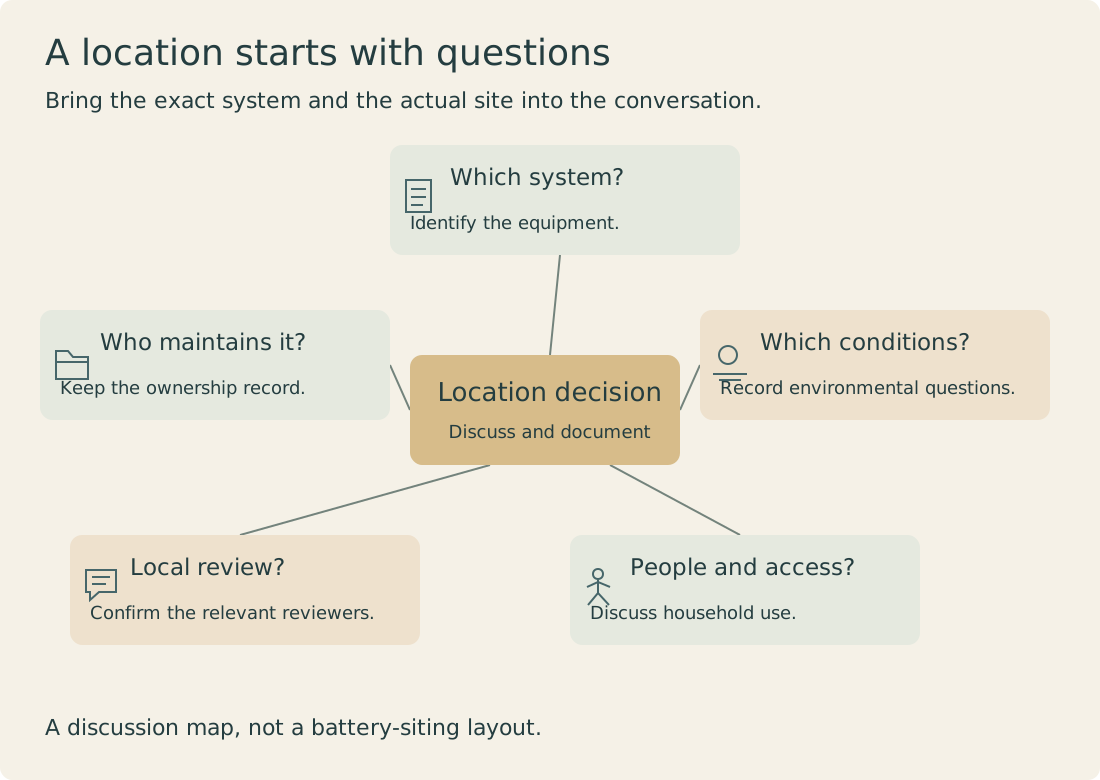
A location starts with questions
Bring the exact system and the actual site into the conversation.
Which system?
Identify the equipment.
Which conditions?
Record environmental questions.
People and access?
Discuss household use.
Local review?
Confirm the relevant reviewers.
Who maintains it?
Keep the ownership record.
Location decision
A discussion map, not a battery-siting layout.
Five questions for the qualified design team. This diagram does not approve a location or specify an installation.
Here’s the location conversation I’d bring
Home battery location: questions for the design team
Part of the decision
My question
Evidence I would request
Equipment identity
Which technology, model and system combination is proposed?
Matching current manuals and product records
Heat and humidity
What conditions and performance limits apply here?
Model-specific limits and site assessment
Rain, salt and flood
Which exposures are permitted or excluded?
Manufacturer clarification and design response
People and access
How are escape routes, service access and everyday use protected?
Qualified location review and authority requirements
Long-term ownership
What changes, maintenance and warranty conditions matter?
Owner instructions and named service contacts
This is an original discussion aid. It does not rank locations or establish that an installation is acceptable.
Supporting visual: A central “Location decision” card surrounded by five separate questions: “Which system?”, “Which conditions?”, “People and access?”, “Local review?” and “Who maintains it?” No floor plan, dimensions, electrical paths or installation details.
I wouldn’t hide it in a decorative cupboard
The location review should include normal movement around the home, access for service and emergency escape. Fire and Rescue NSW advises siting residential battery systems away from entries and exits, with suitable surroundings and qualified installation. Its legal references apply to New South Wales, Australia, not Panama. I’d have the local designer and relevant fire authority resolve the actual location requirements. Fire and Rescue NSW: Residential Battery Energy Storage Systems ↗ (opens in a new tab)
I would show any proposed screen, enclosure or cupboard to the design team before it becomes part of the architecture. Tesla’s Powerwall 3 owner guidance, for example, requires the surrounding area to remain clear for airflow and says not to install things around or in front of it. An attractive cabinet cannot simply be added afterward. Tesla: Powerwall 3 Care and Maintenance ↗ (opens in a new tab)
The same review should consider vehicle impact where relevant and how replacement equipment would reach the location. I’d rather move a pencil line now than discover later that a permanently landscaped route blocks the service visit.
I’d want the emergency plan before the emergency
Ask for a short, system-specific household plan: warning signs, who to call, how to leave safely and what occupants must not attempt. Keep an accessible copy and the installer’s contact information without relying solely on an online account.
If a battery appears damaged, is smoking or presents other signs of danger, do not approach it to inspect, operate controls or try a repair. Leave the area; in an emergency, evacuate and call the local emergency service from a safe place, explaining that a stationary battery system is involved. Do not re-enter until authorities permit it. Fire and Rescue NSW also warns against restarting a damaged system. Its Australian emergency number is not a number to copy into another country’s plan. Fire and Rescue NSW: damage and emergency guidance ↗ (opens in a new tab)
I’m not providing a shutdown sequence or a firefighting recipe. Those are not things to improvise from a general house article.
The last page belongs to the next owner, too
My handover folder would include the installed system identity, approved location records, relevant inspection and commissioning documents, manuals, warranty terms, service contacts and emergency plan. I’d ask what owner care is permitted, what professional attention is needed, and what changes require a new review. Maintenance requirements must follow the actual equipment rather than a universal schedule borrowed from another brand.
Before accepting the proposal, I’d also ask who handles a warranty claim locally and what happens if a component needs replacement. The answer should be more useful than a distant email address and an optimistic shrug.
That is the place I want to reach: an exact system, an assessed location and a household that understands its limits. The beach chairs can have their cupboard back.
Research checked November 8, 2026. Entertainment and general owner education only. Product examples are from the cited US manuals; Australian guidance supplies general safety context. No Panama approval, installation design or claim of equal safety across battery technologies is made.
Sources behind the questions
Research checked 2026-11-08. External source links open in a new tab. Foreign sources explain principles, not Panama project requirements. No illustration establishes the performance of a real house.