Field notes · Before the work begins
Outdoor Outlets: I’d Plan the Afternoon Before Picking the Socket
Plan the afternoon before picking the socket.
For entertainment and general understanding. These illustrations and questions are not a construction specification or a legal, engineering or site-specific professional assessment.
Imagine a terrace with a comfortable table, a garden beyond it and one electrical outlet hiding behind the heaviest planter. Naturally, that is the planter nobody has moved since the beginning of recorded gardening.
I would rather settle the power questions while the garden is still on paper. Where will people actually use equipment? What might get wet? Which ordinary activity turns into an awkward cord across the walkway?
This is my brief for a qualified local electrician, not a wiring guide. I’m looking at fixed outdoor receptacles, their intended uses and their protection from the surroundings. Lighting design, pool installations and choosing conduit have their own conversations. I would not use this article to install, open or electrically test anything.

I’d start with what happens outside
“An outlet somewhere on the terrace” sounds reasonable until someone asks what it serves. I would list the actual activities: occasional cleaning, a planned outdoor appliance, seasonal decoration or maintenance work. Then I would identify the equipment, using its instructions and model information where available.
I’d separate regular use from occasional use. Something intended to stay connected deserves an explicit place in the brief. Something used twice a year still needs a sensible plan, but it should not quietly dictate the whole terrace.
On a simple landscape drawing, I’d mark activities and questions, leaving the electrician to propose fixed outlet locations. Include doors, walking routes, furniture, irrigation and places where children or pets spend time. I’d also say who needs to reach the equipment comfortably. These marks express household needs; they do not approve mounting positions or distances.
If the proposed arrangement relies on an extension cord living outside indefinitely, I’d reopen the design. ESFI describes extension cords as temporary equipment and advises against substituting them for permanent wiring. That is a planning signal to discuss adequate fixed provision with the electrician. ESFI: Extension Cord Safety Tips (opens in a new tab)
The roof doesn’t finish the weather conversation
A covered terrace gives me a starting observation, not an electrical classification. I’d describe wind-driven rain, roof runoff, irrigation spray, washing routines, sun exposure and any known flooding. Near the coast, I’d add salt exposure as a separate question for the supplier and electrician.
Leviton’s safety guidance identifies corrosion and damage from water and ultraviolet exposure as concerns for outdoor receptacles. Its document addresses US workplace products and standards; I am using that exposure distinction, not importing its code requirements into a Panama home. Leviton: Personnel and Facility Protection, receptacles section (opens in a new tab)
I’d ask which materials and product documentation support the proposed conditions, including any coastal limitations. “Outdoor” is too short an answer if the real question includes salt spray and regular washdown. Missing evidence stays on the unresolved list rather than becoming a hopeful assumption.
For an existing property, I’d describe weather effects I have already noticed from ordinary, safe use. I would not stand near equipment during rain to collect better observations. A planning brief does not need a dramatic field expedition.
I’d ask about the whole outlet assembly
The receptacle, its cover and its enclosure need to be considered together. I’d request their exact product identities, the matching instructions and confirmation that the proposed combination suits the location and intended use.
One distinction is especially easy to miss: protection when nothing is plugged in is different from protection while equipment remains connected. Leviton explains that a while-in-use cover protects the receptacle with a plug and cord connected, whereas an ordinary closed cover may protect it only when unused. That product-function distinction is useful beyond the US code discussion on the same page. Leviton: Understanding While-In-Use Covers (opens in a new tab)
I would ask the electrician to confirm suitability with the intended plug, cord and installed orientation. Does the specified cover close as its instructions require? Does the documentation cover that actual assembly? A catalog photograph with no plug inserted leaves the important part of my question unanswered.
I wouldn’t improvise a rain shield, enlarge an opening or substitute a convenient lid. Nor would I translate an IP marking into a different enclosure designation myself. I want the professional to identify the relevant ratings and explain their scope for the exact products.
Four things before a decision
Gather the information. Ask the electrician.
-
Activity
What will happen outside?
-
Exposure
What might reach the equipment?
-
Actual products
Which compatible assembly?
-
Professional review
What needs a documented answer?
- Agreed plan
Questions only: no location or installation is approved.
Four conversations I’d keep separate
| What I’m trying to settle | What I would bring | What I’d ask the electrician to resolve |
|---|---|---|
| Useful locations | Activities, equipment identities and walking routes | Fixed provision suited to the intended use |
| Weather and surroundings | Known rain, runoff, irrigation, salt and sun exposure | Location classification and product suitability |
| Connected use | Which equipment stays plugged in | Receptacle, cover and enclosure compatibility while in use |
| Long-term care | Who uses and maintains the space | Inspection, owner instructions and professional follow-up |
This is a qualitative conversation aid, not a compliance checklist. No row establishes that an installation is safe.
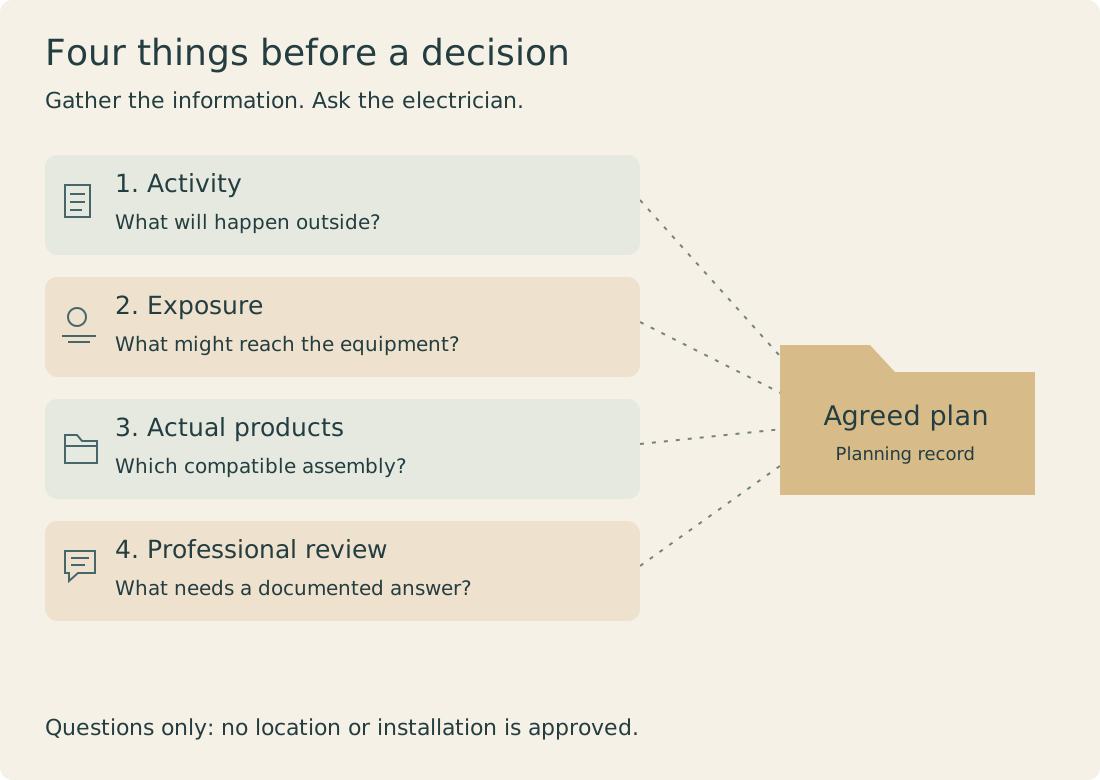
Supporting visual: Four separate cards labelled “Activity,” “Exposure,” “Actual products” and “Professional review.” They gather into a folder labelled “Agreed plan.” The arrows show information being collected, not wiring or electrical flow.
Protection devices do not make wet equipment safe
I’d ask the electrician which protective devices the installation needs, what each one does and how professional verification will be documented. I would also want the household instructions explained in ordinary language.
ESFI distinguishes overcurrent protection from ground-fault circuit-interrupter protection. A GFCI can reduce the risk of certain electrical shocks, but it cannot prevent every dangerous situation. Its outdoor booklet also warns against using electrical equipment that has become wet. I would never take a protective device as permission to handle wet plugs or use unsuitable equipment in rain. ESFI: Outdoor Electrical Safety Check, safety devices and water hazards (opens in a new tab)
The presence of a button, indicator or familiar label would not close the inspection question for me. I’m not offering owner testing or reset instructions here. Ask the qualified professional for the correct product-specific user guidance, including when to stop using equipment and call for help.
Pools, spas and water features belong in a specialist assessment. I would not extend an ordinary terrace-outlet plan into those areas by guessing a distance from the water.
I’d finish with a handover that survives the first rainy season
Before the work is handed over, I’d ask for the final outlet locations, exact product records, inspection or commissioning documentation, applicable approvals and any unresolved restrictions. For Panama, the qualified local professional must identify the requirements governing the actual property. The foreign sources here do not establish those requirements.
I’d also ask for a maintenance conversation: what the manufacturer permits an owner to do, what needs professional attention, and who supplies replacement covers or other compatible parts. Have the electrician explain any required checks and their timing. I wouldn’t invent a universal inspection interval for every climate and product.
During ordinary use, visible damage, a missing cover or apparent water entry would be a reason to stop using the affected point and seek qualified advice, not open it for a closer look. Keep people away from suspected electrical hazards; smoke, fire or immediate danger calls for local emergency help from a safe place.
Finally, I’d update the brief when furniture, irrigation or the way the terrace is used changes. The useful result is modest: power where the household needs it, conditions assessed properly, and records that explain the decisions. The planter can stay heavy. It just shouldn’t be the keeper of the electrical plan.
Research checked November 8, 2026. Entertainment and general owner education only. The images and planning questions are not site-specific professional advice.
Sources behind the questions
Research checked 2026-11-08. External source links open in a new tab. Foreign sources explain principles, not Panama project requirements. No illustration establishes the performance of a real house.
-
ESFI: Extension Cord Safety Tips (opens in a new tab)
Principle or local example only; scope and limitations are explained beside the claim.
-
Leviton: Personnel and Facility Protection, receptacles section (opens in a new tab)
Principle or local example only; scope and limitations are explained beside the claim.
-
Leviton: Understanding While-In-Use Covers (opens in a new tab)
Principle or local example only; scope and limitations are explained beside the claim.
-
ESFI: Outdoor Electrical Safety Check, safety devices and water hazards (opens in a new tab)
Principle or local example only; scope and limitations are explained beside the claim.