Field notes · Outside the house · Before planting
Where Would I Put the Outdoor AC Unit? Before the Garden Gets the Last Word
A useful corner needs more than a good hiding place.
For entertainment and general understanding. These illustrations and questions are not a construction specification or a legal, engineering or site-specific professional assessment.
An outdoor air-conditioning unit rarely makes the mood board. The terrace gets beautiful furniture, the garden gets dramatic leaves, and the machine gets whatever corner is still available. I would give it a place on the drawing much earlier. That small box has quite a few people to keep happy, including the person trying to sleep next door.
The aim is to choose a location that works with the actual equipment, the weather and the finished house. A tidy-looking corner is only a candidate until those questions have answers.
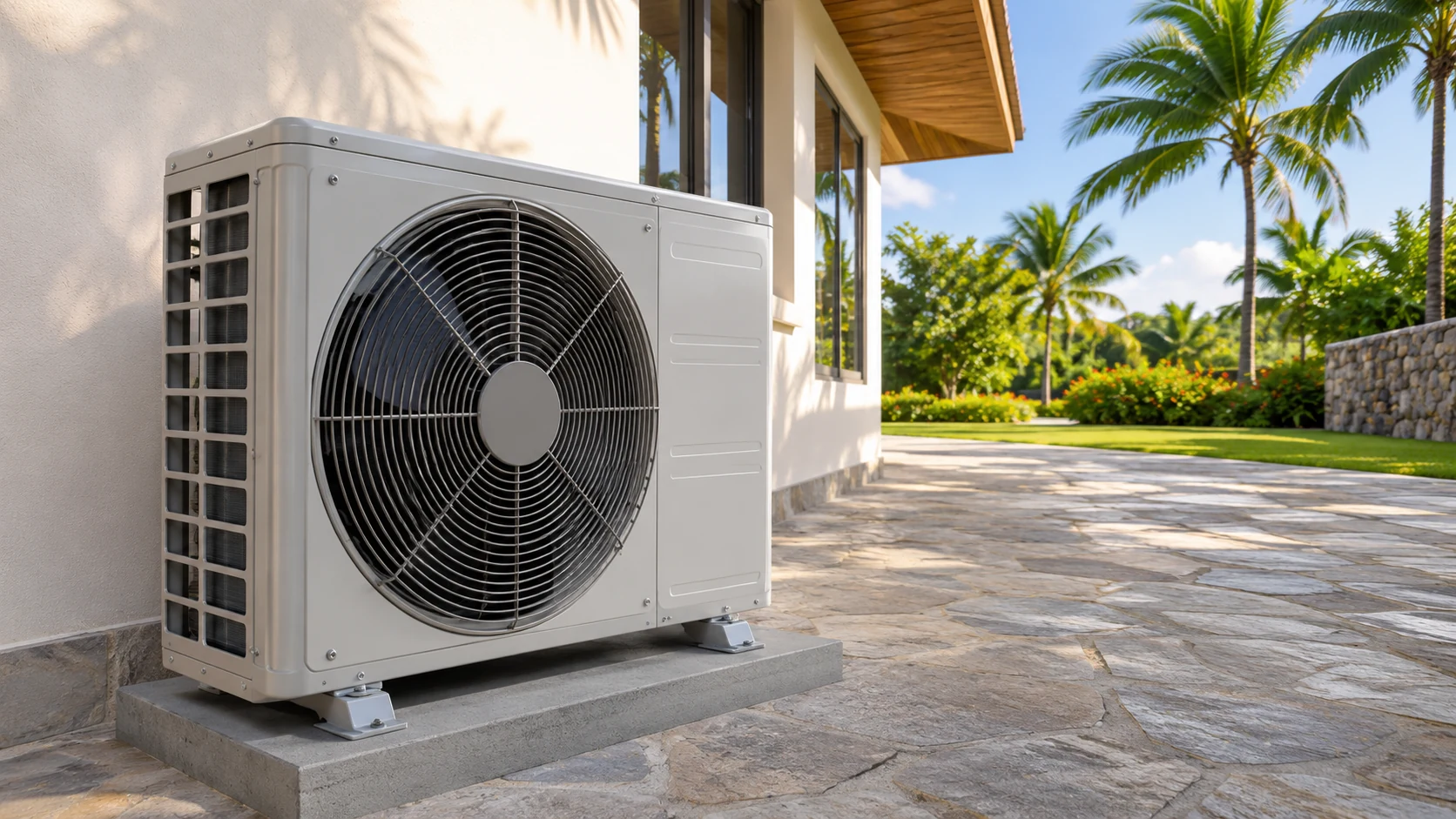
Start with the model, then discuss the corner
I would ask the installer for the exact proposed outdoor model, its current installation instructions and the documentation covering service access. Keep those with the drawing revision being reviewed. A brochure photograph is lovely, but it usually leaves out the person who has to remove a panel.
Manufacturers give requirements for particular equipment and arrangements. For example, Daikin's July 2018 installer reference guide 4P384972-1C covers ERLQ004–008CA outdoor units paired with EHBH/X04+08CB equipment. It includes location, airflow, service-space and environmental restrictions. That is an older European Altherma example, not the manual for your proposed tropical split system. Daikin model-specific installer guide (opens in a new tab)
My practical request would be: show which instructions apply to this model in this location. If the supplier substitutes equipment, review the location again before accepting the change. I would want the answer tied to a model number, not to “we always put them there.”
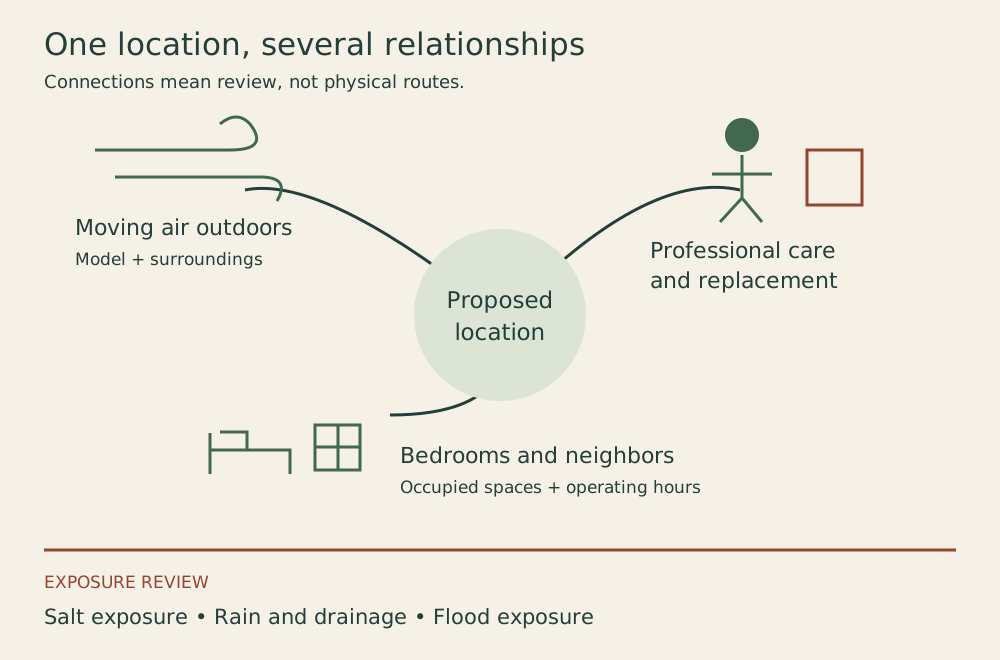
One location, several relationships
Connections mean review, not physical routes.
Proposed location
-
Moving air outdoors
Review the selected model and finished surroundings.
-
Professional care and replacement
Discuss safe service and eventual removal.
-
Bedrooms and neighbors
Review occupied spaces and operating hours.
Also review salt exposure, rain and drainage, and flood exposure.
Follow the heat out of the house
During cooling, heat removed indoors is released outdoors through the outdoor equipment. PNNL describes that heat-transfer route in its outdoor HVAC guidance. The unit therefore needs a suitable outdoor environment for doing its job. PNNL outdoor HVAC equipment (opens in a new tab)
Ask the installer to identify the air inlet and discharge on the proposed model and assess nearby walls, other equipment and the final landscape. Could discharged air return to the inlet? Daikin's cited guide specifically discusses wind-driven recirculation of discharge air and its effect on operation. Its numerical conditions are model-specific; I would not turn them into a universal garden rule.
There is no universal clearance in this article. Nor would I design a decorative screen from a photograph. If concealment matters, tell the designer early and have the equipment professional review the complete proposal. “We can hide it later” leaves an important decision until after everyone has fallen in love with the planting.
Picture a service visit and a future replacement
I would ask for two routes on the site plan: how a qualified technician reaches the equipment for normal service, and how the equipment can eventually leave the property. Daikin's guide explicitly calls for space to bring the unit into and out of the site. Those are useful questions even when your actual manufacturer is different.
Include the finished gate, planting, storage and adjacent furniture in the conversation. Ask whether safe professional access depends on moving something permanent, entering a neighbor's property or arranging specialist access equipment. Identify who is responsible for resolving that before installation.
A location can look wonderfully discreet in an empty construction yard and become awkward once the house is occupied. I would rather move a symbol on a drawing than explain why the new cupboard must leave first.
Keep access planning separate from owner maintenance. This is not an invitation to climb onto roofs, remove guards, open equipment or inspect electrical and refrigerant connections. Have qualified professionals establish safe access and the permitted owner-care tasks for the selected model.
Put the neighbor's bedroom on the drawing
When reviewing candidate positions, I would mark my own bedrooms, the terrace dining area and nearby occupied spaces on neighboring properties. Add likely operating hours. Cooling that runs while someone sleeps deserves more thought than a daytime showroom demonstration.
Sound figures need context. Sound power describes the rate at which a source emits acoustic energy, while sound pressure concerns sound at a particular position and distance. They are not interchangeable. ASHRAE Handbook: sound power and sound pressure (opens in a new tab) Surrounding surfaces and location affect what is heard. Daikin's explanation of sound ratings (opens in a new tab)
Ask which measure a quotation uses, under what operating conditions, and how the installed location has been assessed. A lower-looking number in another brochure may describe something different. I would also ask the local professional to identify applicable noise requirements; there is no invented decibel limit here.
If a sound-control measure is proposed, ask how its compatibility with airflow and service requirements will be established. A homemade enclosure should not become the experiment that settles a neighbor dispute.
A sea view also needs an exposure review
Coastal air deserves a specific equipment conversation. The Daikin example warns that salt exposure can cause corrosion and shorten equipment life, and addresses direct sea winds. That supports asking about the selected product's suitability, rather than treating every outdoor unit as equally suitable for every coast. Daikin coastal-location discussion, section 6.2.1 (opens in a new tab)
I would request written answers about the site's exposure, any factory protection offered, applicable warranty exclusions and the manufacturer's care requirements. Who will carry out the required care, and can they reach the equipment safely? “Coastal” on a sales sheet deserves an explanation of what is actually included.
Let the installer resolve any protection strategy with the manufacturer and design team. I would not add a coating, cover or wind barrier from a generic recipe.
Review rain, drainage and flood exposure together
A photograph taken on a dry afternoon cannot settle a wet-season location. I would ask the site team to review surface drainage, roof runoff, flooding and wind exposure around each candidate position. Include future landscaping and nearby construction in that discussion.
PNNL's U.S. guidance treats floodwater, wind-blown debris and equipment movement as hazards needing attention. Its suggested protection methods and dimensions belong to its U.S. context, not an automatic Panama specification. PNNL hazard-planning guidance (opens in a new tab)
Have the relevant local professionals coordinate flood exposure, support, anchorage and safe servicing. Moving equipment higher may change access and structural questions; it should be reviewed as a complete proposal. This guide supplies no platform, anchoring or drainage construction detail.
Compare locations before choosing one
Here is the qualitative comparison I would take to a design meeting. These are review prompts, not approved locations or a ranking.
| Candidate idea | What might make it attractive | What still needs an answer |
|---|---|---|
| Side of the house | Out of the main terrace view | Neighboring rooms, finished passage, airflow and service access |
| Garden edge | Visually separate from living spaces | Mature planting, drainage, exposure and replacement route |
| More elevated position | Worth considering where ground-level exposure is a concern | Professional hazard review, structural suitability and safe access |
| Near other equipment | Services may appear easier to coordinate | Interaction between units, combined sound and each model's requirements |
I would finish with one agreed location, the applicable manuals, a recorded exposure review and an identified person responsible for coordinating changes. Keep that decision with the cooling design brief and service-access plan.
The outdoor unit does not need the best view. It does need a place where it can work, be cared for and coexist with the people around it. That is a better design result than hiding it beautifully and apologizing for it later.
Sources checked November 8, 2026. Overseas guidance and the older model-specific example explain planning concerns, not local compliance, current product availability or a site-specific installation design.
Sources behind the questions
Research checked 2026-11-08. External source links open in a new tab. Foreign sources explain principles, not Panama project requirements. No illustration establishes the performance of a real house.
-
Daikin model-specific installer guide (opens in a new tab)
Principle or local example only; scope and limitations are explained beside the claim.
-
PNNL outdoor HVAC equipment (opens in a new tab)
Principle or local example only; scope and limitations are explained beside the claim.
-
Daikin's explanation of sound ratings (opens in a new tab)
Principle or local example only; scope and limitations are explained beside the claim.