Field notes · Approval questions · Know the scope
Building in Panama? I Want to Know What “Approved” Actually Means
Before I celebrate the word approved, I would like to know exactly what it covers.
For entertainment and general understanding. These illustrations and questions are not a construction specification or a legal, engineering or site-specific professional assessment.
“Approved” is a lovely word until I have to ask, “Approved for what?” A sketch, a registered drawing set and permission for a particular piece of work can all arrive in the same conversation. I would rather sort that out over coffee than beside a truck waiting to unload.
When planning a house in Panama, I want a useful conversation with the people who can answer for that particular property. Here is how I would organize it. This is an owner's discussion guide, not a legal checklist or permission to begin work.
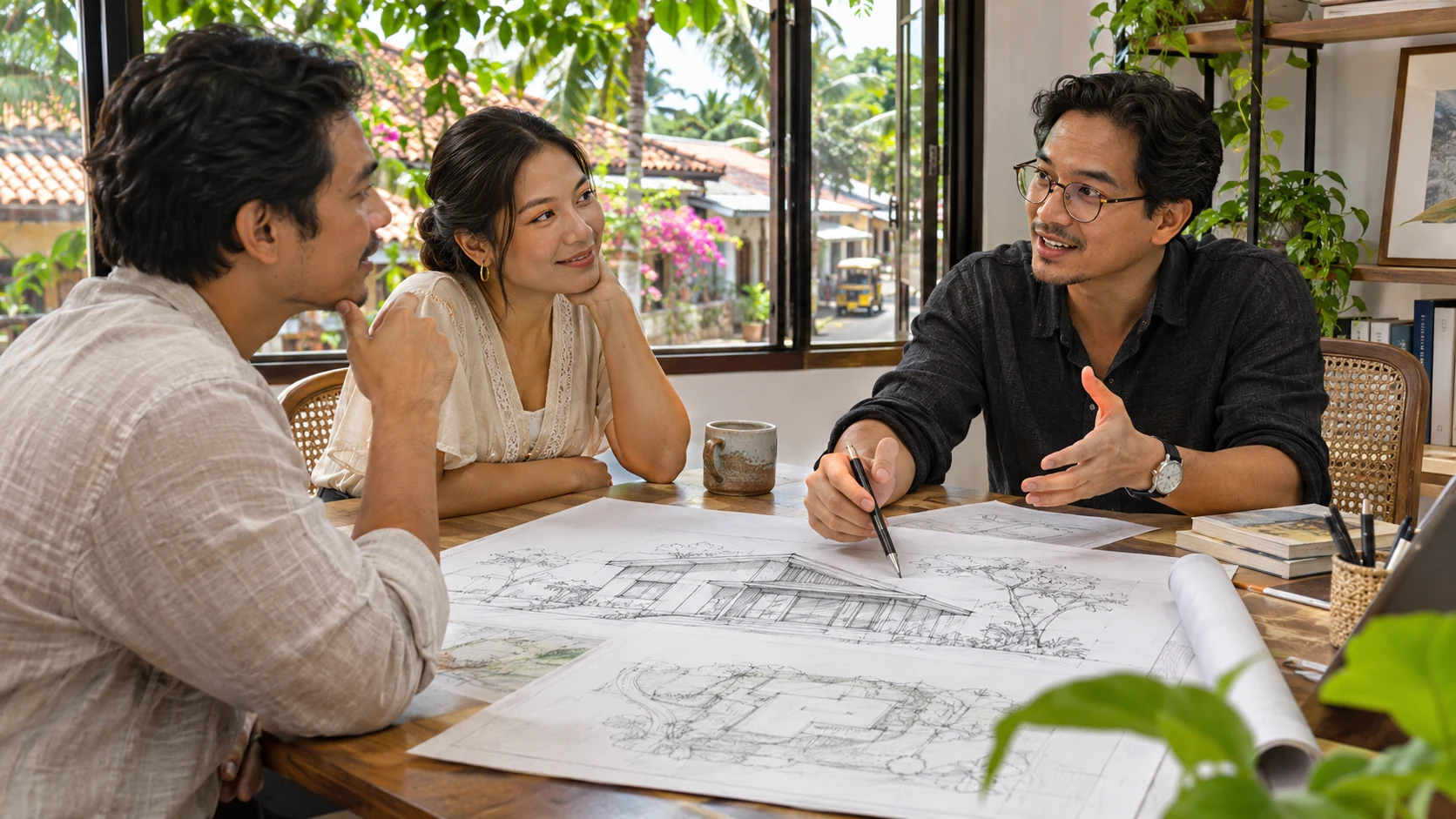
Put the actual municipality at the top
Before collecting forms, I would put the property's district, corregimiento and identifying information on one page. Then I would ask the municipality responsible for that location which office handles the proposed work and which current requirements apply.
Panama City is a useful example, but its process is not a national template. The city's official publications describe Acuerdo 110 of April 22, 2025 as covering construction-document review, registration and permissions within the Distrito de Panamá. Other districts can have different procedures. A familiar form from a friend's house elsewhere is a conversation starter, not an answer. Municipio de Panamá: publications and rules (opens in a new tab)
I would ask my local professional to confirm the correct authority with me. A postal address, a nearby town's name or a seller's description should not quietly decide which office we consult.
Give each question to the right person
For Panama City's municipal construction process, the Dirección de Obras y Construcciones, or DOYC, is the official source I would consult. Its requirements page describes a shared review arrangement involving different disciplines and institutions. That gives me a reason to ask which reviews concern this proposal, rather than assuming one person supplies every answer. DOYC: requirements (opens in a new tab)
Professional competence is a separate question. Panama's Junta Técnica de Ingeniería y Arquitectura, JTIA, describes its role regulating engineering and architecture and provides registration resources. I would ask who is responsible for the project's design disciplines, submission and construction responsibilities, and what formal evidence is needed. JTIA (opens in a new tab)
The online professional search is a useful starting point, but its own page warns that the search is not valid for official procedures. I would not wave a screenshot around as though I had personally issued a certificate. JTIA: professional lookup (opens in a new tab)
Ask which version everyone is using
Here is why I would date the notes. The DOYC publications page also lists Acuerdo 314 of October 13, 2026, modifying Acuerdo 110. That amendment addresses specialized and infrastructure plans. An older municipal page may still be online and perfectly easy to find. That does not settle whether its wording describes the applicable route today. DOYC: publications listing (opens in a new tab) · Acuerdo 314, pages 2–3 (opens in a new tab)
I would ask, “Which current agreement, amendment and guidance are you applying to this proposal?” Keep the answer with the source and date. If two pages appear inconsistent, let the competent authority and qualified local adviser resolve the difference.
Bring a proposal people can recognize
I would prepare a small discussion packet before asking for a definitive answer. It would identify the property, show what is proposed and distinguish existing conditions from new work. This is my meeting preparation, not a list of legally required submissions.
For an imagined house, that might mean a simple location reference, a description of the intended residential use, a concept sketch and a note that an existing structure may be altered. I would flag uncertain facts rather than fill them with confident guesses. “Existing records not yet checked” is useful information.
Then I would ask the professionals which documents must support the application: who prepares them, who signs them, what needs verification and which versions belong together. A beautiful rendering can explain the ambition. It cannot answer every technical or administrative question just by having convincing palm trees.
Keep the conversation in separate columns
This is the little table I would take to the meeting. It is an agenda, not an official form or a prescribed approval sequence.
| Question | Who I would ask to identify the answer | What I would keep |
|---|---|---|
| Which local route applies to this proposal? | Responsible municipal office, with the local professional | Dated explanation and current rule references |
| What design information is needed? | Named design professionals and relevant reviewers | Required documents, authors and outstanding information |
| Which other reviews apply here? | Municipality and the competent authority for each issue | Scope of each review and the contact handling it |
| What does the current document actually authorize? | Issuing authority, explained with the responsible professional | Exact scope, conditions and unresolved questions |
| What must be confirmed before specified site activity? | Responsible professionals and relevant authority | Written answer tied to the proposed activity |
| What will be needed later? | Relevant office and project team | Future inspection, completion or occupancy questions |
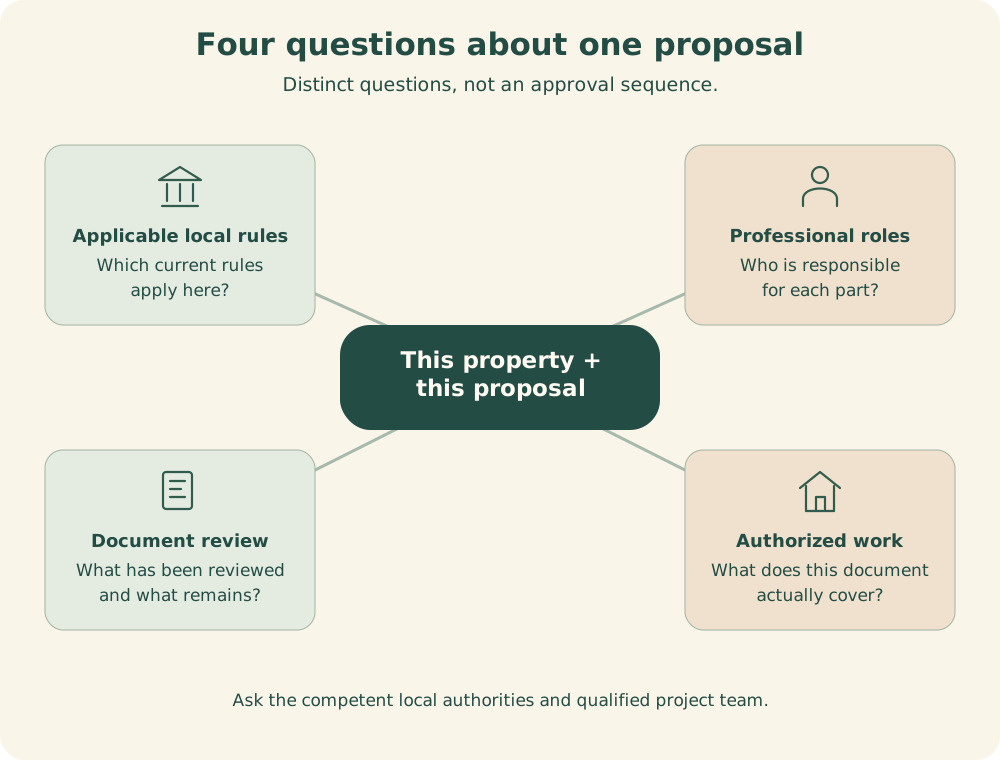
Four questions about one proposal
Distinct questions, not an approval sequence.
This property + this proposal
-
Applicable local rules
Which current rules apply here?
-
Professional roles
Who is responsible for each part?
-
Document review
What has been reviewed and what remains?
-
Authorized work
What does this document actually cover?
Ask the competent local authorities and qualified project team.
I would leave a blank answer blank. A tidy spreadsheet should not become a machine for turning uncertainty into permission.
Separate document progress from work on the ground
DOYC's requirements page distinguishes an accepted anteproyecto from authorization to start work. That is a useful warning against reading too much into a status label. For the actual project, the authority and responsible professional need to confirm the effect of the current documents under the applicable rules. DOYC: requirements (opens in a new tab)
My question would name the activity: “Does our present authorization cover this proposed work, in this location, with these conditions?” I would ask separately about any proposed demolition, earthworks or other site activity instead of assuming it disappears inside the phrase “getting started.”
I would also ask what remains to be established for eventual completion and occupation. We do not need to predict every future decision in the first meeting. We do need to avoid treating today's document as the answer to every later question.
Leave with the next answer assigned
Before ending the conversation, I would read back the unresolved points. Who is obtaining the missing information? Which authority must respond? What document will show the outcome? If the proposal changes, who will check whether that changes the approval requirements?
My aim is modest: a clear description of the house, the right people discussing it, and an honest record of what is confirmed. Once those are in place, “approved” becomes a word I can ask sensible questions about. That is a much better beginning than asking the delivery driver what he thinks.
Sources checked November 8, 2026. Municipality-specific examples are orientation only. The competent local authorities and qualified project professionals must establish current requirements and authorization for the actual work.
Sources behind the questions
Research checked 2026-11-08. External source links open in a new tab. Foreign sources explain principles, not Panama project requirements. Local examples do not replace confirmation for the property.
-
Municipio de Panamá: publications and rules (opens in a new tab)
Principle or local example only; scope and limitations are explained beside the claim.
-
DOYC: requirements (opens in a new tab)
Principle or local example only; scope and limitations are explained beside the claim.
-
JTIA (opens in a new tab)
Principle or local example only; scope and limitations are explained beside the claim.
-
JTIA: professional lookup (opens in a new tab)
Principle or local example only; scope and limitations are explained beside the claim.
-
Acuerdo 314, pages 2–3 (opens in a new tab)
Principle or local example only; scope and limitations are explained beside the claim.