Before I Buy a Building Lot, I Want the Answers in One Place
By Arthur · An illustrated owner’s guide
The view can start the wish list. I would let the evidence help shape the next decision.
For entertainment and general understanding. These illustrations and questions are not a construction specification or a legal, geotechnical or site-specific professional assessment.
“Easy to build on” is doing a remarkable amount of work in a property listing. Easy for which house? With what access? Connected to what? I would give those three words their own little interview before letting them anywhere near my budget.
Here is how I would organize the investigation before buying land for a house. The aim is a usable set of answers, with the gaps still visible. This is an owner's planning guide, not legal advice, a purchase recommendation or a finding that any particular parcel is buildable.
A tropical building lot. Boundaries, access rights and development permission require verification.
Start with the house you mean, and the time to check it
I would write a short description of the intended project: household use, approximate scale, essential services, access needs and possible future additions. A single home and a collection of rental cabins should not quietly share the same brief.
Then I would ask a local property lawyer and design professional which investigations belong before any commitment, how long they may take, and what permission is needed to enter or investigate the land. I would have the lawyer explain the proposed transaction's deadlines, deposits and available protections. I am not supplying contract wording or assuming an investigation period automatically exists.
I would also agree who gathers the answers. Otherwise, “someone is checking” can become the busiest imaginary employee on the project.
Use desk research to decide what needs closer attention
For an initial screen, I would collect available parcel records, planning information, hazard information, previous reports and service contacts. Each gets a source and date. Seller descriptions and neighborhood stories get their own label, too: useful leads awaiting verification.
The Australian Government's Your Home guide includes services, access, slope, geology and planning controls in site selection. I would borrow those broad questions, not Australia's approval rules or climate-specific design assumptions. Your Home: choosing and using a site ↗ (opens in a new tab)
My first review would ask whether the intended project raises an obvious question needing specialist attention. I would not treat an unmarked area on an online map as a clean bill of health. For detailed map interpretation or shoreline issues, I would use the separate land-use and coastal guides rather than repeat them here.
Make sure every document describes the same land
I would give the lawyer and survey professional the listing, available property documents and any plans together. Ask them to reconcile the parcel identity, claimed rights, holder, area, boundaries and access documents. Where something disagrees, I want the discrepancy explained before the next step relies on it.
I would ask which current records and survey work the actual transaction needs, including review of encumbrances, easements, restrictions and the seller's authority. A fence, a pin on a phone and a document each deserve appropriate verification. None gets to settle the whole question by looking convincing.
Ask the authority about the actual proposal
Next I would ask the local team to identify the competent planning and building authorities and obtain the appropriate property-specific response. Include the house, access and service areas, plus any relevant environmental or water-related constraints.
The MIVIOT service described on Panamá Digital concerns permitted use and planning provisions for an identified property. I would use that as an example of the question to resolve, while asking which authority and current procedure apply in the municipality concerned. It does not establish construction permission. Land-use certification description ↗ (opens in a new tab)
I would keep the response beside the exact proposal it considered. If the proposal changes, ask whether the answer still applies.
Check the ground and the whole journey to it
With authorized access, I would arrange the professional site review recommended for the project. Ask what surveying, geotechnical, drainage, environmental or other investigation is needed before relying on the preliminary concept. The foundation and slope questions belong with qualified professionals, not a shovel test borrowed from the internet.
Access gets two separate conversations. The lawyer checks the rights; the design and construction team checks practical suitability. I would ask about the complete route, shared sections, crossings, maintenance responsibilities, rainy-season constraints and construction deliveries. Who confirms emergency and service access? What work, permissions or third-party agreements remain unresolved?
A pleasant drive to the gate is a useful observation. I would still want an answer about getting the proposed building materials beyond it.
Turn “services nearby” into a specific response
For water, electricity, wastewater and communications, I would ask the relevant provider or qualified local adviser to respond for the identified parcel and intended demand. What is available, where would connection occur, what work is needed, who pays, and what timing or conditions remain uncertain?
Naturgy Panamá publishes connection requirements and separately addresses temporary supply. That is a useful provider-specific reminder to ask about construction-stage service as well as the finished house. Its page does not promise capacity or connection to a particular lot. Naturgy's connection information ↗ (opens in a new tab)
For an independent supply or on-site wastewater proposal, I would request the appropriate feasibility, quality and approval checks. “We can probably do something” stays unresolved until the responsible specialist explains what.
Put the answers beside the next decision
This is the compact record I would bring to a review meeting. It is my organizing tool, not an official approval form.
The evidence I would bring to the meeting
Evidence area
What I would keep
What I would ask before relying on it
Desk information
Dated maps, records and report list
What still needs property-specific verification?
Property and survey
Reviewed rights and reconciled identification
Which discrepancies or access rights remain open?
Authorities
Responses tied to the intended proposal
What further approvals or conditions apply?
Ground and access
Professional findings and limitations
What could change the concept or investigation scope?
Services
Provider responses and specialist feasibility findings
Which costs, permissions and timing are provisional?
Whole project
Updated scope, allowances and unresolved list
Which answers are needed before commitment?
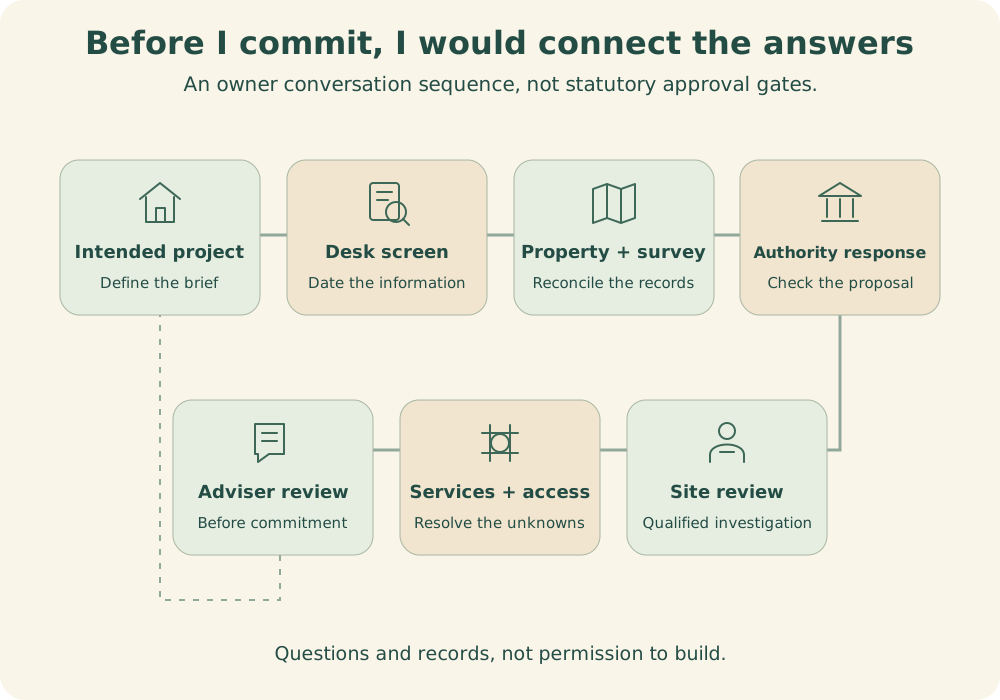
Before I commit, I would connect the answers
An owner conversation sequence, not statutory approval gates.
Intended project
Define the brief
Desk screen
Date the information
Property + survey
Reconcile the records
Authority response
Check the proposal
Site review
Qualified investigation
Services + access
Resolve the unknowns
Adviser review
Before commitment
Questions and records, not permission to build.
Questions and records, not permission to build. Educational illustration, not a property assessment or construction detail.
Leave the meeting with the uncertainty explained
I would ask the team to bring the findings together before the transaction's next consequential step. Which costs now have evidence? Which remain allowances? What happens to the programme if an investigation, service or approval takes longer? The whole-project budget guide can hold those numbers without inventing a universal contingency percentage.
For each open issue, I would record the person responsible, the evidence still needed and the decision it affects. Then discuss with the advisers what can appropriately be resolved before proceeding, what options remain, and whether further time or a changed proposal is needed. The purchase decision stays with the buyer.
I would rather finish with a shorter wish list and clearer answers than a magnificent folder full of assumptions.
Source limits: All linked pages were opened on November 8, 2026. The Panama service pages and Naturgy page showed no dependable current revision date; confirm their present requirements directly. Their published descriptions are not a verified nationwide legal checklist. No actual property, including any Los Planes site, was assessed for this article.
Sources behind the questions
Research checked 2026-11-08. External source links open in a new tab. Foreign sources explain principles, not Panama project requirements. Local examples do not replace confirmation for the property.