A delivery is not ready simply because a truck is available. The site also needs a suitable receiving area, an agreed storage arrangement, someone responsible for inspection and a clear reason for the material to arrive at that stage of the work.
For a wet-weather build, put those conditions beside the delivery date. This owner-facing guide helps organize the questions. The contractor and relevant professionals remain responsible for safe access, unloading, lifting, storage loads, temporary protection and installation methods. Do not enter an unsafe work area to perform checks yourself.
Tie the order to a construction milestone
Begin with when the item will be used, then work backward with the contractor and supplier. Ask what information must be finalized before ordering and what conditions must exist before the delivery can be received. Keep the supplier's current lead-time statement separate from the requested arrival date.
DOE's Building America guidance recommends limiting the time materials spend stored on site and considering delivery changes during wet weather. [1] That does not mean every item should arrive at the last possible moment. The practical choice depends on availability, storage options and the construction sequence.
For each important item, record four dates or milestones: the decision needed, the order confirmation, the proposed delivery and the planned use. If one changes, ask which others need to be revisited. Mark estimates clearly and retain the supplier's dated response instead of treating an early conversation as a guaranteed delivery commitment.
Ask for a storage plan before the truck is booked
Have the contractor identify where the material will be received, inspected and protected, and how it will be moved to its eventual place of use. The arrangement must suit the exact product and the site. A convenient empty room may not have been assessed for a concentrated stack of materials.
DOE guidance highlights protection from rain and ground moisture, inspection of damaged packaging and the risk of moisture trapped under a covering. [1] Ask how the proposed protection deals with those concerns. The correct covering, support and ventilation arrangement must be established for the material rather than assumed from the presence of a tarp.
Ask who checks the storage after weather events and who can contact the supplier if the original delivery arrangement is no longer suitable. Include access for inspection so that material is not buried behind other deliveries before anyone has recorded its condition.
Use a receiving record that follows the material
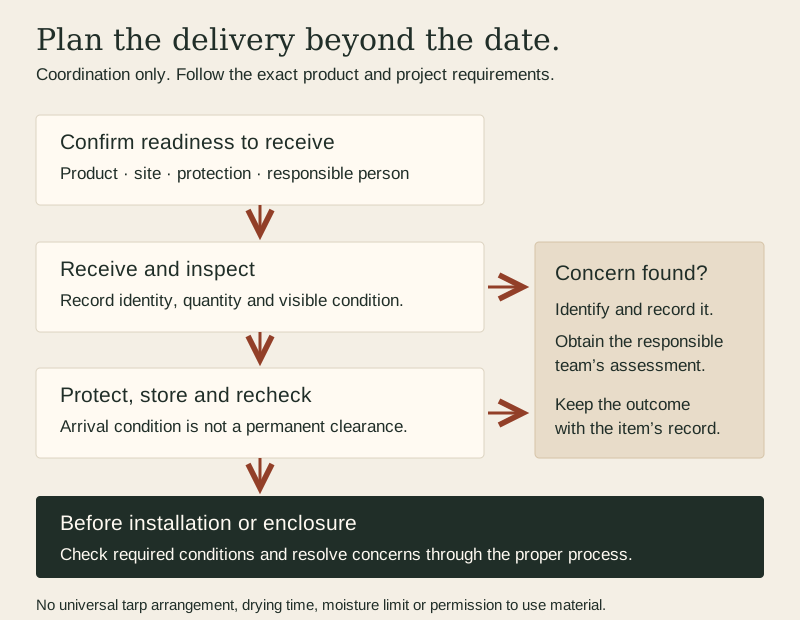
Original coordination diagram, not a storage or drying method. The responsible team determines whether the exact material is ready for use.
The diagram is a coordination prompt, not an unloading, storage or drying method. Where a concern is found, the responsible team should determine the next action before the material is accepted for installation.
Prepare a short record for the contractor's receiving process:
Purchase or order reference and the exact product supplied.
Quantity, batch or identifying information where relevant.
Delivery date and the person who checked it.
Packaging and visible condition, with photographs where useful.
Storage location and the current protection arrangement.
Any discrepancy or concern reported to the supplier.
The person responsible for deciding the next step and recording the response.
An owner's copy of this record is useful when checking progress, but it should not be used to declare structural suitability or waive a supplier's requirements. Follow the agreed delivery-acceptance and reporting procedure rather than improvising a legal position at the truck.
Different materials need different questions
The table below is a planning worksheet. It does not provide universal stacking, exposure or drying limits. Use the current manufacturer instructions for the exact product and the project's professional specifications.
Questions for different materials and work stages
Material or work stage
Question to resolve before delivery or use
Record to keep
Timber and wood-based panels
What condition is required before installation and before the assembly is enclosed?
Inspection and any specified moisture assessment
Interior gypsum panels
Is the planned storage protected as required for this product?
Manufacturer storage instructions and receiving condition
Packaged insulation
How will it remain protected, and what happens if packaging or contents are wet?
Product instructions and the responsible reviewer's decision
Products installed wet
What curing or drying conditions must be satisfied before the next layer?
Product-specific requirements and the planned verification
Finishes and equipment
What storage conditions, shelf-life or warranty limits apply to the exact item?
Supplier documentation and dated delivery information
On a small screen, swipe the table horizontally to see every column.
As one product-specific example, USG says its Sheetrock Brand Gypsum Panels need protection from excessive or continuous moisture and does not recommend uncovered outdoor storage. [2] This does not establish the storage or exposure limits of every gypsum, fiber-cement or exterior sheathing product. Similar-looking boards can have different intended uses and instructions.
Distinguish arrival condition from installation readiness
Materials can arrive wet, become wet while stored or be exposed during the work. A receiving photograph captures one moment. Ask who will check the condition again before installation or before another layer hides it.
DOE guidance warns against enclosing damp framing and insulation, and calls for product-specific drying requirements for wet-applied materials. [3] Do not copy a moisture threshold for one material or U.S. building program onto every product in a Panama house. The relevant professional should identify the criterion, assessment method and evidence appropriate to the assembly.
A surface that looks dry does not by itself answer whether a material is suitable to enclose. Likewise, the number of sunny days since rain is not a universal release rule. Record the review and the basis for proceeding, including any replacement or further assessment required.
Give wet or damaged material a clear status
If damage, unusual wetting or suspected mold is reported, make the issue visible in the project record and notify the responsible contractor or professional promptly. Identify the affected items so the concern is not lost when materials are moved.
This article does not give a mold-cleaning recipe or tell an owner to salvage a particular material. The response depends on what it is, how it was exposed, its intended function and the applicable product requirements. Ask for the supplier's and relevant professional's assessment rather than accepting “it will dry” as a complete decision.
If replacement or a revised work sequence is needed, connect that decision to the delivery log and the construction-change record. Preserve the original observation and the eventual disposition instead of silently erasing the problem from the schedule.
Assign responsibility through the whole sequence
EPA's construction guidance treats storage, sequencing, monitoring and clear responsibilities as parts of an indoor-air-quality plan. [4] Although written for school projects, these process questions are useful to discuss on a house build. They are not Panama residential requirements.
At the next site meeting, ask who owns each step: confirming readiness to receive, inspecting the delivery, maintaining protection, checking the material before use and retaining the record. Agree how a delayed roof, changed supplier date or wet storage area will be communicated before the next shipment is released.
Keep the plan practical enough to update. A short register with current evidence is more useful than a detailed schedule that nobody revises when conditions change.
Sources checked November 7, 2026. U.S. guidance is used for general principles and a clearly identified product example, not as Panama law or a substitute for the exact product instructions. The worksheet and workflow are original editorial tools. No storage-load, lifting, remediation or construction design is provided.