“Order it early” is incomplete advice when the dimensions are still changing, the finish is unconfirmed or the installer has not checked the product. A custom-home procurement plan needs to show both when an item is required and what must be settled before someone commits to buying it.
This guide focuses on decisions before delivery. The rainy-season delivery guide covers receiving, protection and material condition. Neither article replaces the builder's construction schedule, a supplier's terms or professional contract advice.
Identify the items that need an early decision
AIA Contract Documents identifies special fabrication, specialty equipment and items that are not normally stocked as reasons to discuss long-lead procurement with the contractor. [1] Its example concerns facility maintenance, but the screening question is useful for a house: which selections could require more preparation than a routine purchase?
Ask the builder and relevant trades to identify candidates from the actual design. Custom joinery, a particular window system or a selected piece of equipment may deserve attention, but this article does not claim that any category currently has a particular lead time in Panama.
Record why the item matters. Does another trade need its dimensions? Must a compatible component be selected? Would a change alter the drawings? Prioritize the questions that affect other decisions, not simply the purchases with the largest price tags.
Separate information dates from delivery dates
A product can be needed on paper before it is needed on site. The team may need approved dimensions, connection information or a reviewed shop drawing to complete related work while the physical item is still being made.
An older USACE scheduling-help example connects material, approval and submission dates to the work activity they support, with separate allowances for procurement and review. [2] That is a useful distinction, not a requirement to adopt a U.S. government system or its procedures for a private house.
Ask the team for two answers: when the relevant information must be settled, and when the accepted item must be ready for use. Include the necessary design review and any field verification before release. Do not let a requested arrival date conceal an already missed decision date.
Use a dated supplier statement
A lead-time estimate needs a starting point and an endpoint. Ask the supplier what starts the stated period: an inquiry, an accepted order, a deposit, approved drawings or another defined event. Then establish what ends it: production complete, dispatch, arrival at a port or delivery to the agreed site.
Keep the supplier's exact written response with its date and product reference. Record the assumptions, exclusions and unresolved questions. An item shown in an online catalog is not proof of stock allocated to the project, and “shipping soon” is not a confirmed installation date.
If freight, import handling or another party's transport is involved, ask the responsible provider to clarify those stages separately. Do not fill gaps with a generic number of weeks. The schedule should expose uncertainty while someone is still able to resolve it.
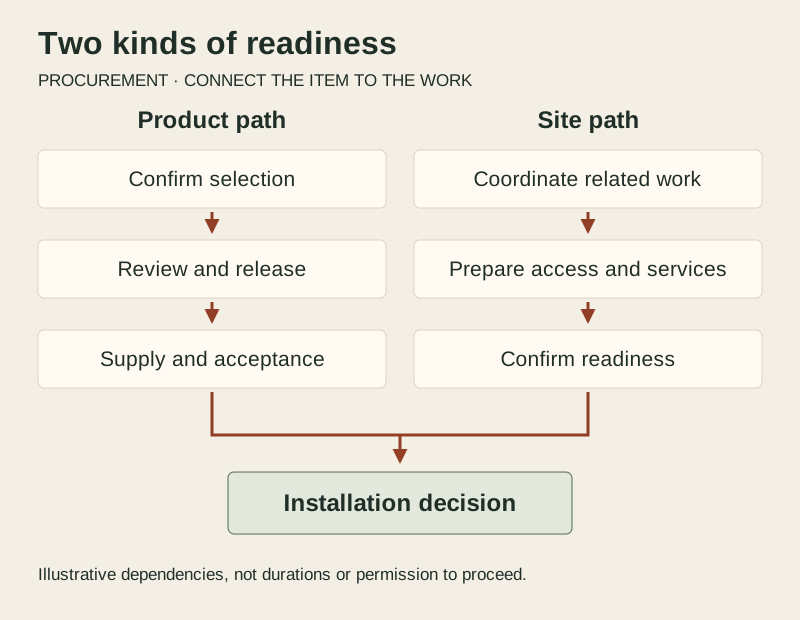
Original simplified dependency diagram. Actual work may overlap or require additional steps. The responsible project team confirms the sequence and readiness; the diagram does not authorize installation.
Show what depends on the item
GAO's scheduling guidance emphasizes logical connections between activities and explains that missing links can hide the effect of a delay on later work. [3] A shopping list without those connections does not explain what a late item would actually interrupt.
Ask the builder which work depends on the product, its approved information or both. Also identify what must be ready for installation: supporting work, access, the appropriate trade and any required checks. The diagram is an original simplified prompt, not the full project schedule.
Consider an invented example: a selected appliance is expected to arrive later, but the joinery team needs its confirmed installation information now. The immediate decision may concern approving the exact model and coordinating the cabinet design, rather than rushing the shipment. The actual dependencies must be confirmed by the responsible trades; this example is not a construction sequence for every appliance.
Maintain a short procurement register
Use one row per significant item or coordinated package. The following original worksheet describes the fields, so it can be adapted to a spreadsheet or project record. Leave unknown answers explicit.
Fields for a useful home procurement register
Record field
What belongs there
What it helps distinguish
Exact item and revision
Model, finish, drawing or specification reference
A current selection from a superseded idea
Information needed by
Decision or technical information required by another task
Design readiness from physical arrival
Order-release conditions
Reviews, measurements and commercial steps still outstanding
A quotation from authorization to proceed
Supplier statement
Dated evidence, duration basis and stated delivery endpoint
A supplier estimate from the project's requested date
Work enabled
Related activity and responsible trade
A purchase list from a coordinated schedule
Current forecast and next action
Latest expected milestone, unresolved issue and named person
Verified progress from an optimistic status label
On a small screen, swipe the table horizontally to see every column.
Evaluate early purchase as a complete arrangement
Buying early can create another set of decisions. The American Bar Association's supply-chain discussion identifies storage, additional handling, transport and insurance among the costs to consider when materials are purchased ahead of their use. [4]
Before committing, ask who will hold the item, who can inspect it, how the exact product must be preserved and which terms govern damage, changes or cancellation. Ask the supplier when warranty coverage begins rather than assuming that it starts at installation. Have the appropriate adviser review any material contractual uncertainty.
Keep an early-purchase proposal distinct from approval. The owner, builder and supplier should be clear about who may release the order and what evidence supports that decision. This guide does not recommend paying a deposit, accepting a clause or buying an unapproved item to protect an optimistic schedule.
Recheck when the design or forecast changes
A change in model, dimensions or finish can affect more than the purchase price. Ask the relevant professionals whether the change alters compatibility, related drawings, required approvals or work already planned. Record the decision through the construction-change process before treating a substitute as equivalent.
The ABA article also recommends incorporating review and fabrication into the schedule and updating it with information from suppliers and trades. [4] Agree a review rhythm suited to the project, then bring forward any update that could change an impending decision. A fixed generic reporting interval is not a substitute for responding to new evidence.
At a review, ask three practical questions: what changed, which activity does that affect, and who needs to act next? Preserve the previous forecast and the reason for revision. Quietly replacing an old date makes it harder to understand whether the plan improved or merely moved.
The useful outcome is a current record of decisions, dependencies and evidence. It should help the team choose a realistic next step without turning uncertainty into a delivery promise.
Sources checked November 7, 2026. These overseas professional and government sources illustrate planning principles, not current Panama lead times, local law or the terms of a particular contract. The diagram, worksheet and appliance example are original editorial tools; no actual project dates, costs or outcomes are asserted.