Outdoor living · Ideas for a lovely afternoon
The Garden That Cools the House: Shade Without Losing the Breeze
By Arthur · November 8, 2026
Picture the garden with me as a leafy room: a ceiling, a few carefully placed walls, and plenty of space for the air to wander through.
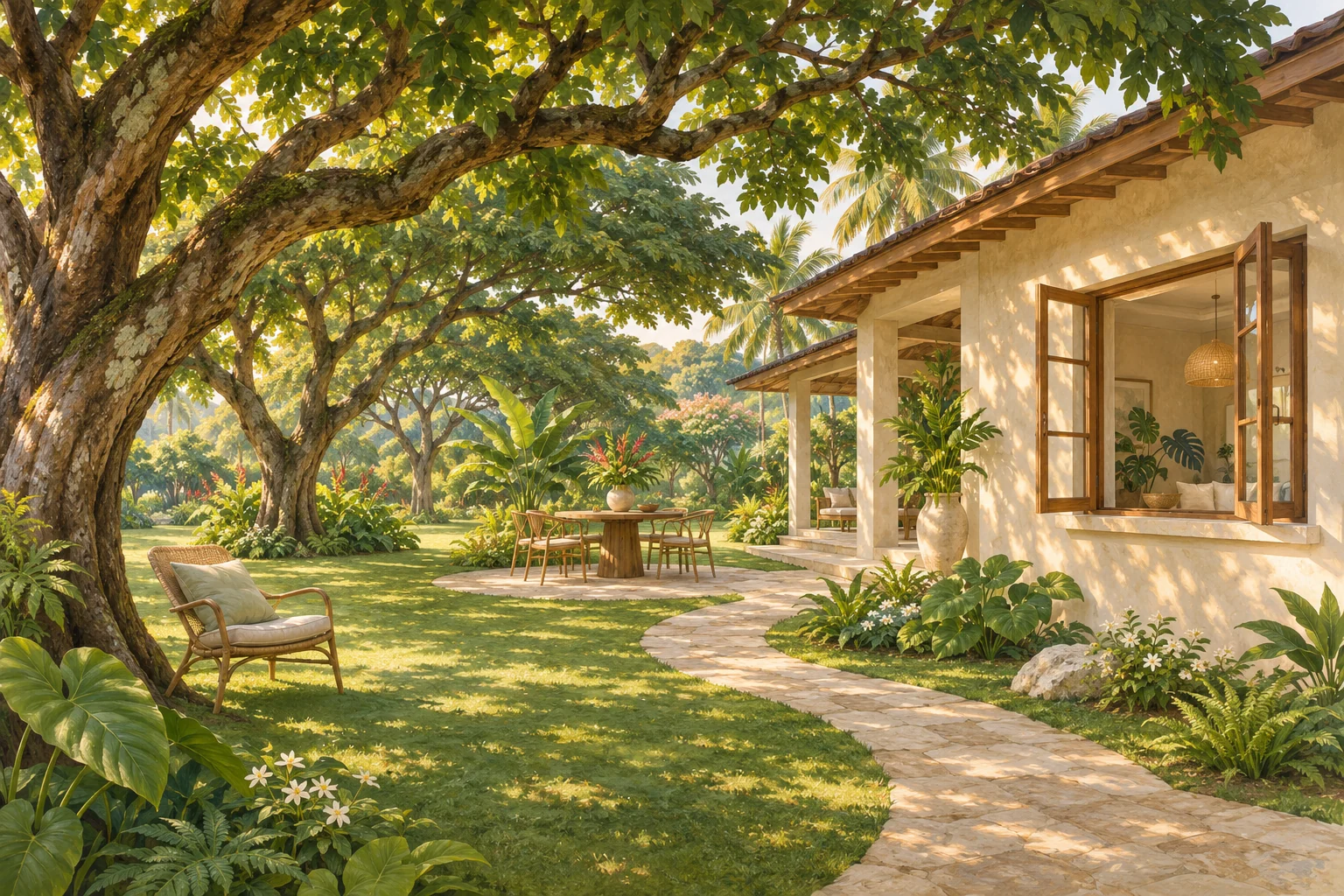
Let me take you to an imagined seat in a tropical garden. A patch of moving shade crosses the table. Beyond it, a window stands open. The planting feels generous, but you can still see between the trunks. Nothing about the scene looks like a cooling strategy. It just looks like somewhere you would happily lose an afternoon.
That is the sort of garden I would aim for, with greenery placed where it makes a difference.
Two gifts, not one
Plants can help cool their surroundings through shade and evapotranspiration, the movement of water into the air from vegetation and soil. That makes landscaping part of a home's climate response, rather than decoration added after everything else is finished.[1]
But a comfortable garden also needs to leave room for moving air. Cooling a building and cooling a person are related, not identical: blocking sun reduces heat gain, while a breeze helps our bodies lose heat through evaporation.[2]
I would keep both goals on the sketch. A dense leafy screen might intercept sunshine beautifully yet sit directly across the breeze you were hoping to enjoy.
The question is not “How much can we plant?” It is “What should the leaves interrupt, and what should they let through?”
Follow the shadow, not the nursery label
Before choosing a tree, I would pick a moment to improve.
Perhaps it is breakfast beside a glaring window. Perhaps it is the garden chair nobody uses after lunch. Give that moment a place on a rough sketch, then notice where the sunlight comes from.
Start a little shadow diary: photograph the same view in the morning, around midday, and later in the afternoon. Mark the sunlit glass, wall or paving you would most like to shade. University of Florida guidance similarly begins with identifying the windows and walls that actually receive the sun.[7]
I would treat that diary as a first look, not a complete sun study. Shadows change with season and latitude; a pleasing patch today does not promise the same protection all year.[3] For a substantial planting decision, ask a designer to check the relevant seasons at your location.
And remember that low morning or afternoon sun comes in sideways. A canopy that shades the ground at noon may leave a window exposed later. The right solution depends on where the foliage meets the incoming sun, not just how tall the tree looks.[5]
Leave a doorway for the breeze
Next, I would make a second sketch, this time for air.
Where do you actually feel a pleasant breeze? Is it at the garden gate, beside the kitchen, or only upstairs? Nearby buildings, vegetation and landforms can change local wind direction. Observing your own site and asking neighbors about hotter-season breezes is more useful than borrowing an arrow from a generic tropical-house drawing.[4]
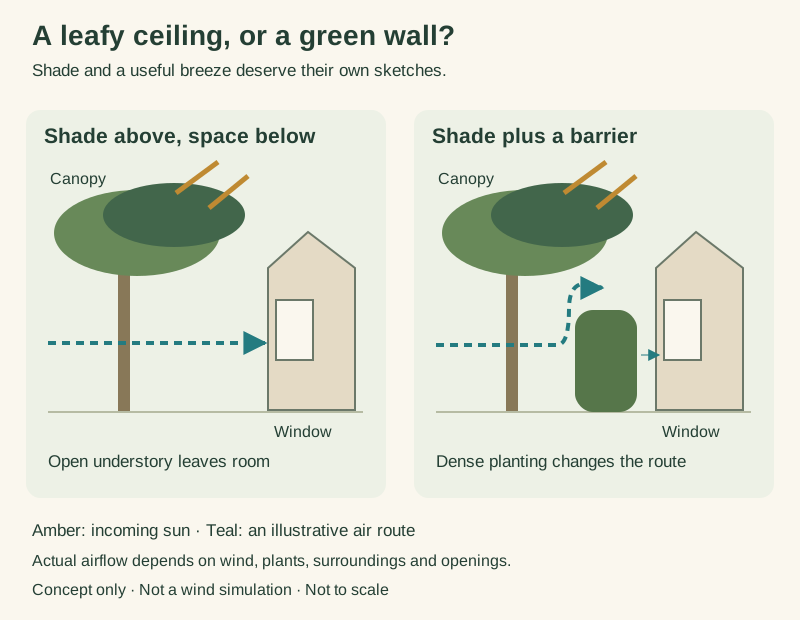
One idea I would explore is a leafy ceiling with an open understory. You can picture how that differs from a solid green wall outside every window. This is a design idea to test, not a prescription to cut branches off an existing tree.
Australia's Your Home guidance for hot-humid climates makes the central tradeoff explicit: arrange landscape shade without obstructing useful cooling breezes.[5] The open window still needs a usable airflow route through the home; planting alone cannot create cross-ventilation.[2]
Privacy matters too. I would mark the particular view you want to screen before assuming the whole boundary needs dense planting. That gives a landscape designer a more interesting problem than “hide everything.”
On a narrow screen, scroll the diagram to explore each area.
Four ways to make a leafy room
These are starting points for a conversation, not performance ratings. The best combination depends on your site and the mature plants.[5][6][7]
| Garden idea | Its lovely part | The question to ask |
|---|---|---|
| Broad canopy with space beneath | Overhead shade and framed garden views | Will its mature shadow reach the place we use? |
| Dense hedge or shrub screen | Privacy and a sense of enclosure | Does it occupy our useful breeze route? |
| Vine on a separate trellis | A smaller-space way to shade a particular opening | How will its support and growth be maintained? |
| Several planted pockets | A garden with openings and places to pause | Will those openings remain as plants fill out? |
On a narrow screen, scroll the table to read all three columns.
A trellised vine can be an alternative where a tree will not fit, but “smaller” still needs planning. Its position, eventual growth and upkeep deserve attention too.[7]
Buy the future tree
At the nursery, I would keep the mature tree in mind. The small version is only the preview, and the garden does not come with an undo button.
The International Society of Arboriculture recommends matching a tree's function and form to the site, including soil, drainage, sun and wind exposure, and available space.[6] Rooting space also matters: it affects how well a tree can grow and how long it can thrive.[3]
Here are the questions I would take to a locally qualified arborist or landscape professional:
- What will the canopy look like when this tree is mature?
- Will it keep useful foliage during our hottest periods?
- Is there enough suitable soil and room around buildings, paths and utilities?
- What care, watering and storm-related assessment will it need here?
Do not turn a photo into a universal planting distance. A graceful tree beside someone else's house is not proof that the same arrangement suits yours.
Before starting over, look at what you already have. Existing vegetation can be worth retaining, particularly trees that would take years to replace.[1] Ask for an assessment before deciding the garden needs a completely fresh start.
A small plan for your next free afternoon
For a simple starting point, I would take two sheets of paper outside. Label one “shade we want” and the other “air we want to keep.” Add the places you actually sit, walk and open a window. Put a star beside one uncomfortable spot.
That is enough for a useful first conversation. I would begin with that one uncomfortable corner rather than trying to solve the whole garden at once. Give it a little thought, and it has a better chance of becoming the place you choose for the afternoon.
These are general design ideas drawn from Australian and US guidance, not local planting specifications or Panama requirements. Species, clearances and tree condition need local advice. Garden shade can support comfort; it does not guarantee an indoor temperature or replace needed cooling.
Sources and further reading
[1] Australian Government, Your Home. Landscaping and garden design.
[2] Australian Government, Your Home. Passive cooling.
[3] Colorado State University Extension. Tree Placement: Right Plant, Right Place.
[4] Australian Government, Energy.gov.au. Design for your climate and keep cool.
[5] Australian Government, Your Home. Shading.
[6] International Society of Arboriculture. Choosing the Right Tree.
[7] University of Florida IFAS. Planting Trees for Energy Savings.