Outdoor living · Ideas for a lovely afternoon
An Outdoor Kitchen People Actually Want to Use
By Arthur · November 8, 2026
Here is the outdoor-kitchen scene I would rather help you avoid: the ice is inside, the clean platter is inside, and someone wants a spoon, also inside. The magnificent kitchen has become a very expensive place to wait while the host disappears through the back door.
Let me start with lunch before getting to the appliances. Picture a shaded counter, a bowl of limes, somewhere to put down a tray, and a table that catches the conversation. Beyond the pavilion, a separate uncovered cooking area does the hot work. The host gets to enjoy the party, too.
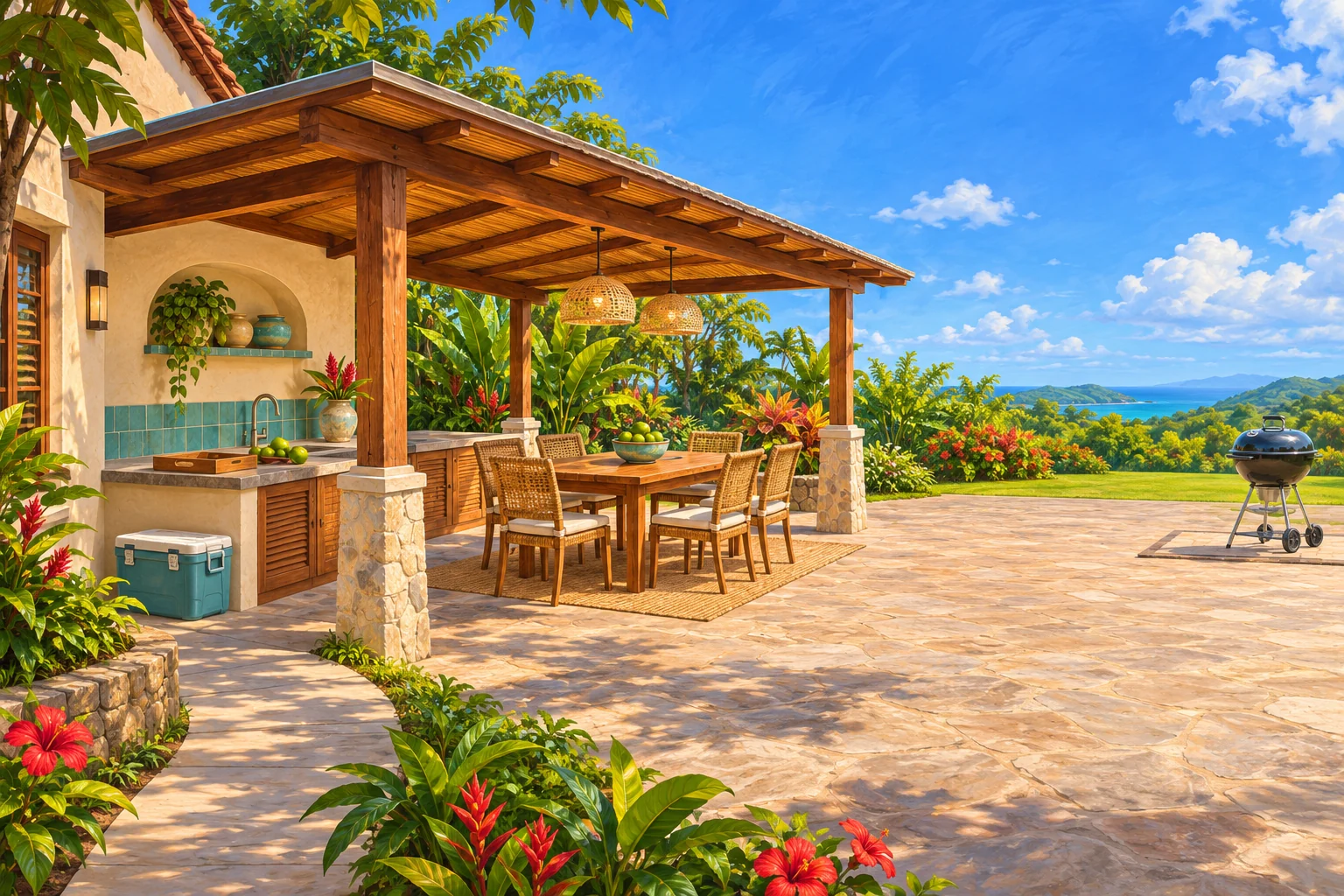
Start with the journey of a tray
Before choosing stone or a shiny grill, I would walk from the indoor kitchen to the proposed outdoor table carrying an empty tray. Where would you open a door? Step around a chair? Put the tray down?
You can turn that little rehearsal into a useful design brief. Give arriving groceries, clean plates and finished food somewhere to land. Put self-service drinks where guests can reach them without squeezing through the preparation area. Let dirty dishes return toward the house without taking over the serving counter.
In the layout, I would separate three jobs: preparing, cooking and gathering. They can belong to one lovely garden setting without being squeezed onto the same island. Separating raw-food preparation from ready-to-eat food also supports FDA guidance on avoiding cross-contamination.[1]
Choose the smallest setup that feels generous
Start with how you actually entertain. I would keep in mind that every extra piece of equipment brings something else to clean, protect and eventually repair.
| Your kind of afternoon | A setup worth considering | The trade-off to discuss |
|---|---|---|
| Drinks and food prepared indoors | Shaded serving counter, table and chilled-food cooler | More carrying, fewer permanent appliances |
| Regular grilled lunches | Prep/serving pavilion plus a separate uncovered grill area | A weather-dependent cooking step and a clear food route |
| Frequent, longer gatherings | The same separated zones, with suitable outdoor refrigeration and a planned wash-up point | More servicing, cleaning and professional installation coordination |
On a narrow screen, scroll the table to read all three columns.
Use these as lifestyle options, not equipment packages. I would choose a compact counter that works beautifully over an impressive run of cabinets nobody wants to maintain.
Give the gathering a roof, and lunch a rain plan
Picture the pavilion with me as a small garden room for preparation and serving: pale surfaces, comfortable seats, perhaps a cheerful tile accent. Keep the working counter out of the most exposed edge of the shelter, and ask your designer to consider wind-driven rain as well as sun.
Where will roof runoff go? Which path gets wet? Can cabinet doors open without pushing someone into that path? I would put those questions on the sketch before the finishes.
The rain plan should be wonderfully unheroic: cook indoors and serve under shelter when conditions allow, or move the meal inside. Don't improvise by bringing the grill under the pavilion.
Let the grill have its own address
In this concept, I would keep the grill completely outside the pavilion, in a separate uncovered location. CPSC advises using grills outdoors in well-ventilated areas, never in a garage, breezeway, carport or porch, or beneath a surface that can burn. A hot grill must not be left unattended.[2]
Ask a qualified designer or installer to confirm the actual location against the chosen appliance's current instructions, nearby materials, vegetation, openings and applicable local requirements. A pretty sketch cannot certify a safe clearance.
For example, Wolf's OG-series installation guide has different enclosure conditions for combustible and noncombustible construction and calls for qualified installation.[3] Those are product-specific instructions, not dimensions to borrow for another grill.
Keep the cook's working area out of the main route to the drinks and table. Leave fuel and electrical arrangements to qualified professionals. I want the cook to be part of the gathering, with no one using the hot workspace as a shortcut.
On a narrow screen, scroll the diagram to explore each area.
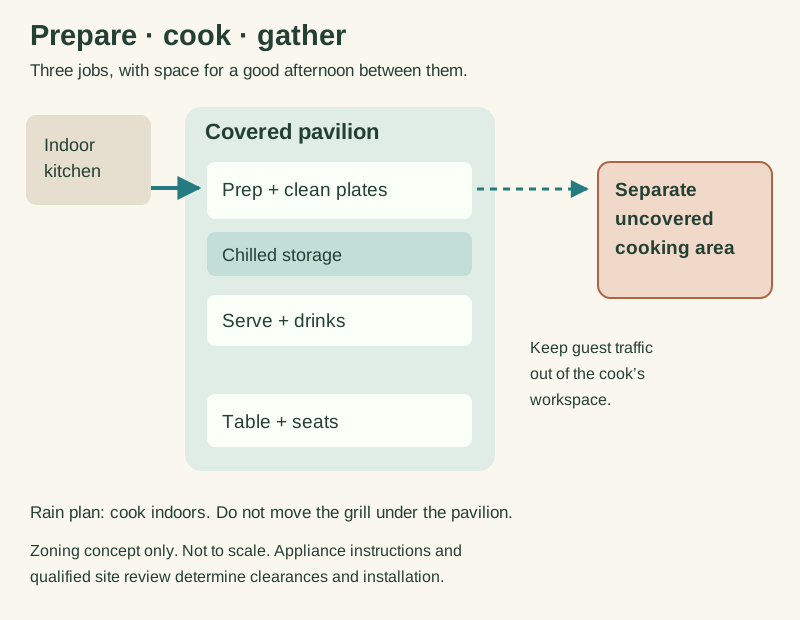
Make cold food part of the design
A shaded counter is pleasant; it is not refrigeration. FDA guidance calls for cold perishable foods at 40°F (about 4°C) or below and hot holding at 140°F (60°C) or above. Perishable food out of temperature control has a two-hour limit, shortened to one hour when outdoor temperatures exceed 90°F (about 32°C); discard it if it has exceeded that limit.[4]
I would plan for smaller dishes brought out in rounds, with backup portions kept properly chilled. Give a cooler a convenient home rather than treating it as something to hide after the guests arrive. FDA suggests separate coolers for drinks and perishable foods, reducing warm-air exposure as drinks are fetched.[4]
Keep clean serving tools and a food thermometer within easy reach. Grilled meat's appearance is not a reliable safety test, and utensils used for raw meat, poultry or seafood must not touch cooked food unless properly washed and sanitized.[5]
Choose finishes for the morning after
I would picture the morning after as well as the first lunch. Can you clean up without negotiating a dozen awkward corners?
Ask for countertop and cabinet samples, their outdoor-use limitations, and their cleaning instructions. Try to picture spilled juice around a joint, crumbs behind a handle and a tray that needs somewhere to dry. FDA recommends washing food-contact boards, dishes, utensils and counters after preparing each food item.[1] A wipeable-looking surface still needs proper cleaning.
For a coastal home, I would want more detail than “stainless” in the specification. Sub-Zero, for example, describes upgraded outdoor components and salt-spray testing for its UC-24RO refrigerator.[6] That evidence belongs to that model, not every appliance with a silver door.
Outdoor equipment still needs care. Sub-Zero notes that weather can leave water inside its outdoor units and advises cleaning and drying the interior surfaces.[7] Before closing in the equipment, ask how its vents, doors and service areas will stay accessible, and how an appliance could be removed without demolishing the counter.
Take this to the first design conversation
I would bring a rough sketch and these five questions:
- Where does a full tray land?
- Can guests get drinks without crossing the cooking area?
- Where does food stay properly cold until serving?
- What happens when rain interrupts lunch?
- Can every appliance be cleaned, serviced and eventually replaced?
With those answers clear, I would turn to the lovely details: the blue tile, the leafy view, the table that invites another hour. My aim is an outdoor kitchen that lets you stay outside with everyone else. Even the spoon has a place to land.
These general planning ideas use US safety guidance and model-specific examples, not local building approval.
Sources and further reading
[1] FDA, Safe Food Handling.
[2] CPSC, Summer Grilling Safety.
[3] Wolf, Outdoor Gas Grill Installation Guide, printed pages 4–7; OG30, OG36, OG42 and OG54 family.
[4] FDA, Handling Food Safely While Eating Outdoors.
[5] FoodSafety.gov, How to Grill Safely this Summer.
[6] Sub-Zero, Undercounter UC-24RO Salt Rating.
[7] Sub-Zero, Water Collecting in Outdoor Sub-Zero Unit.
General design inspiration, not a construction or installation plan. US safety guidance cited here is not a statement of Panama requirements. Follow the chosen appliance’s instructions and qualified local advice for siting, clearances, fuel, electricity, plumbing and food safety.