A house can be quiet without being trouble-free. When nobody is there to notice a new stain, a stopped appliance or a failed connection, the important question becomes who will notice the change and what they are expected to do next.
An absence plan should connect preparation, observation and response. It is more useful than a departure checklist alone. Keep it specific to the building, its equipment and the length and season of the absence, without publishing travel dates or access details.
Decide who owns the plan
UF/IFAS Extension Sarasota County identifies moisture, exterior deterioration and security as concerns when a Florida home is left for a period. [1] Those broad categories are useful prompts elsewhere in humid climates, but the arrangements must suit the actual property.
Name one person who keeps the plan current, one local contact who has agreed to the role, and a backup if that person is unavailable. Explain the difference between noticing a problem, authorizing work and carrying it out. A neighbor willing to report something unusual has not necessarily agreed to manage repairs.
Check the actual insurance policy and any building-management agreement. Ask what notification, inspection or maintenance conditions apply to your planned absence, and retain the written answer. Do not assume that a definition of “unoccupied” or a required visit frequency from another policy applies to yours.
Set the intended operating condition before leaving
List which systems will remain operating, which will be placed in an approved absence mode and which need a planned shutdown. Have the relevant service professionals explain the consequences and restart requirements. Avoid a blanket instruction to turn off all power or water when other systems may depend on them.
Include cooling or dehumidification, alarms, network equipment, refrigeration if retained, pumps, irrigation and any specialist systems actually present. This is an inventory for discussion, not a recommendation that every home needs those systems or that each should remain on.
A useful entry says what was agreed, who confirmed it, when it was checked and what would make the arrangement need review. Keep the detailed operating instructions with the equipment documentation, where the authorized person can find them.
Plan moisture control for the unoccupied period
EPA guidance emphasizes addressing moisture sources and keeping indoor humidity under control. It also calls attention to air-conditioning condensate drainage. [2] Arrange the appropriate maintenance before departure rather than leaving a known leak or drainage concern on a “watch it later” list.
ASHRAE discusses moisture problems during unoccupied periods and explains why reduced cooling demand does not necessarily mean adequate moisture removal. [3] A thermostat setting alone is not evidence that a particular house will stay dry. Ask the HVAC professional how the intended absence mode deals with moisture under the site's conditions and how its operation will be checked.
Do not copy a universal temperature, timer program or ventilation setting from a seasonal-home checklist. A naturally ventilated house, a closed air-conditioned room and a mixed arrangement need different review. Changes to exhaust, ventilation or equipment controls should follow the building's actual requirements.
For observation, retain the location and time of any temperature or humidity reading and the equipment's operating state. A reading in one room does not certify hidden spaces or every other room. The humidity guide explains how to keep measurements and possible causes separate.
Give each observation an action
An alert system is only useful if its report reaches someone who knows what to do. For each connected device, identify the dependencies that apply: local power, batteries, a home network, internet service, an app or subscription, and the recipient's ability to receive messages. Some devices work differently, so use the actual documentation.
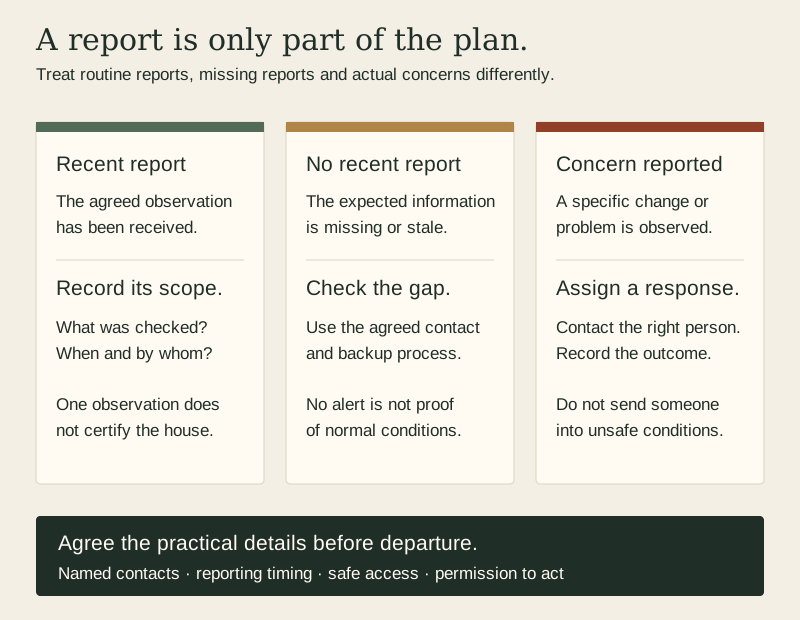
Agree what counts as a recent report and what happens when reports stop. Silence might mean normal conditions, but it might also mean a dead battery, failed connection or an unavailable recipient. Do not record “all clear” solely because no notification arrived.
Original editorial reporting guide. Timing, contacts and permitted responses come from the property-specific plan, not this diagram.
This original diagram separates three reporting states. It does not set an inspection interval or tell anyone to enter an unsafe building. The property-specific plan supplies the contacts, timing and permitted actions.
Test the agreed notification process before leaving. Confirm that the intended recipient receives the message and can identify the property and next step. Use the manufacturer's supported test method; do not create a real leak, disable a safety system or simulate an emergency in a way that causes danger or unnecessary dispatch.
Write a short responsibility sheet
This worksheet is a starting point for discussion. Fill it with the actual professionals' instructions and the agreements made with the people involved.
An absence-plan responsibility worksheet
Topic
Decision to record
Evidence or follow-up
Building condition
Which existing concerns must be resolved before departure?
Completion record and any remaining limitations
Moisture control
What operating mode has the relevant professional confirmed?
Service record, intended observations and response contact
Power, water and equipment
What stays active, what changes and who may operate it?
Product instructions and a property-specific restart plan
Routine visits
Who has agreed to check what, and when?
Dated report that distinguishes observations from assumptions
Remote reports
What depends on connectivity, and how is a missing report handled?
Tested notification route and named backup person
Repairs and incidents
Who can authorize which actions or expenditure?
Clear approval limits and emergency contacts
Return
What needs checking before normal use resumes?
Outstanding issues, service instructions and required professional review
On a small screen, swipe the table horizontally to see every column.
Keep credentials, keys, entry codes and detailed travel dates out of a broadly shared sheet. Give each trusted person only the access and information needed for the role you agreed. The public example above intentionally contains none of those details.
Make visits useful without turning them into inspections
Agree a practical observation list with the local contact. It might include visible water where it was not present before, unusual odors, changed equipment indications or damage visible from a safe place. Ask for a dated description and appropriate photographs, not a claim that the building has been professionally inspected.
Give the contact a clear way to report a concern and a backup route if you cannot respond. Decide in advance which routine actions have been authorized and which require a further decision. Record the eventual outcome so that an alert does not disappear into a message thread without resolution.
For example, a missing remote report could first prompt the agreed connectivity check, while an actual water report needs the relevant response contact. This is a hypothetical distinction, not an incident at one of Arthur's houses. The response should follow the evidence rather than treat both situations as the same fault.
Separate routine care from storm or flood response
An ordinary visit arrangement is not permission to enter after a damaging event. CDC guidance says to follow local authorities and have obvious damage assessed for safety before entering. It also warns against operating wet electrical equipment or switching power while standing in water. [4]
Tell the local contact not to climb a roof, enter floodwater, investigate damaged electrical equipment or take other risks to complete the checklist. Where access is unsafe or uncertain, the next step is the appropriate emergency service or qualified professional, not a better photograph.
The plan should identify how official warnings and major events trigger a review of the arrangements. It should not promise that a routine visit, sensor or camera can prevent damage.
Close the loop when you return
Read the visit and alert records before restoring the house to its usual operating state. Follow the agreed equipment and service instructions, and resolve any issue that was left open. Do not assume a water, electrical or other system is ready for normal use solely because it has been switched back on.
Update the plan after each absence: which report was useful, which contact was unavailable, and which instruction was unclear? Retain the current version with the house handover and maintenance file. If remote reporting depends on the home network, review the Wi-Fi planning guide as part of that dependency check.
Sources checked November 7, 2026. These sources support the stated principles, not a universal absence setting, local legal requirement or insurance interpretation. The responsibility sheet, reporting diagram and hypothetical example are original editorial tools. Follow local safety advice and the instructions for the actual building and equipment.