House ideas · The wall behind the wardrobe
That Beautiful Wardrobe Has a Wall Behind It
Before I put cabinets on an exterior wall, I want to know what happens behind the good-looking doors.
External sources open in a new tab so you can keep your place.
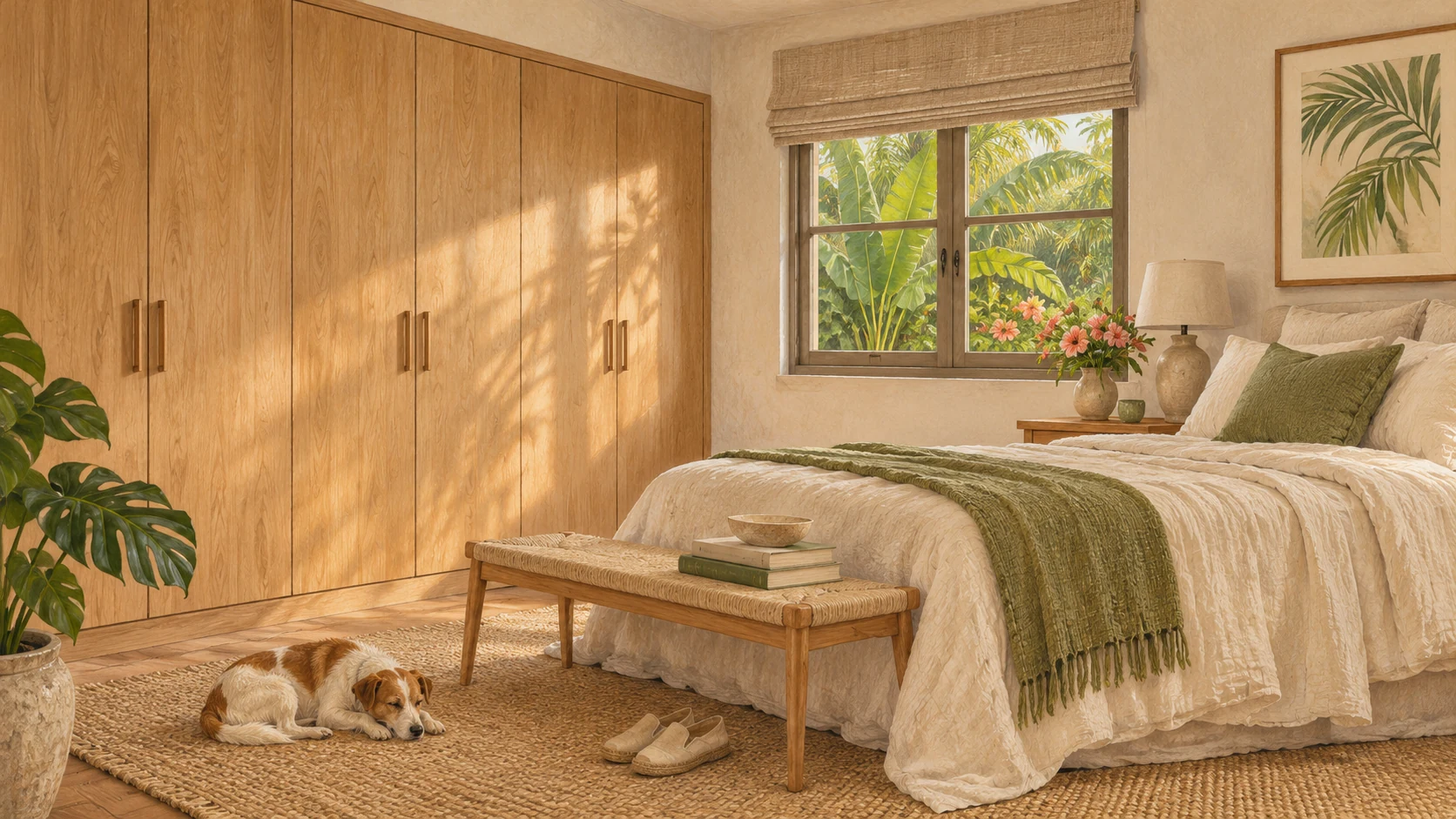
I can see the appeal: warm oak doors, a place for every shirt, and no suitcase balanced on top like it is waiting to jump. A fitted wardrobe can make a bedroom feel wonderfully settled.
Before choosing handles, though, I would ask one less glamorous question: what wall are we covering?
If it is an exterior wall, the conversation should include moisture, surface temperature, and how that hidden space will work. That does not rule out beautiful storage. It gives the design something useful to do besides hide the laundry basket.
The climate changes the story
In a hot, humid place such as Panama, I would not assume that an exterior wall is cold. Air conditioning can cool surfaces enough for humid air reaching them to condense, and outdoor air entering the home may add moisture. Whether that is happening behind a particular wardrobe needs actual surface-temperature and moisture evidence. EPA describes this hot-weather mechanism separately from winter condensation. EPA moisture-control guidance
In cold weather, a poorly insulated exterior wall may already have a chilly inside surface. Put substantial furniture in front of it, and less room heat reaches that surface. Moisture in the air can still reach the space behind the furniture.
That combination matters. The German Environment Agency explains that furniture reduces heat transfer to the wall and can raise the relative humidity at its surface. The risk depends on the wall, indoor conditions, and building performance; an exterior-wall wardrobe is not automatically a moisture problem. German Environment Agency guidance
The wardrobe also hides the view. A beautifully finished front tells us very little about the condition behind it.
And I would not wait for a puddle. EPA notes that humidity alone can sometimes supply enough moisture for mold growth. A wall does not have to look as though someone spilled a glass of water down it. EPA mold course
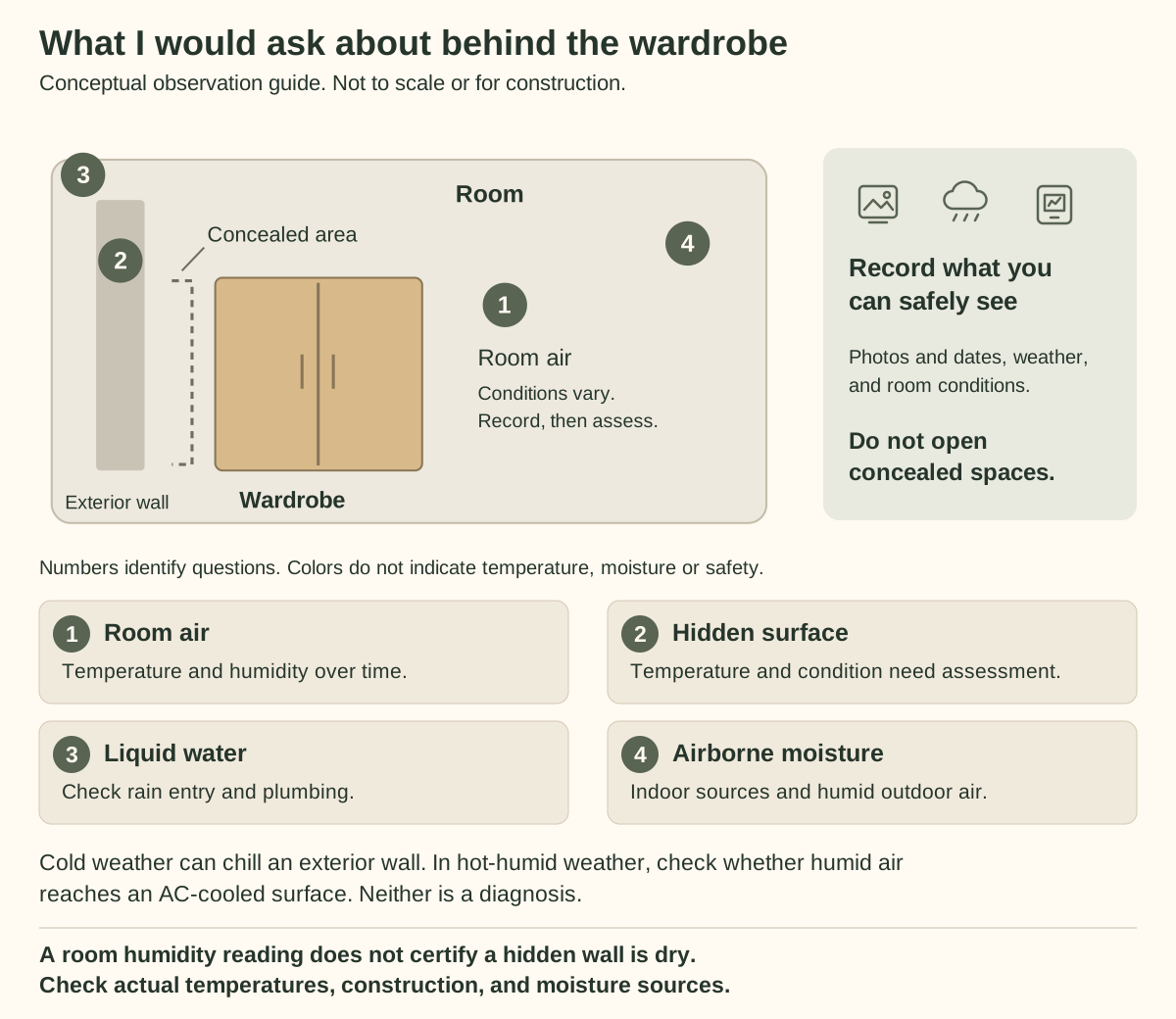
What I would ask about behind the wardrobe
Conceptual observation guide. Not to scale or for construction. Colors do not indicate temperature or moisture.
Scroll the scene sideways if needed. The four questions are written out below.
Question 1: Room air
Temperature and humidity over time.
Question 2: Hidden surface
Temperature and condition need assessment.
Question 3: Liquid water
Check rain entry and plumbing.
Question 4: Airborne moisture
Indoor sources and humid outdoor air.
The climate changes the question. Cold weather can chill an exterior wall. In hot-humid weather, check whether humid air reaches an AC-cooled surface. Neither is a diagnosis.
A room humidity reading does not certify a hidden wall is dry. Check actual temperatures, construction, and moisture sources.
First, find out where the moisture comes from
“Needs more air” is an easy verdict. I would rather ask a few questions before giving the carpenter a new grille to cut.
These are different possibilities, and more than one can be present. The clues below help describe the problem; they cannot diagnose it.
| Possibility | What I would record | What needs checking |
|---|---|---|
| Rain entering the building | Whether marks change after wet weather, and where they appear | The relevant wall, window, roof, or other weatherproofing details |
| Plumbing leak | Nearby water services and whether wetness seems related to fixture use | The pipework and actual water path, by a qualified plumber |
| Condensation at a sufficiently cool surface | Season, air-conditioning use, and location of affected surfaces | Local air dew point and actual surface temperature, alongside wall construction |
| Moisture generated indoors | Temperature/humidity trends and moisture-producing activities | Sources and the home's ventilation or dehumidification performance |
| Humid outdoor air entering | Outdoor conditions and any apparent link with open windows or cooling use | Where air enters, its moisture content, and whether it reaches cooled surfaces |
On a narrow screen, scroll sideways to see all three columns. The clues describe a problem; they do not establish its cause.
Either airborne-moisture source can feed condensation if the surface is cool enough. Neither is the same as liquid water leaking in. UK government guidance distinguishes rain entry, plumbing failures, and condensation, and stresses that causes can overlap. Damp and mould guidance
A gap is a design question, not a magic number
I would be suspicious of any universal promise that one particular gap makes every wardrobe safe.
The Australian Building Codes Board specifically discusses exterior-wall cupboards in its condensation handbook, including insulation, thermal bridges, and circulation. Those considerations belong together. A slot in a cabinet door does not establish that air reaches the concealed wall behind the cabinet. Condensation in Buildings handbook
For a new layout, I would ask the designer:
- Could this storage work on an internal wall instead?
- What is known about the exterior wall's condition and moisture history?
- How will air circulate, and what surface temperatures are expected in this climate?
- How can the area be checked and maintained later?
The answer needs to suit the actual wall and cabinet system. I would not turn a decorative drawing into instructions for drilling vents, changing wall layers, or loosening furniture anchors.
Air movement and moisture removal are different jobs
Circulating room air can help exchange air around storage. It does not, by itself, remove water from the home.
Opening a window is also weather-dependent. EPA warns that warm, humid outside air can add moisture, even when its relative humidity is lower than the indoor reading. The outdoor air's temperature matters too. EPA indoor-air guidance
So I would ask for a plan suited to the climate and the building: control the moisture source, then assess the ventilation and any needed dehumidification. A leaking pipe will not be persuaded to behave by a handsome louvered door.
Bring evidence, not just a reassuring number
A small temperature-and-humidity monitor can help record room conditions. I would note its location and the time, rather than treating one pleasant afternoon reading as a certificate for the wall behind the wardrobe.
A qualified assessor may need surface temperatures, nearby air conditions, and suitable material-moisture measurements. Condensation depends on the relationship between the surface temperature and the surrounding air's dew point. Air humidity and moisture inside a building material are different measurements. EPA moisture-control guidance
For the homeowner, useful observations can stay simple: photographs of accessible marks, dates, weather, smells, and any known leak history. I would record those while arranging help, rather than delay action to build a perfect spreadsheet.
A persistent musty smell, recurring dampness, or visible growth deserves investigation. I would not remove cabinet backs or wall finishes to hunt for it. EPA cautions that disturbing concealed mold can release spores and recommends experienced professional help for suspected hidden problems. If renting, report moisture problems to the owner or manager promptly. EPA guide to mold and moisture
Then choose the lovely doors
If moisture is already present, I would pause the cover-up. EPA advises against enclosing, sealing, or painting wet materials or materials showing mold growth. Have the cause addressed and the condition assessed before concealing the wall again. EPA moisture-control principles
My vote is still for the attractive bedroom: good proportions, useful drawers, and somewhere sensible for the shoes. I just want the storage plan to include the wall behind it.
The handles can be the fun decision. Whether the wall is ready should be the informed one.
General design discussion for interested homeowners, not a moisture diagnosis, health assessment or installation detail. Hidden problems and the actual wall-and-cabinet design need suitably qualified local assessment.
Sources and further reading
Government guidance behind the questions. These sources explain mechanisms; they do not diagnose a particular room.
- German Environment Agency. Guideline on the prevention, detection and remediation of mould in buildings. Section 3.1.3, printed pages 51–53; cold-weather furniture and wall conditions.
- Australian Building Codes Board. Condensation in Buildings handbook. Exterior-wall storage, insulation, thermal bridges and circulation.
- UK Government. Understanding and addressing the health risks of damp and mould in the home. Moisture causes, overlapping problems and assessment.
- US Environmental Protection Agency. Mold Course, Chapter 2. Moisture sources and humidity without visible pooling.
- US Environmental Protection Agency. Moisture Control Guidance for Building Design, Construction and Maintenance. Chapter 1, hot-weather condensation and dew point; appendix C, material measurements.
- US Environmental Protection Agency. Biological Contaminants and Indoor Air Quality. Outdoor humidity, moisture control and avoiding enclosure of wet or moldy material.
- US Environmental Protection Agency. A Brief Guide to Mold, Moisture and Your Home. Hidden mold, professional investigation and reporting moisture problems.