The same tile collection can appear in a bathroom, a covered veranda and an outdoor path. That visual continuity can be attractive, but each location asks a different question of the finished surface. Bare feet with soap, wet shoes from the garden and cooking spills are different conditions.
Start with those conditions before choosing a color or comparing friction numbers. A useful flooring decision connects the exact product and finish to its intended use, the completed installation and a cleaning routine the household can maintain. This guide concentrates on that selection process, not waterproofing details, installation instructions or a guarantee against slipping.
Friction belongs to a contact, not just a tile
Dynamic coefficient of friction, or DCOF, describes resistance during sliding under specified test conditions. The measured relationship involves the surface, the material sliding against it and any intervening contamination. TCNA explains that water, soap, oil and dirt can change that relationship; a DCOF value alone does not predict whether an individual will slip. [1]
Think of the practical question as “this surface, with what on it, under what kind of use?” A dry display sample answers only a small part of it. The word “matte,” a rough appearance or a general material description cannot replace evidence for the actual finish and application.
This also explains why preventing water accumulation and choosing a surface are complementary decisions. The product does not control every condition that develops around it. Identify where wetting comes from, how the space will be used and who is responsible for the overall floor design.
Map the places that get wet differently
For a Panama home with indoor–outdoor living, draw the wet-use zones on the plan. Do not label the entire ground floor simply “bathroom tile” or “outdoor tile.” The following scenarios are planning examples, not prescribed material choices.
Describe wet-use zones before choosing a floor
Location
Describe the actual use
Decision this brings forward
Bathroom outside the shower
Barefoot or shod use, occasional splash and the route to towels
Confirm the exact floor use rather than relying on a wall-tile display.
Shower floor
Bare feet, soap, frequent water and the proposed drainage arrangement
Obtain specific shower-floor suitability and a coordinated design.
Covered veranda or entry
Rain carried or blown inside, garden dirt and changing footwear
Assess the real exposure, not just whether a roof is overhead.
Outdoor cooking area
Water plus possible food oils and grease
Describe likely contaminants before requesting product evidence.
On a small screen, swipe the table horizontally to see every column.
Ask how the route works when someone moves between zones. A family carrying groceries in from rain has different needs from someone standing in a shower. Slopes, thresholds and accessibility also need project-specific review; a surface-friction report does not design those transitions.
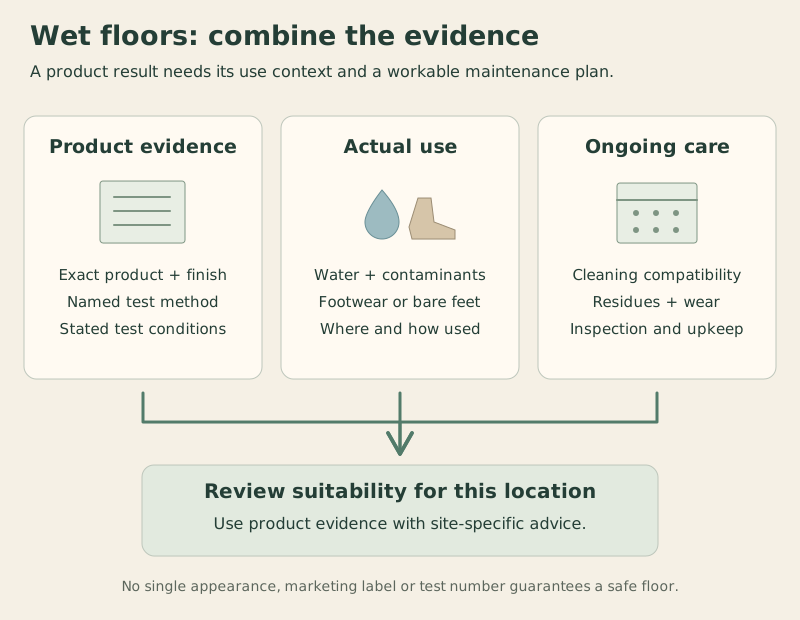
On a small screen, swipe or scroll the diagram horizontally to read every panel.
Product evidence, actual use and ongoing care belong in the same suitability review. The diagram is a decision aid, not a safety score or an installation detail.
Read the test method before the number
Supplier sheets may show wet DCOF, a pendulum test value, an R classification or a barefoot classification. These are not interchangeable units. HSE's technical guide describes tests with different contact materials, contaminants and procedures, including different approaches for shod and barefoot use. It also emphasizes competent operation and interpretation of testing. [2]
When comparing offers, request the method, edition, wet or dry condition, test surface and report identity. Ask whether both results concern the exact finish being offered. If one quotation supplies a DCOF value and another an R classification, do not turn the larger-looking number into the winner or attempt a simple conversion.
The report should answer the project's question. A result for a factory sample may be useful selection evidence, while an assessment of the completed floor answers a different question. The project's qualified specifier should decide what verification is appropriate. Do not deliberately wet a showroom or home floor and try to slip on it as a substitute for testing.
Understand the ANSI use categories in context
As checked in November 2026, TCNA's standards-status page lists ANSI A326.3-2021 as current. [3] Its product-use classifications combine specified DCOF criteria with manufacturer declarations; they are not one universal ladder of safety scores. [1, 4]
Interpret ANSI A326.3 product-use categories
Category
Basis summarized by TCNA
What to request
Interior, Dry (ID)
At least 0.42 dry DCOF under the specified procedure
Confirmation that the intended use can meet the dry-use conditions
Interior, Wet (IW)
At least 0.42 wet DCOF under the specified procedure, or manufacturer declaration
The basis of the classification for this product
Interior, Wet Plus (IW+)
Manufacturer-declared
Written suitability for the particular wet use
Exterior, Wet (EW)
Manufacturer-declared
Written suitability for the actual exterior exposure
Oils/Greases (O/G)
Manufacturer-declared
The expected contaminants and maintenance conditions
On a small screen, swipe the table horizontally to see every column.
This is a limited orientation, not the complete standard. The numerical values belong to its specified test context. The standard does not supply a single normative DCOF limit for shower floors, pool decks, exterior applications, ramps, barefoot use or contamination other than water. Its five use categories do not address ramps or inclines. [1, 4]
Consequently, “above 0.42” is not a complete shower or patio specification. Manufacturer-declared also does not mean the project review disappears. Request the declaration and its conditions, then have the responsible specifier assess the actual use.
Compare texture with the work needed to clean it
Texture affects more than how a floor looks. HSE explains that rougher safety-floor surfaces can take additional effort to clean and retain more cleaning solution. If the water evaporates without the dirt being removed, residue can remain. [5]
For the owner, this creates a useful comparison: which documented surface is appropriate for the location, and can its required maintenance be carried out with the available tools and time? Choosing the most aggressive texture by touch alone leaves the second half unanswered.
Ask the supplier to demonstrate the recommended cleaning process on a sample assembly, including joints. You are evaluating access to recesses, equipment needs and the finished appearance, not conducting a homemade slip test. Ask how barefoot comfort will be assessed separately where relevant.
A surface that needs a particular brush or cleaning system may be a reasonable choice. It should be a deliberate commitment, recorded before purchase, rather than a surprise after the ordinary household mop fails to remove soil.
Make grout and tile size part of the comparison
Small mosaics and larger tiles create different joint patterns. More joints also mean more joint surface to maintain. Neither a busy joint pattern nor a nearly joint-free appearance proves suitability for a wet floor.
For shower selection, ANSI A326.3 specifically identifies drainage, tile surface structure, grout-joint size and number, and barefoot use as relevant considerations. [4] Ask the designer and installer to explain how the chosen format fits the planned geometry. This is a coordination question, not a recommendation for a particular tile size or slope.
Grout needs an identity, not just a color. LATICRETE's cement-grout guidance explains that these grouts are not self-cleaning or absolutely stain-resistant, and that cleaning can deposit dirt in joints. [6] Daltile similarly cautions that sealing or choosing epoxy grout does not guarantee freedom from buildup or discoloration. [7]
Compare complete combinations: exact tile, exact grout and their compatible care requirements. A more expensive grout may offer useful product-specific properties, but “maintenance-free” is not a sensible substitute for its technical documentation. Do not assume all cement grouts require the same sealing treatment.
Treat coatings and treatments as a new surface decision
A sealer, wax, coating or traction treatment can change the surface that was originally assessed. TCNA's explanation of A326.3 says post-manufacture or onsite coatings require the coating manufacturer's declaration for use beyond areas kept dry. [1]
If a supplier proposes a treatment, ask for the precise product, intended use, compatibility, maintenance and evidence for the treated floor. Keep the original tile report and the treatment information separate. A result obtained before treatment cannot automatically describe the finished surface afterward.
Do not improvise chemical etching or apply an “anti-slip” treatment based on a sales slogan. HSE notes that etching can affect appearance and service life, and that some treatments involve hazardous chemicals. [5] Have the responsible professionals assess the proposal and the relevant product instructions.
Test the purchase decision against an ordinary week
Consider a fictional household choosing between two documented veranda finishes in the same visual collection. One quote includes only the tile. The other identifies its exterior-use declaration, grout, cleaning equipment and handover requirements. That fuller quote is easier to evaluate, even if it is not automatically the better floor.
Now imagine the area on a rainy evening, the morning after gardening and during routine cleaning. Who notices tracked-in dirt? How is contaminated water removed? Can the route remain out of use while it dries? These questions expose missing scope without inventing a lifespan or claiming a financial saving.
HSE stresses that cleaning removes contamination but can itself introduce wet-floor hazards. The method and product need to suit the surface, and drying time must be managed. [8] Daltile also warns that residual cleaner can compromise slip resistance. [7] Maintenance therefore belongs in the selection meeting, not solely in a leaflet handed over at the end.
Keep a record of the finished floor
HSE distinguishes factory-sample data from the surface after grouting, cleaning, polishing, wear and maintenance. [2] Before handover, assemble:
Exact tile or flooring identity, size and finish, with the relevant reports and use declarations.
The selected grout, coating or treatment and written compatibility information.
The designer's decisions for drainage, transitions and any required field verification.
Confirmation of construction-residue removal and product-specific care instructions.
A named contact for a change in appearance, persistent residue or a slip concern.
A well-supported choice explains why the precise finished surface fits the intended place and how its condition will be maintained. That is more useful than a reassuring adjective on a sample box.
Sources checked November 8, 2026. ANSI material and UK HSE guidance are technical references, not claims about Panama law. HSE's 2012 testing sheet is used for method distinctions and installed-floor considerations, not as a statement that its listed standard editions are current. No surface, category or number guarantees prevention of a slip.