A water heater should be selected for the hot water the household needs and the place where the system will operate. Start with the uses and timing, then compare complete proposals. A tank volume, a flow-rate headline or a promise of low running cost tells only part of the story.
This is a planning brief for discussion with qualified local plumbing, electrical and other relevant professionals. It does not size equipment or give installation, temperature-setting, gas, wiring or pressure-control instructions.
Describe the household's busiest period
List the outlets and appliances expected to use hot water. Note which uses may overlap, which happen one after another, and how normal occupancy differs from a full house of guests. Include the actual appliance models where known.
Check the appliance instructions rather than assuming that every washing machine or dishwasher uses the home's hot-water supply. Your Home notes that some appliances heat water internally from a cold connection. [1]
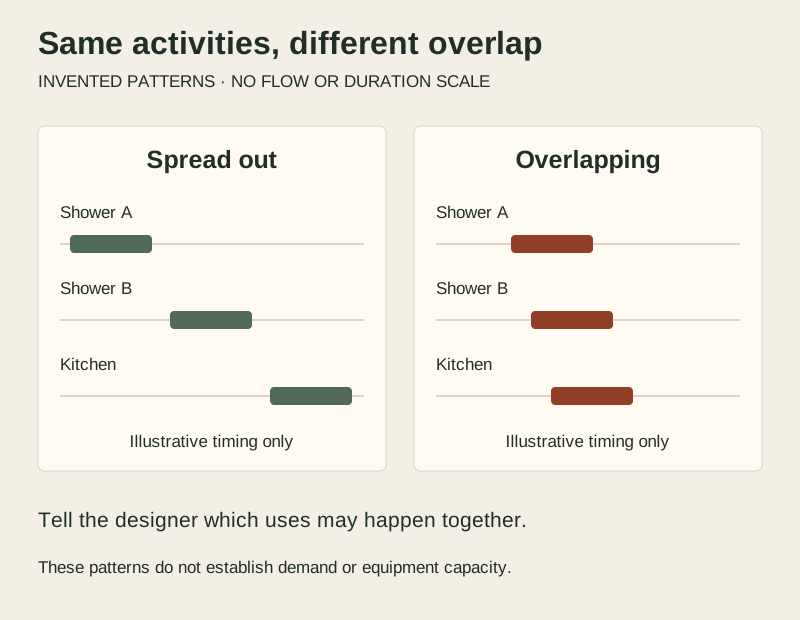
Consider an invented example: two households have the same number of people and similar daily activities. In one, showers are spread out. In the other, two showers and kitchen use can overlap. Those descriptions should reach the designer before the same heater is proposed for both.
Invented use patterns, not measured household data. The bars show only whether activities overlap; their lengths cannot be used to calculate demand or choose equipment. See source 3 for the importance of simultaneous flow.
The drawing illustrates timing only. It contains no measured durations, flow rates or volumes and cannot determine a heater size. Ask the professional which demand assumptions matter for the proposed system and record the answer with the quotation.
Distinguish storage volume from hot-water delivery
A storage system holds heated water in a tank. [1] Its volume is useful information, but also ask how the selected unit replenishes hot water during the household's expected pattern of use.
For products using the U.S. rating system, ENERGY STAR defines First Hour Rating as the hot-water volume a storage heater can supply over an hour beginning with a fully heated tank, under its test method. [2] It describes something different from the tank's physical volume.
Ask the proposer to explain which performance information applies to the exact model and how it relates to the household brief. Do not treat a test rating as a promise that every outlet will receive the required flow and temperature under any circumstances.
If occupancy or fixtures are still uncertain, identify that uncertainty explicitly. A future guest bathroom is a design input to review, not a reason to silently add an unspecified margin to every proposal.
Read tankless flow alongside temperature rise
Tankless systems heat water as it is needed, but their delivery rate is finite. DOE/PNNL's gas-tankless guidance bases selection on the hot-water flow required at the same time and the temperature rise between incoming and heated water. [3]
Ask for the model's performance information at the conditions the designer expects for the property. A maximum flow number without its temperature-rise basis is incomplete. ENERGY STAR's glossary likewise defines an instantaneous heater's flow rating in relation to a stated temperature rise. [2]
For a gas proposal, have a qualified professional verify the supply, combustion and venting arrangements for the actual model and location. For an electric proposal, have the electrical professional confirm the required supply and any associated work. Keep those works in the installed quotation rather than discovering them after equipment arrives.
“Tankless” also does not explain how hot water will be distributed to a distant bathroom. Equipment selection and the route to each outlet need coordinated review.
Assess a heat pump in its proposed location
A heat-pump water heater uses electricity to move heat from the surrounding air into water. ENERGY STAR describes hybrid models that also use electric resistance heating during higher demand. [4] Ask which operating modes and backup arrangements the exact proposed unit has.
The location matters. ENERGY STAR's buying guidance calls attention to available air space, surrounding conditions and the cooling effect on the installation space. It also recommends checking actual local availability and support. [5]
Ask the installer to show how the model's current instructions apply to the chosen location, including airflow, service access, condensate handling and sound. A floor-plan label saying “equipment cupboard” does not establish that the space is suitable.
Request an explanation of how the proposed system will meet the busy-period brief, including when backup heating is expected. Do not assume that every mode has the same energy performance, or change modes from a generic article without the instructions appropriate to the installed equipment.
Include solar collection and backup in one proposal
Solar thermal water heating collects heat for the hot-water system. A quotation for a photovoltaic array supplying an electric heater describes a different arrangement; ask which is actually proposed.
DOE's solar-water-heating overview identifies solar access and backup heating as parts of the system discussion. [6] For the actual property, ask the designer to assess available sunlight, shading and the expected backup contribution during periods with less useful solar energy.
Have the appropriate professionals coordinate any roof-mounted equipment, supports, penetrations and safe access. Ask how the proposed system will be serviced and what happens if a component needs replacement. Do not adopt a collector orientation or plumbing layout from a generic diagram.
A sunny location alone cannot establish the installed cost, annual performance or amount of backup energy for a particular household.
Compare the questions each option must answer
These are system categories, not mutually exclusive choices: a heat-pump or solar arrangement can include storage. The original table highlights different questions to resolve rather than declaring one universal winner.
Hot-water system questions to compare
Proposal type
Main question about delivery
Installation or ownership question
Conventional storage
How do storage and reheating serve the busy period?
Where will the tank, services and replacement route fit?
Tankless
What flow is available at the required temperature rise?
Are the energy supply and model-specific installation works included?
Heat pump with storage
How do the selected modes meet demand?
Are the air conditions, access and local service suitable?
Solar thermal with backup
How is demand met when solar contribution falls?
Are collectors, backup, roof work and maintenance covered together?
On a small screen, swipe the table horizontally to see every column.
Ask for the exact models, included works, exclusions, warranty documents and responsible service provider. Confirm what can be supported locally before treating an online product listing as a practical purchase option.
Count distribution and operating costs
Your Home recommends considering the distance between the heater and points of use to limit pipe heat losses. [1] Give the designer the actual layout, including separate pavilions or guest spaces, and ask how waiting time, pipe routes and operating arrangements will be handled.
For running-cost comparisons, use the same household brief and stated local energy prices. Request the assumptions behind the estimate, including the equipment modes and any backup contribution. ENERGY STAR's Uniform Energy Factor is a standardized efficiency measure, not a local annual bill. [2]
Keep purchase, installation, energy and maintenance costs separate. Include any necessary supply upgrades, access works and recurring service in the comparison. The whole-project budget guide can help keep those items visible.
Make safe operation and service part of handover
Have the qualified installer address safe delivery temperatures, stored-water hygiene, pressure protection and the applicable local requirements as one coordinated system. Energy-saving schedules should not override required safety functions. This guide supplies no setpoint or disinfection procedure.
Request the commissioning and compliance records appropriate to the installation, current manuals, model identification, normal operating instructions and a service contact. Ask for system-specific advice for absences rather than simply switching equipment off and improvising a restart.
A useful proposal explains how the system meets the household's actual use, where it fits, what work is included and who will support it. Those answers make the price and efficiency figures meaningful.
Sources checked November 7, 2026. U.S. and Australian sources support general principles, not Panama code compliance, equipment availability, local tariffs or guaranteed savings. No foreign sizing benchmark or temperature instruction is applied here. The timing diagram and table are original planning aids, not measured household data or a system design.