Water · Collection and quality
Planning Rainwater Collection: Quantity, Use and Water Quality
By Best House Ideas · November 7, 2026
External sources open in a new tab so you can keep your place.
A rainwater system has to answer two different questions: how much water might be collected, and whether that water is suitable for the intended use. A full tank does not answer the second question.
Write the intended uses into the brief before selecting equipment. Then have the appropriate local professionals assess collection, storage, water quality and plumbing together.
Begin with the intended use
CDC warns that rainwater can contain germs and chemicals even when it looks clean. It recommends regular testing when rainwater is used for drinking, cooking or bathing, with advice from the relevant health authority about what to test. [1]
Where possible, CDC recommends public-system or bottled water rather than rainwater for uses such as drinking and cooking. It also says collected rainwater must not enter pipes carrying safe drinking water. [1] Have a qualified professional resolve the actual system separation; this guide is not a plumbing detail.
Record the proposed use, who may be exposed, the required quality and how that quality will be verified. Do not label an untested system “potable” because it has a filter.
Understand the basic volume calculation
Your Home gives the useful unit relationship: 1 mm of rainfall on 1 m² of collection area corresponds to 1 litre of water before collection losses. It also identifies rainfall patterns, demand, collection area and desired supply reliability as tank-sizing considerations. [2]
The following examples are arithmetic illustrations, not measurements from Panama or estimates for Arthur's houses.
| Assumed rainfall depth | Assumed collection area | Gross rainfall volume before losses |
|---|---|---|
| 10 mm | 50 m² | 500 L |
| 10 mm | 100 m² | 1,000 L |
| 20 mm | 100 m² | 2,000 L |
On a small screen, swipe the table horizontally to see every column.
Calculation: rainfall depth in mm × collection area in m² = litres. Use horizontal projected catchment area, not the larger sloping roof surface. Assumptions: the stated depth applies uniformly to the stated area; no losses, diversion, overflow or capacity limits are deducted. These are exact unit calculations under assumed inputs, not predicted usable yield.
Actual stored water may be lower. Ask the designer to explain the collection area used, losses assumed, storage limits, demand and periods without sufficient rainfall. A large annual total alone is not a complete supply plan.
Check the materials water touches
NSF advises using materials and components tested for their intended drinking-water application. Its rainwater guidance describes assessment of catchment components and drinking-water-contact components, and points to product certification listings. [3]
Ask for documentation for the exact roofing finish, tank and other relevant components. A general brand statement or a certificate for a different model does not answer the question. Component suitability is also different from proving the quality of water delivered by a complete installed system.
Ask what each stage does
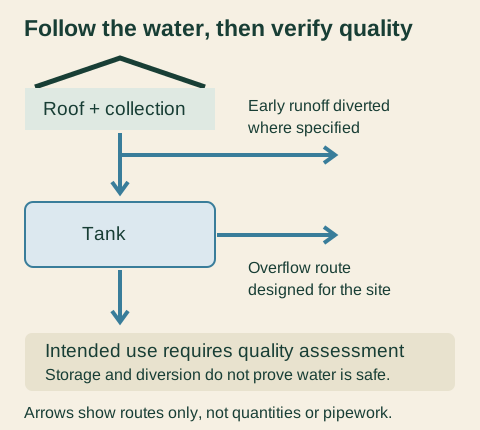
Discuss the collection route with the designer: roof, gutters, collection equipment, tank and distribution. Your Home describes those as parts of a rainwater system. [2]
CDC explains that a first-flush diverter directs early runoff away from collection to improve water quality. [1] Do not treat that step as proof that the remaining water is safe to drink. The intended use still determines the testing and treatment assessment.
Ask what happens to excess water, how the tank will be accessed for maintenance, who checks the equipment and what happens if a component fails. Have the relevant professionals verify site-specific support, drainage, electrical and plumbing requirements.
Keep the operating plan with the house
Retain the system description, installed-product documents, test results, maintenance records and responsible contacts. If the intended use changes, reassess the requirements before connecting another outlet or using the water differently.
U.S. and Australian sources provide general principles. They do not establish permission, health compliance or plumbing requirements for a particular Panama installation. No treatment recipe, tank-size recommendation or claim about Arthur's water supply is made here.
Continue with roof selection, the house handover file, and pre-build planning.